Story code: ST-000580
Part 2: The Favor Started Looking Different
By the time Deacon Paul said, “What you still owe in time,” I wasn’t hearing generosity anymore. I was hearing him put a chain around a favor I never chose, using the offering basket like it made him holier than a man trying to collect on a private debt in a church office.
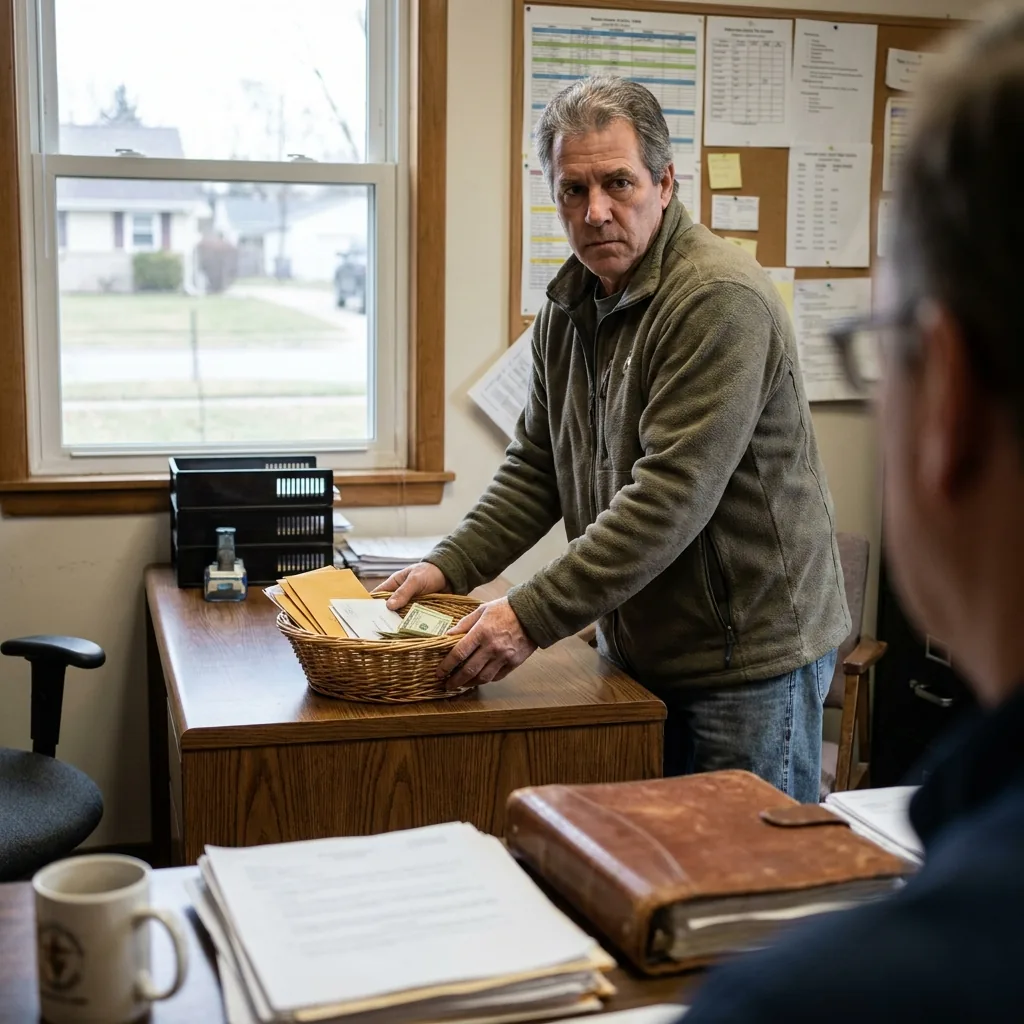
He had the loose bills spread in front of him now, ones turned one way, twenties another, envelopes stacked by size. I stayed on the other side of the worktable, close enough to see his hands, far enough that I did not feel trapped in the chair he had left open for me.
“Say it plainly,” I told him. “What exactly are you saying I owe?”
He leaned back a little, as if I had finally asked the grown-up question. “Consistency. Service. Availability when this office needs trusted help. And if ministry expenses get tight, I expect support instead of resistance.”
“That isn’t plain.”
“Fine.” He folded one hand over the other. “You don’t get to accept quiet help and then act like you’re just another casual volunteer. People who have been covered are expected to cover back.”
There was no paper in front of him with my name on it. No amount. No form. That was the point. If he kept it in sermon language, he could make anything sound righteous and make my refusal sound dirty.
Marlene came in with the youth flyers and set them by the bulletin stack. She glanced at the money on the table, then at me.
Paul said, bright and easy, “Rachel’s being a blessing and staying a little longer tonight.”
I said, “I haven’t agreed to that.”
The room went still for one beat. Marlene pressed her palm flat on the flyers. “Do you need me to come back?”
“We’re fine,” Paul said.
I answered at the same time. “No, that’s okay.”
She gave one short nod, took a paper cutter from the shelf, and left again. The door stayed partly open behind her. Paul got up and pushed it almost closed with two fingers, not enough to draw attention, just enough to lower the hallway noise.
Then he turned back to me. “You are making this harder than it needs to be.”
“No. You’re refusing to say what happened honestly.”
He breathed out through his nose and pointed to the envelopes. “That utility situation could have embarrassed your mother badly. Shutoff notice, gossip, questions. I prevented that.”
“You routed it through her because you needed a local name attached fast,” I said.
His jaw tightened, only for a second. “We solved a problem for your family.”
I watched him rest his fingertips on the offering basket. It was a familiar move, almost absent-minded, but it kept pulling my attention back to what sat in front of him. Church money. Church trust. Church language. He wanted all three in the room while he told me my gratitude was due.
“That account wasn’t for our apartment,” I said. “It was the outreach pantry meter behind the fellowship hall. My mother told me that later, after the notice stopped coming to her house. She said you asked if her name could sit on it temporarily because there had been a delay with the church transfer.” I kept my voice low. “So explain why you’re talking like you paid our bill when what you really got was my mother taking your problem on her mailbox.”
He did not answer right away. He straightened a pile of twenties that did not need straightening.
“The pantry serves people,” he said at last. “Sometimes ministry requires flexibility.”
“Then say that. Don’t call it rescuing us.”
“The church absorbed the expense.”
“And my mother absorbed the notice.” I heard my own chair scrape when I moved it back with one hand. “And now you’re trying to collect from me because she kept your pantry account from turning into a visible mess.”
His voice changed then, not louder, just sharper around the edges. “Be careful, Rachel. You are talking about sacred work like it’s some scheme.”
“I’m talking about cause and effect.”
He stood there with both palms on the table. The basket sat between them like a prop he had used too many times. Every sentence he gave me pushed the same direction: he had helped us, therefore I owed him. But the more he explained, the less that old story held together.
If my mother’s name had been used to keep the pantry account from drawing attention, then the quiet he kept bragging about had protected the church office first. Maybe us too, a little, in the spillover. But not the way he was preaching it now.
He tried again, slower. “Your family benefited from discretion. You should be thankful enough not to split hairs over who carried what percentage of burden.”
That was the closest he had come to admitting the burden had been shared the wrong way.
I looked at the envelopes, the basket, the deposit slips tucked off to the side, and then back at him. “You keep calling it burden like you lifted ours. What I’m hearing is that my mother helped you keep church business from landing on the church in public.”
His mouth opened, then shut. He picked up a pen, set it down, and said, “You don’t understand the full picture.”
“Then give me the part I was supposed to repay,” I said. “What exactly did you give us that wasn’t also solving your problem first?”
He did not answer that either. He just looked at the basket, then at me, and for the first time since I walked in, I could see his version of the story was starting to snag on its own details.
I still had not decided what I was going to do next, but I knew one thing by then: whatever favor he kept trying to invoice me for had protected him more than it ever protected us.