Story code: ST-000778
Part 2: The Term That Would Not Stay Standing
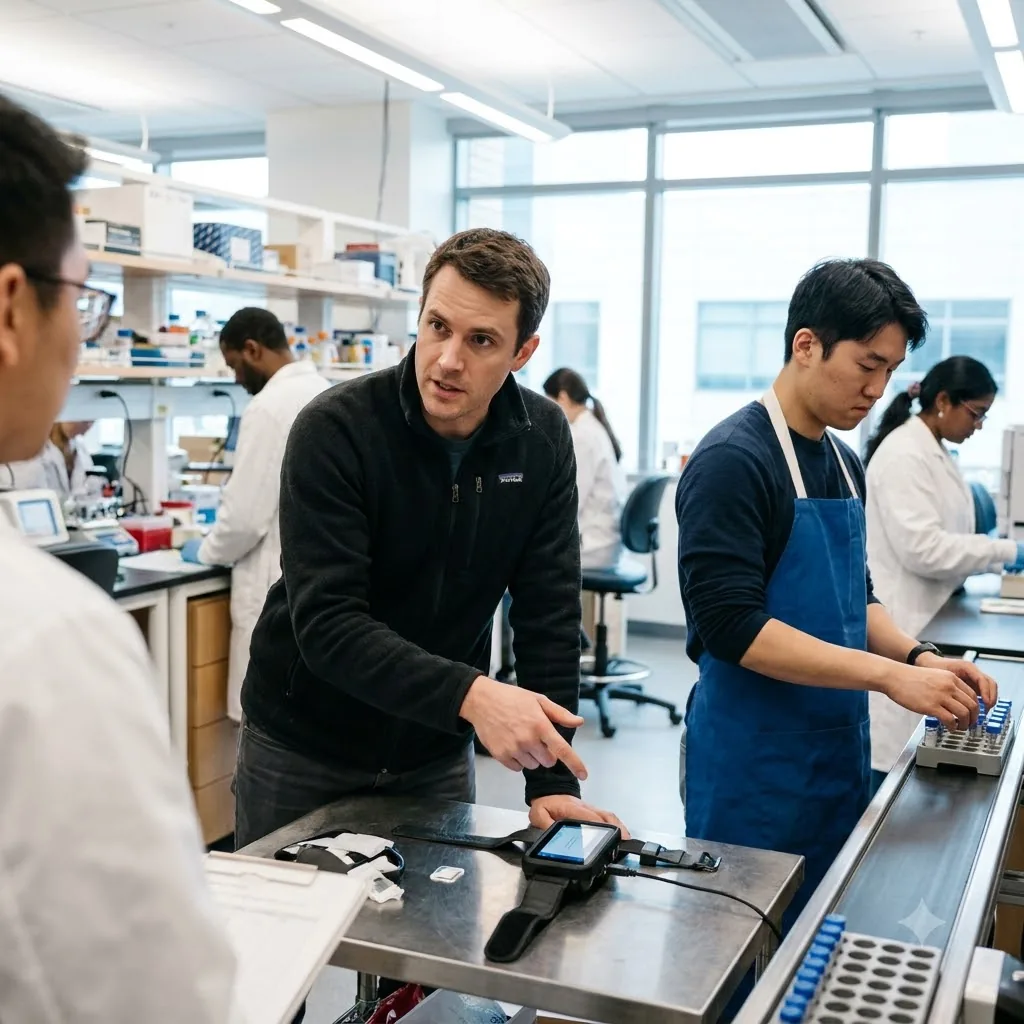
The bracelet held its line on the monitor, and Eli kept talking through it as if his voice could cover the gap. That was the first thing I noticed. The second was Noah’s hand moving from the cable bundle to the timing key, one careful inch at a time, like he wanted the room to look at the numbers and not at Eli.
“Say that term again,” Dr. Vaughn said.
Eli blinked once. “Which term?”
“The one you just used for the failure mode.” Her voice stayed level. She did not step back from the screen. She did not give him space to perform around the answer.
He smiled without showing teeth. “The coherence lattice bleed.”
Noah looked up from the monitor. The bracelet’s readout kept pulsing. On the adjacent screen, the timeline bars were steady, and the live pulse was not matching the explanation at all. I did not need a special degree to see that. The packet timing was clean. The band on the bracelet was not behaving like the story Eli had built around it.
I said, “That is not the label in the run sheet.”
Eli turned toward me fast. “Because you are not reading the same layer I am.”
“Then show it,” I said.
He did a tiny exhale through his nose, the kind people use when they want to make patience look like expertise. Then he clicked into a dropdown and brought up a diagram I had seen before in other contexts, except now he had pinned his strange term to it like it belonged there. He traced a line with the stylus and kept explaining, voice steady, hands steady, as if steady hands could stand in for a real mechanism.
Dr. Vaughn read the screen, then read the bracelet, then looked at him. “That term is not in the protocol glossary.”
Eli’s pen paused in midair.
Noah said, very quietly, “It is not in the calibration notes either.”
The room did not change all at once. That is not how it happened. It changed in pieces. Dr. Vaughn moved one step closer to the tablet. Noah lifted the connector he had been holding and checked the port label again. I set my palm flat on the bench so I would not reach for the bracelet and break the chain of the run.
Eli laughed once, short and dry. “Not every internal shorthand makes it into the notes.”
“Then use the published term,” Dr. Vaughn said.
He did not answer right away. That pause said more than the jargon did.
The bracelet gave another readout, and this time the graph nudged harder against his explanation. The line did not drift into his invented category. It cut across it. Clean. Visible. Hard to talk over.
I watched Eli’s eyes move from the monitor to the bracelet and back again. He touched the edge of the tablet, then moved his hand away. His shoulders stayed square, but his mouth had gone still.
“Run the live test again,” I said.
He answered too quickly. “There is no need. The system is compensating.” His voice had lost some of the polish. Not all of it. Just enough to show the seam.
Dr. Vaughn did not look at him. She looked at me. “Same procedure?”
I nodded once. Noah was already resetting the timing window. The bracelet sat in the cradle with its green light on, as plain and unforgiving as anything in the lab.
Eli opened his mouth, closed it, then tried again. “If you force a raw read now, you will misread the phase offset.”
Noah said, without lifting his eyes from the controls, “The offset is already in the record.”
That was the part Eli did not have a clean answer for. He turned the tablet slightly, like angle could fix it, and for the first time all morning he stopped sounding certain.
The bracelet chimed once as the next live cycle armed itself, and every screen in front of us waited on the same question: if his term was real, why did the numbers keep refusing to stand still?