Story code: ST-000778
Part 3: The Read That Would Not Bend
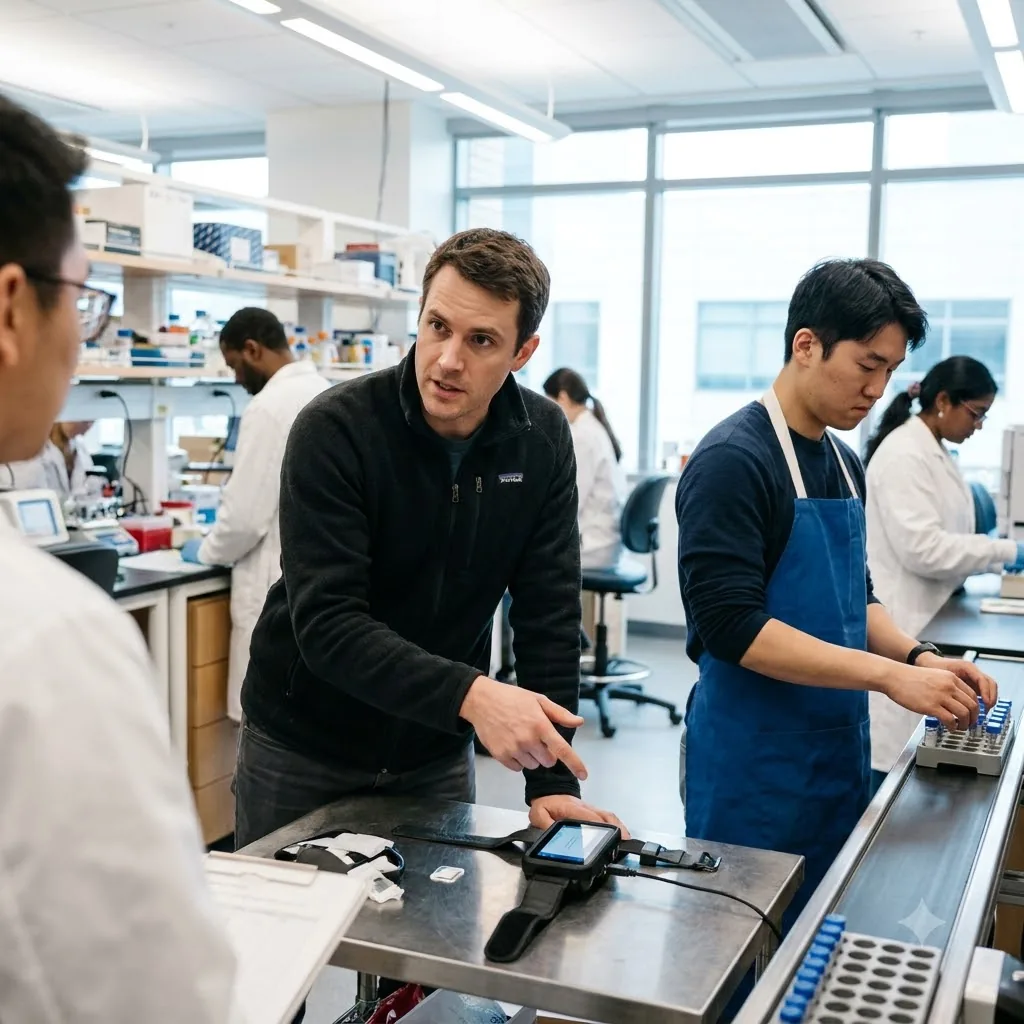
Noah started the next live cycle with the same careful motions as before, but nobody in Lab 3B was pretending this was routine anymore. The bracelet sat in its cradle under the task light, green indicator steady, the little display waiting for the run. Dr. Lena Vaughn stood at the monitor with her hands behind her back. I stayed at the bench edge, close enough to see the timing bars and far enough not to touch anything unless asked.
Eli kept one hand on the tablet and the other on the bench rail. He had stopped trying to talk over everyone all at once. Now he was speaking in smaller pieces, like each sentence had to carry its own weight.
“The compensation layer is masking the raw drift,” he said.
Dr. Vaughn did not look at him. “Then show the raw read.”
Noah glanced at me once, then tapped through the display. The run sheet opened beside the bracelet output. Two windows. Same clock. Same device. The left side held Eli’s explanation. The right side held the live data.
They did not agree.
The bracelet gave a clean pulse, then another. The readout climbed, flattened, and dropped in a pattern that had nothing to do with the neat curve Eli kept describing. He moved the stylus over the screen and tried to reframe it again, but the numbers stayed put. The room had that lab silence where every fan, every relay click, every soft shoe shift sounds louder than it should.
“Say the procedure step by step,” Dr. Vaughn said.
Eli straightened. “We already covered it.”
“Say it again.”
He looked from her to the screen and back. His jaw worked once before he answered. “Brace the bracelet. Let the lattice settle. Pull the read.”
Noah reached for the run log and scrolled back to the calibration mark. The marker was there in the record, timestamped, not hidden, not ambiguous. I could see the gap between that mark and the claim Eli kept making about a correction layer nobody else had written down.
“That isn’t the sequence you ran,” I said.
Eli turned toward me fast. “It is the sequence that matters.”
That was when Dr. Vaughn lifted the tablet from the bench and put her finger on the line where the invented term sat in the notes.
“This wording isn’t in the lab protocol,” she said. “And it doesn’t match the live output.”
Eli’s hand tightened on the tablet edge. The bracelet chirped again, almost politely, and the new trace appeared below the first one. The shape was plain enough for anybody in the room to read it. It did not correct itself to fit his explanation. It exposed it.
Noah leaned in and pointed, not at Eli, but at the line where the bracelet had shifted under the real run conditions. “This is the correction point,” he said. His voice stayed even. “It matches the prior baseline, not the term he just used.”
Eli opened his mouth and then stopped. He looked at the screen longer than he had looked at any person all morning.
Dr. Vaughn reached for the lab sign-out sheet, the one clipped to the side of the cart, and slid it closer to herself. She wrote one line in the margin with a sharp black pen. Not a speech. Not a lecture. Just the record.
Then she said, “We are not carrying that label forward. Run it clean.”
The change hit the room in a smaller way than a shout would have, but it landed harder. Noah deleted the fake tag from the display and replaced it with the standard calibration code. The bracelet accepted the correction without blinking. Eli watched the screen while the new code loaded, and his hand slipped off the tablet edge. He did not grab it again.
The next cycle armed itself, and the bracelet gave a steady tone that belonged to the actual procedure, not the performance around it.
And Dr. Vaughn was still holding the sign-out sheet when she said, without raising her voice, “If the read cannot be supported, the demonstration does not move under your name.”