Story code: ST-000858
Part 2: He Kept Explaining Past the Page
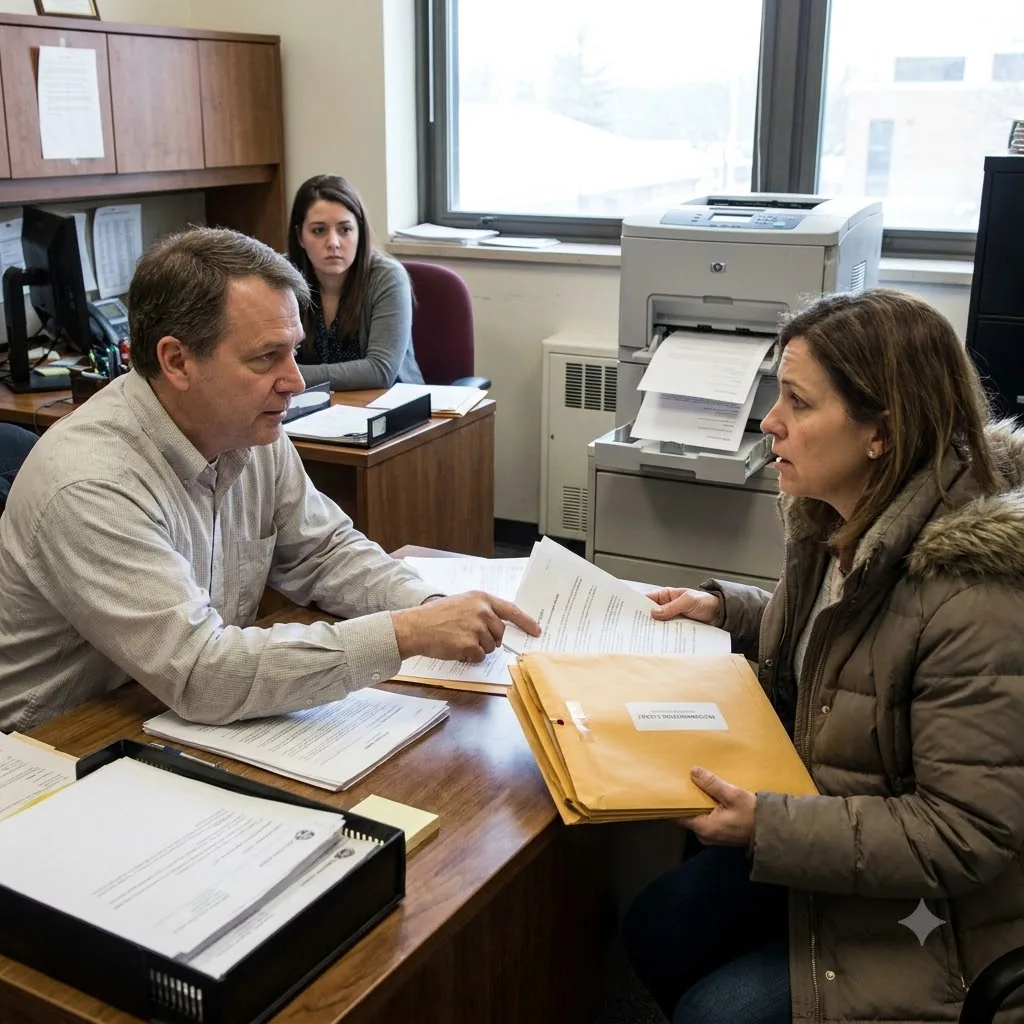
By the time Glen started using the phrase “cross-letter synchronization,” the front desk had gone half-silent in that special way offices do when people pretend to keep working while they listen. Nobody stopped moving. A stapler snapped somewhere behind me. The copier fed out two crooked pages. But the sound in our specialist room had narrowed down to Glen’s voice, Dana’s questions, and the soft scrape of Leah’s packet each time it shifted under his hand.
He said the three letters in Leah Brooks’s recommendation packet were “misaligned across advocacy categories” and that the packet showed “cross-letter synchronization failure.” He said it smoothly, one phrase stacked on the next, as if each term had been printed in a handbook the rest of us had somehow forgotten to read.
Dana stood with both palms on the table now. She wasn’t loud. She had gotten quieter, which made every plain question sound sharper.
“Show me which line says that,” she said.
Glen looked down at the packet, then back up at her. “You’re still asking for a one-line trigger when the problem is structural. That’s not how specialist review works.”
“Then how does it work?” Dana asked.
“You evaluate whether the recommenders are reinforcing the same admissions narrative with proper proportionality. If one letter over-indexes on resilience while another foregrounds leadership and a third pivots to work ethic, the packet can read as narratively unscored.”
He said “unscored” the way other people say “unsigned” or “late”-like a thing that exists in the world whether you know the term or not.
Leah finally spoke again. “Are you saying my teachers wrote the wrong things?”
Glen turned to her with the same low, even tone. “I’m saying the packet, as assembled, may not protect you in committee flow.”
Dana drew the packet back an inch. He let it move, then kept two fingertips on the top page like he was still anchoring the conversation.
“We were told to submit three recommendations,” she said. “We submitted three recommendations. If there is some other standard, I want to see it. If there isn’t, I want you to stop saying my daughter’s file is defective.”
He answered quickly, which was one of the things I had started noticing most. The faster the question got, the longer his answer became.
“No one said your daughter is defective. I’m talking about packet integrity. Families hear a technical correction and immediately personalize it, which makes it harder to solve.”
That landed hard too. He had corrected her and blamed her for hearing the correction. Leah looked down at the clear cover, then at the sticky flags clipped inside. Dana did not look away from Glen.
A student worker passed my desk with a tray of forms and slowed just enough to glance in. I kept my eyes on the packet. Glen had now used five separate terms for the same alleged problem, and every one of them floated a little higher above the paper.
I asked the smallest question I thought I could ask without taking over the room.
“Glen, which page are you using for that?”
He looked at me for a beat, then gave a short nod, as if I had simply invited him to clarify something obvious.
“It’s a packet-level assessment, Nina. Not a single-page issue.”
That was true as an answer to a different question. It was not an answer to mine.
Dana heard that too. “Then read me the wording from our instructions,” she said. “The packet instructions. The website printout. A checklist. Anything.”
Glen adjusted the order of the pages without actually revealing anything new. Counselor letter on top. Teacher letter second. Activity advisor third. School profile underneath. His hand kept traveling back to the same three letters, but he never cited a sentence from any of them.
“The problem isn’t in one sentence,” he said. “It’s in the lack of a stabilizing through-line. Your counselor should have coordinated the narrative frame. That’s standard if a school understands recommendation architecture.”
Dana gave a short laugh with no smile in it. “Recommendation architecture?”
“Yes,” Glen said. “The architecture of how advocacy documents support an application.”
I had worked intake long enough to know the names of the forms we actually used, the checklists families printed, the places students forgot signatures, the color of the routing slips different offices clipped on top. I knew how often people used fancy language to speed a family past a question. I did not know this term. I did not know the last one either.
And what I could observe, sitting three feet away, was that Glen’s explanations were getting broader while the packet stayed stubbornly ordinary. Three letters. School profile. Résumé. Cover sheet. No insert labeled calibration. No rubric mentioning architecture. No visible note from our office calling for synchronized narrative categories.
Dana reached into her bag and pulled out a folded printout, creased into quarters from being carried around. She opened it on the table beside the packet. It was the recommendation instructions families usually brought in, the same plain-language sheet we handed out at the front.
“Here,” she said. “Can you point to it on this?”
Glen did not touch the printout right away. “That sheet is simplified.”
“Fine,” Dana said. “Then bring me the not-simplified version.”
Leah looked from the printout to Glen, then to me, then toward the doorway, where footsteps had slowed outside the specialist room. The office hadn’t stopped, but it had started listening with its whole body.
Glen kept speaking. He said family handouts were “nonexhaustive communication tools.” He said front-facing documents could not capture every committee-facing expectation. He said specialist review often required interpretation beyond what applicants were given in writing.
And then Marisol Trent stopped at the doorway, looked at the packet, looked at the creased instruction sheet, and asked one short question in the quietest voice in the room.
“What exact source are we relying on here?”