Story code: ST-000858
Part 3: Point to the Line
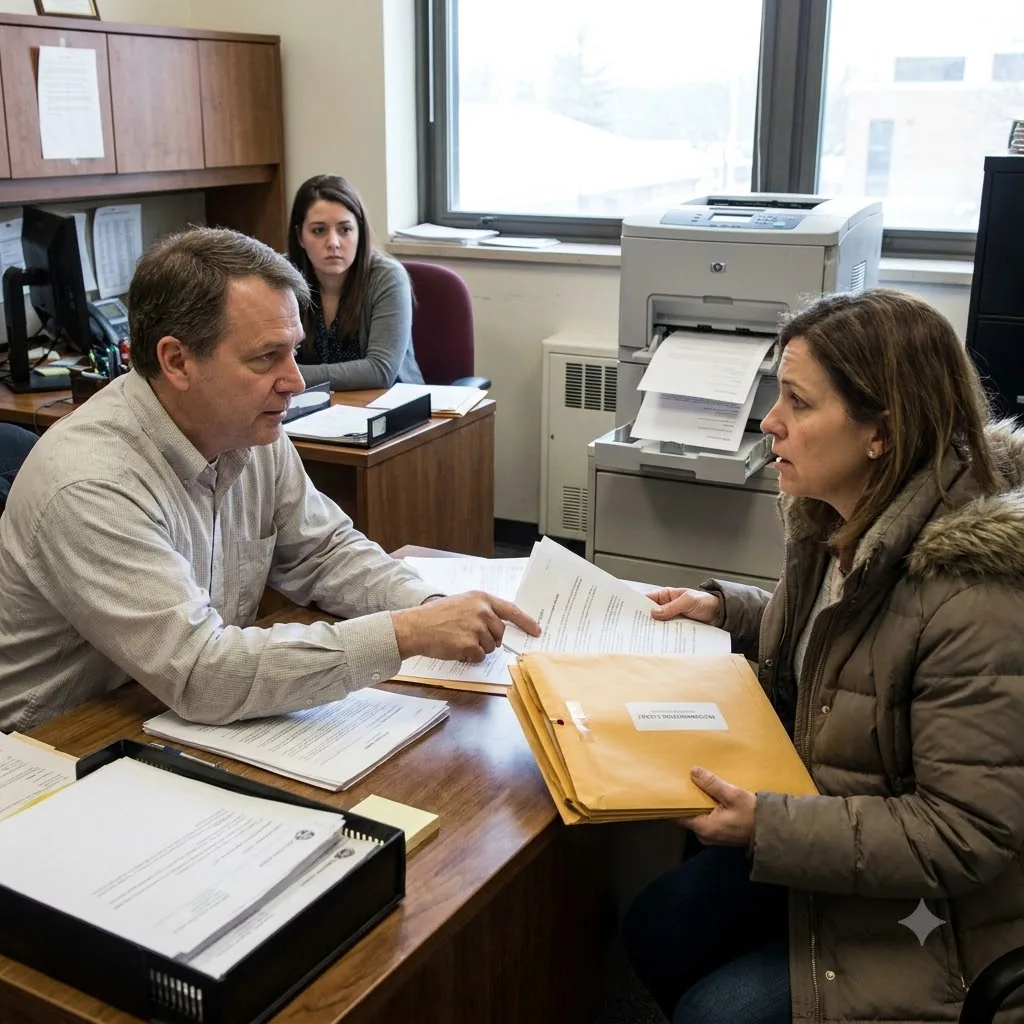
Marisol Trent did not step all the way into the room at first. She set one hand on the doorframe, looked at the folded instruction sheet Dana had opened on the table, then at Leah Brooks’s recommendation packet under Glen Harper’s fingers.
“What exact source are we relying on here?” she asked again.
Glen turned toward her without moving his hand off the packet. “This is a packet-level interpretive issue,” he said. “Not something a family handout is designed to capture.”
Marisol came in then and stopped beside the table. She did what she always did when something was about to get narrower instead of louder. She looked at the page in front of her before she looked at the person talking.
“I heard the answer,” she said. “I asked for the source.”
The printer behind me kicked on again and then quit halfway through a page. Nobody in the room moved toward it.
Glen gave a small nod, like he was agreeing to slow down for someone else’s benefit. “The issue is cross-letter synchronization,” he said. “The packet lacks a stabilizing narrative bridge, so the recommendation architecture doesn’t hold.”
Marisol put two fingertips on the family instruction sheet. “Is that phrase on this document?”
“No,” Glen said.
“Is it on the packet checklist we give at intake?”
“Not in those words.”
“Is it on a review rubric you can show in this room?”
There was a pause there. Not long, but long enough that Dana’s hand, which had been flat on the table, eased back to the edge of the packet and stayed there.
Glen looked down at the letters and tapped the top one. “It is part of specialist review practice.”
Marisol did not look up. “Show me the printed source.”
“Not everything lives in a family-facing document,” he said.
“I didn’t ask for family-facing. I asked for printed.”
That landed differently. Dana stopped trying to decode his terms and just watched him. Leah had both hands on the strap of her backpack now, holding it close against her side. I stayed where I was with the intake forms squared in front of me, because by then the whole room had shifted from explanation to demonstration.
Glen opened the packet wider. He moved the counselor letter on top and drew a finger under a paragraph as if the answer might appear if he handled the page confidently enough.
“This letter stresses diligence,” he said. He shifted to the second. “This one elevates leadership.” Then the third. “This one emphasizes resilience under pressure. They are not narratively coordinated.”
Marisol asked, “Where is the requirement that they must be?”
He answered right away. “In how committee flow reads packet coherence.”
“That is an effect you are claiming,” she said. “I am asking for the requirement.”
Glen’s finger stayed on the page, but it stopped moving.
Dana spoke before he could restart. Her voice was steady now, stripped down to the simplest version of the problem. “So there isn’t a line on our instructions. There isn’t a line on the checklist. And you still told my daughter we may need to rebuild all three letters.”
Glen looked at her, then back at Marisol. “I said the safer move was to hold submission.”
Marisol finally lifted the instruction sheet and read one section aloud. “Three recommendations from approved sources. Submitted together in packet form if the school uses packet service.” She set it down. “Now show me where the packet fails that requirement.”
He did not answer immediately. Instead he touched the clear cover, then the clip, then the first page again, as if rearranging the same pages might create a missing rule.
I heard myself say, before the silence closed over it, “He hasn’t cited the letters either.”
Marisol glanced at me once and nodded for me to continue.
So I stayed exact. “He has described them by theme, but he hasn’t pointed to wording in any letter that conflicts with another letter.”
That was the first time Glen looked directly at me as if I had stepped on something marked staff only.
Marisol turned back to the packet. “All right,” she said. “Let’s do this plainly. Pick one sentence from one letter that creates the defect you’re naming. Then pick the sentence from another letter that contradicts it.”
Nobody spoke for a few seconds. Out in the front area, a phone began ringing and kept ringing.
Glen flipped to the counselor letter and read a line about Leah’s consistency and follow-through. He moved to the teacher letter and read a line about her leading a lab team. Then he looked at the third letter without reading.
Marisol waited.
Dana waited.
I watched Glen’s hand stop at the bottom corner of the page.
“These don’t contradict,” Marisol said. “They describe different strengths.”
Glen straightened the packet. “That’s exactly the kind of oversimplification that misses committee-level nuance.”
“Then give me the exact term from the committee materials,” Marisol said.
Another pause.
Then, in the smallest voice he had used all morning, Glen said, “I don’t have that in front of me.”
Marisol held out her hand. “Then give me the packet.”
He let go of it.
That was the first visible crack. Not a confession. Not an apology. Just his hand lifting off Leah Brooks’s recommendation packet while Marisol slid it to the center of the table and said, “We are going to read what is actually here before anyone tells this family to rebuild anything.”