Story code: ST-000798
Part 1: The Word He Used to Shut Them Down
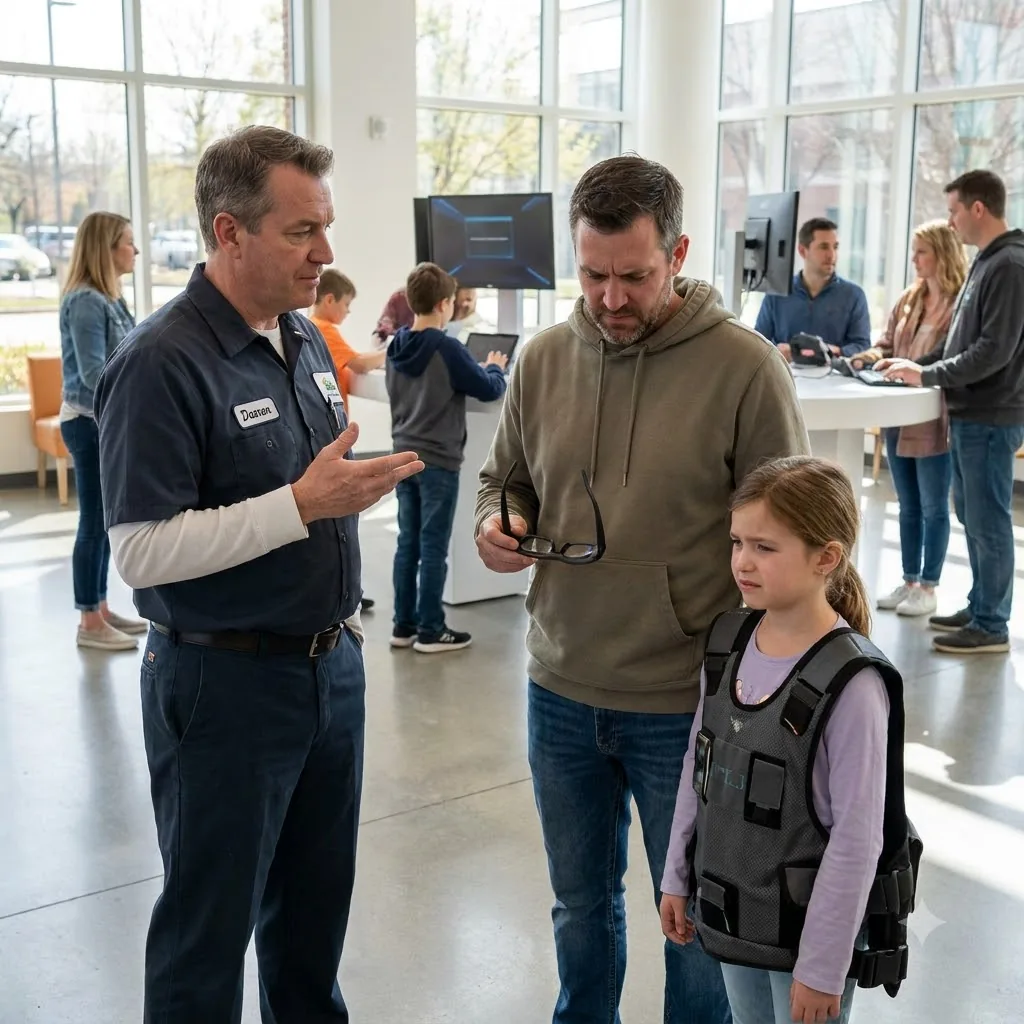
The dad said the new filter was making his daughter miss easy targets and pull the AR glasses off between rounds, and Darren Pike answered him by talking like he was correcting a graduate student instead of a customer. We were in the specialist calibration room off the main game floor, with birthday kids thumping past the glass wall and target lane graphics pulsing on the monitor, and I watched a grown man get talked over for saying, in plain English, that his kid could not play right anymore.
I work fittings and calibration checks at the plaza, so I was already in the room with my tablet open when Evan Brooks came in carrying the hard case. Lila stood beside him in her wristband and tournament tee, one hand on the glasses frame before she even sat down. That usually tells me something faster than a complaint does.
Evan set the case on the counter and said, “She was fine before that update. After the new filter, the targets slide when she turns. She keeps missing on the right side, and she said it made her feel sick after ten minutes.”
Darren did not answer the problem first. He straightened the badge on his jacket, leaned one hand on the counter, and said, “That would only happen if you were misreading adaptive overlay drift as phase-latched parallax compensation.”
Evan blinked at him. “I don’t know what that means. I’m telling you what happened.”
Darren gave him a small smile that did not reach his eyes. “Exactly. You are describing a normal transitional artifact in a dynamic filter environment, but because you don’t have the vocabulary, you’re calling it failure.”
Lila looked at her dad, then at me. She adjusted the glasses again even though they were still in standby.
I said, “We can fit-check first and run the room sequence.”
Darren lifted two fingers without looking at me. “Let’s not confuse hardware fit with perceptual adaptation.”
That was the tone from there on out. Evan would give a concrete example. Darren would rename it until the example disappeared.
“She missed three stationary marks in warm-up,” Evan said.
“Stationary relative to what layer?” Darren said.
“The red circles on the lane wall.”
“Those are not the operative reference objects once chroma prioritization is engaged.”
“She never had this problem before.”
“Before this version, she was playing with an inferior filter stack.”
He said it all in a polished voice, like the room itself agreed with him. Through the glass, the plaza floor kept moving like normal. Kids in loaner visors ran past. A party host walked by with a tray of neon wrist straps. Inside our room, the air got tighter every time Evan had to stop and restart a sentence.
I took the glasses from the case and started the basic fit procedure because that part was mine no matter who was talking. Temple width looked right. Nose bridge looked right. Lens seating was clean. I asked Lila, “Any pinch points?”
She shook her head once.
“Any blur standing still?”
“Not standing still,” she said. “When I turn, the target kind of keeps going. Then the other one jumps in.”
Darren turned to her so fast it almost looked rehearsed. “That is because you are noticing predictive ghosting before your visual system finishes reconciling depth cue prioritization. That’s not a defect. That’s advanced responsiveness.”
Lila pressed her lips together. Evan said, “She’s twelve. She doesn’t need advanced responsiveness. She needs to hit what she’s looking at.”
Darren let out a short breath through his nose. “No, she needs time to stop fighting the filter. Parents often create a feedback problem by coaching against the intended experience.”
That landed hard. Evan’s hand stayed on the carrying case handle like he had to remind himself where to put it. Lila stared at the floor striping by the test stool.
I kept my voice level. “We can still run the calibration lane.”
Darren finally looked at me. “Of course we can. But if we’re going to do that, let’s be precise.” He tapped the monitor with one knuckle and said, “What he’s calling target slide is most likely vestibulo-spectral lag.”
He said it like it was a term everyone but Evan should already know.
Evan looked at me then, not because I outranked Darren, but because I was the only other employee in the room. “Is that real?”
I did not invent explanations for customers, and I was not going to start there. “We’ll log what the glasses do in the test.”
Darren gave a quiet laugh and leaned back. “You can log all you want. If the family doesn’t understand vestibulo-spectral lag, the raw output won’t help them much.”
He had turned the complaint into a language test, and Evan was losing it on purpose-built ground. But the room had one thing Darren could not talk over for long. On the calibration tablet, the live sequence button was waiting, and our system did not care what word he used if the overlay failed to hold.
I set the glasses in Lila’s hands and opened the target lane program. Darren had just named the problem with a term I had never seen in any of our menus, and now he was standing in front of a room full of tools that were about to ask him to prove it.
The dad said the new filter was making his daughter miss easy targets and pull the AR glasses off between rounds, and Darren Pike answered him by talking like he was correcting a graduate student instead of a customer. We were in the specialist calibration room off the main game floor, with birthday kids thumping past the glass wall and target lane graphics pulsing on the monitor, and I watched a grown man get talked over for saying, in plain English, that his kid could not play right anymore.
I work fittings and calibration checks at the plaza, so I was already in the room with my tablet open when Evan Brooks came in carrying the hard case. Lila stood beside him in her wristband and tournament tee, one hand on the glasses frame before she even sat down. That usually tells me something faster than a complaint does.
Evan set the case on the counter and said, “She was fine before that update. After the new filter, the targets slide when she turns. She keeps missing on the right side, and she said it made her feel sick after ten minutes.”
Darren did not answer the problem first. He straightened the badge on his jacket, leaned one hand on the counter, and said, “That would only happen if you were misreading adaptive overlay drift as phase-latched parallax compensation.”
Evan blinked at him. “I don’t know what that means. I’m telling you what happened.”
Darren gave him a small smile that did not reach his eyes. “Exactly. You are describing a normal transitional artifact in a dynamic filter environment, but because you don’t have the vocabulary, you’re calling it failure.”
Lila looked at her dad, then at me. She adjusted the glasses again even though they were still in standby.
I said, “We can fit-check first and run the room sequence.”
Darren lifted two fingers without looking at me. “Let’s not confuse hardware fit with perceptual adaptation.”
That was the tone from there on out. Evan would give a concrete example. Darren would rename it until the example disappeared.
“She missed three stationary marks in warm-up,” Evan said.
“Stationary relative to what layer?” Darren said.
“The red circles on the lane wall.”
“Those are not the operative reference objects once chroma prioritization is engaged.”
“She never had this problem before.”
“Before this version, she was playing with an inferior filter stack.”
He said it all in a polished voice, like the room itself agreed with him. Through the glass, the plaza floor kept moving like normal. Kids in loaner visors ran past. A party host walked by with a tray of neon wrist straps. Inside our room, the air got tighter every time Evan had to stop and restart a sentence.
I took the glasses from the case and started the basic fit procedure because that part was mine no matter who was talking. Temple width looked right. Nose bridge looked right. Lens seating was clean. I asked Lila, “Any pinch points?”
She shook her head once.
“Any blur standing still?”
“Not standing still,” she said. “When I turn, the target kind of keeps going. Then the other one jumps in.”
Darren turned to her so fast it almost looked rehearsed. “That is because you are noticing predictive ghosting before your visual system finishes reconciling depth cue prioritization. That’s not a defect. That’s advanced responsiveness.”
Lila pressed her lips together. Evan said, “She’s twelve. She doesn’t need advanced responsiveness. She needs to hit what she’s looking at.”
Darren let out a short breath through his nose. “No, she needs time to stop fighting the filter. Parents often create a feedback problem by coaching against the intended experience.”
That landed hard. Evan’s hand stayed on the carrying case handle like he had to remind himself where to put it. Lila stared at the floor striping by the test stool.
I kept my voice level. “We can still run the calibration lane.”
Darren finally looked at me. “Of course we can. But if we’re going to do that, let’s be precise.” He tapped the monitor with one knuckle and said, “What he’s calling target slide is most likely vestibulo-spectral lag.”
He said it like it was a term everyone but Evan should already know.
Evan looked at me then, not because I outranked Darren, but because I was the only other employee in the room. “Is that real?”
I did not invent explanations for customers, and I was not going to start there. “We’ll log what the glasses do in the test.”
Darren gave a quiet laugh and leaned back. “You can log all you want. If the family doesn’t understand vestibulo-spectral lag, the raw output won’t help them much.”
He had turned the complaint into a language test, and Evan was losing it on purpose-built ground. But the room had one thing Darren could not talk over for long. On the calibration tablet, the live sequence button was waiting, and our system did not care what word he used if the overlay failed to hold.
I set the glasses in Lila’s hands and opened the target lane program. Darren had just named the problem with a term I had never seen in any of our menus, and now he was standing in front of a room full of tools that were about to ask him to prove it.