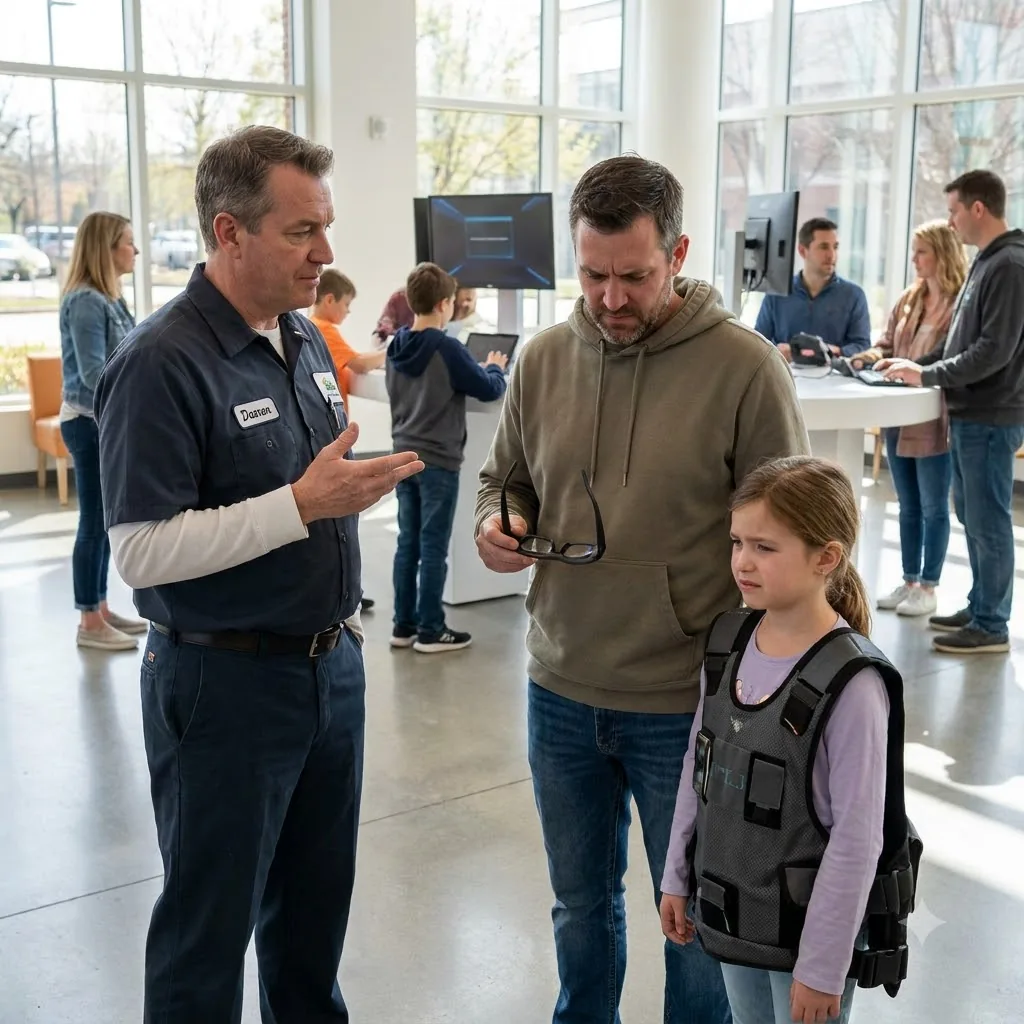
Story code: ST-000798
Part 2: The Test He Could Not Talk Around
Once Darren said “vestibulo-spectral lag” out loud, everything in the room started orbiting that phrase like it belonged there. He repeated it twice more while I loaded the calibration lane, and each time he said it slower, like the problem with Evan was pronunciation instead of the glasses sliding targets across Lila’s view. The specialist room had one wall of glass to the plaza floor, one target lane with floor markers, and one mirrored monitor that showed the customer feed on the left and my calibration panel on the right. I stood at the tablet dock. Lila stood on marker three with the glasses on. Evan stayed half a step behind the yellow line, carrying case still in one hand. Darren took the spot closest to the monitor. I started with the standard room procedure because it gave everybody the same steps. “Neutral gaze first,” I said. “Lila, look at center marker and keep your feet still.” She did. The center reticle settled. Head tracking numbers came up clean. Fit pressure stayed in range. I said each item as I logged it. That part matters in a room like that. If I speak in sequence, the room follows sequence. Darren folded his arms and said, “You’ll want to note that static alignment doesn’t capture vestibulo-spectral behavior.” “Noted,” I said, because I could write down the words without agreeing to them. I advanced to the turn-and-acquire step. “Lila, when the red target appears, turn and tap it with your pointer. Then return to center.” The first target appeared left. She hit it. Second appeared right. She turned, paused a fraction too long, then tapped air just outside the ring. On the mirrored screen, the target shimmered and settled a hair after her head stopped. Evan pointed without crossing the line. “That’s it. That’s what I mean.” Darren stepped in before I could answer. “No. What you’re seeing is anticipatory compensation. The display is protecting her from overcorrection.” Lila lowered the pointer. “It moved after I stopped.” “You perceived the handoff,” Darren said. “That’s different.” I reset the step and asked her to do it again. Same target, same direction. This time I watched the output panel more than the lane. Head movement curve. target lock. overlay settle. The settle line trailed the stop by a visible beat. I did not add an opinion. I just logged the timing. Darren saw me looking at the panel and shifted closer. “Raw settle delay is not clinically meaningful in this context.” Nobody had said anything about clinical anything. Evan gave him a long look, then turned to me. “Can she try without that new filter? Same room, same step?” That was a normal request. In our room, we could compare profiles if the session allowed it. I checked the current package on the tablet and said, “I can load the previous approved profile for a side-by-side check.” Darren answered before the family could. “That would create cross-state contamination in her adaptation window.” Evan said, very evenly, “In plain English.” Darren’s jaw tightened once. “It would confuse her visual response.” Lila was still on marker three. She lifted the glasses slightly off her nose and said, “I’m already confused when I turn.” That was the first time the room went fully still. Even the floor noise through the glass seemed farther away for a second. I kept to procedure. “For comparison, we can run previous approved profile, one pass only, same target set.” Darren put one hand on the back of the spare stool. “If you do that, and she performs differently, it won’t disprove vestibulo-spectral lag. It may only mean her baseline dependence is stronger than expected.” There it was again, that polished habit of making every outcome feed the same explanation. I asked the only question that mattered in my role. “Do you want the comparison logged or declined?” Evan said, “Logged.” Darren looked at the monitor instead of at him. “Fine. Log it.” I switched profiles. The tablet showed the old approved filter name, version number, and timestamp. No dramatic music, no argument, just a different line on my screen and one quiet loading bar. I made sure the mirrored monitor showed the active profile label where everyone could see it. “Same step,” I said. “Center, then right target.” Lila settled at center. The reticle locked. The target flashed right. She turned and tapped it clean on the first pass. No shimmer. No late settle. Just hit, return, center. Evan did not say I told you so. He only looked from the screen to Darren and then back to me. Darren did not speak for a full two seconds, which was the longest silence he had left in the room all afternoon. Then he said, “Run it again. One successful acquisition doesn’t isolate the variable.” I ran it again. Clean hit. I ran the left side. Clean hit. Then I reloaded the new filter Darren had defended for the last twenty minutes and repeated the same sequence, same marker, same pace, same target spacing. On the first right-side turn, the overlay lag showed up on the monitor before Lila even said anything. She stopped with the pointer still raised and said, “There. It did it again.” I looked at the log panel. The difference was now sitting in two columns under two profile names, simple enough that nobody needed specialty language to see which set was stable and which one was not. Darren leaned toward the screen and started explaining before I asked a question, speaking faster now, stacking new terms on top of the old one. He was still talking when I hit the discrepancy flag in the session log, and that flag was the setting that automatically notified Rosa Martinez to review the room before release. By the time Darren noticed I had marked it, the manager alert was already on its way, and he had finally given us something better than an argument: a test result that did not.