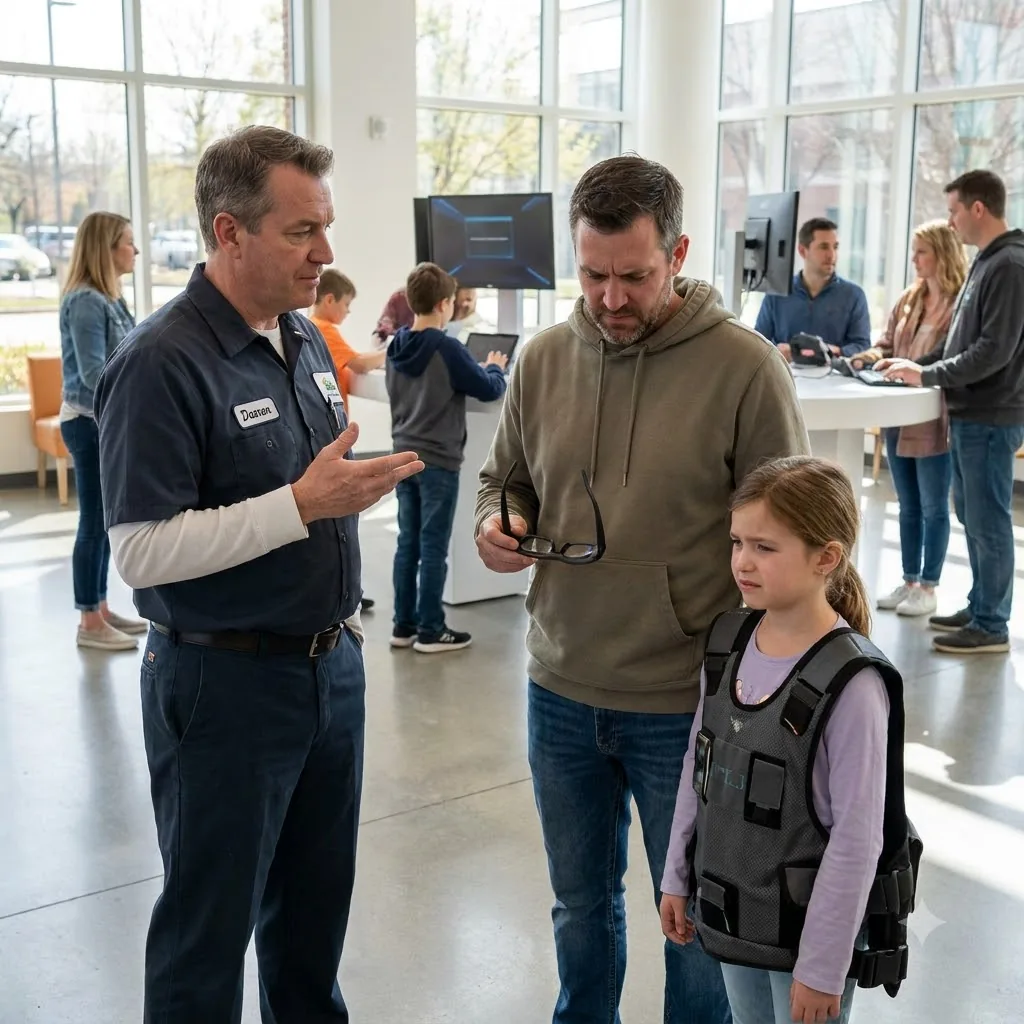
Story code: ST-000798
Part 3: When the Screen Had to Match His Mouth
Rosa had not reached the room yet, but the discrepancy flag changed the shape of it before she ever touched the door. Darren kept talking, only now he was talking at the monitor instead of at Evan, like if he layered enough language over the mirrored feed the numbers might get embarrassed and fix themselves.
He pointed at the right side of the panel. “You cannot isolate vestibulo-spectral lag from user anticipation without a forced reacquisition pass and fixed-angle recovery.”
I said, “We can run forced reacquisition.”
That stopped him for half a beat.
The calibration room had a set sequence for any profile dispute that stayed unresolved after side-by-side comparison. We did not use it much because most arguments ended before then. It locked target timing, locked turn angle, and put the live overlay trace full-screen on the mirrored monitor so everybody in the room could watch the same thing at the same time.
Evan looked at me. “Does that make it clearer?”
“Yes,” I said. “Same lane. More controlled.”
Darren adjusted his cuffs and nodded once, smooth again. “Good. Then we can stop mistaking adaptation resistance for filter instability.”
I loaded the forced pass. The monitor changed to the trace view: Lila’s head movement line in blue, target acquisition in white, overlay settle in yellow. The labels were plain. Even the room lighting made the colors look sharp against the gray background.
“Lila,” I said, “same marker. Center first. When the tone hits, turn right and hold still after the turn until I tell you reset.”
She put the glasses back on and rolled her shoulders once. Evan moved closer to the yellow line but did not cross it. Darren stood near the monitor with one hand braced on the counter edge.
I started with Darren’s preferred profile still active.
Tone.
Turn.
Hold.
On screen, the blue line stopped first. The yellow settle line kept sliding a fraction past it before snapping back into place.
Lila said, “It’s still drifting.”
Nobody answered right away because the screen already had.
I logged the pass and ran it again. Same angle. Same target. Same delay. The second trace laid almost directly on top of the first. Repeatable. Visible. Quiet.
Darren cleared his throat. “That only shows a transient reconciliation window. You would need a baseline recovery series to know whether the lag is actually maladaptive.”
I tapped the next sequence. “We have baseline recovery.”
He looked at me then, not at the tablet.
The system kept previous approved profiles in the comparison lane for exactly this reason. I switched to the older profile again, left everything else locked, and mirrored the active version label to the big screen.
“Same pass,” I said.
Tone.
Turn.
Hold.
The blue line stopped. The yellow line settled with it.
No slide. No catch-up motion. No late snap.
I ran the second pass. Same result.
The room got so still I could hear a birthday countdown chant starting somewhere on the other side of the glass wall, faint and separate from us.
Evan did not raise his voice. He only said, “So when I said it slid on the right side, that was just me not having the vocabulary?”
Darren kept his eyes on the monitor. “You are oversimplifying a multi-layer display event.”
Lila lifted the glasses just enough to look under them at the screen. “It only does it on the new one.”
That landed harder than anything louder would have.
I reopened Darren’s profile for one final controlled pass because once the traces were side by side, there was nowhere for a speech to hide. The monitor showed the old profile in one column and the new one in the next. Same room. Same player. Same step. Different result.
Darren started explaining again, but now his sentences came out faster than the sequence. He named vestibular load, spectral handoff, adaptation debt. He corrected the word drift even though the yellow line on the screen was still hanging late beside the blue stop point.
Then Rosa opened the door.
She did not ask what was happening first. She walked straight to the mirrored monitor, read the profile labels, read the discrepancy flag, and watched the trace history while Darren was still mid-sentence.
I said, “Customer complaint was right-side target slide after the new filter update. We ran standard sequence, prior approved comparison, then forced reacquisition at his request. Delay repeats on the current profile and clears on the previous approved profile.”
Rosa held out her hand without looking away from the screen. I passed her the tablet.
Darren said, “Those conclusions are premature unless the staff here understands vestibulo-spectral lag in context.”
Rosa scrolled once, then stopped at the repeated trace pair. “Show me where that term appears in the logged filter notes or room procedure.”
For the first time all afternoon, Darren did not answer right away.
He stepped toward the tablet. Rosa did not hand it over.
The monitor stayed lit behind them with the two profile columns frozen in place, one stable and one not, and the room no longer needed anybody to translate what we were all looking at.