Story code: ST-000596
Part 3: He Knew Exactly How to Save It Once He Had No One Left to Hand It To
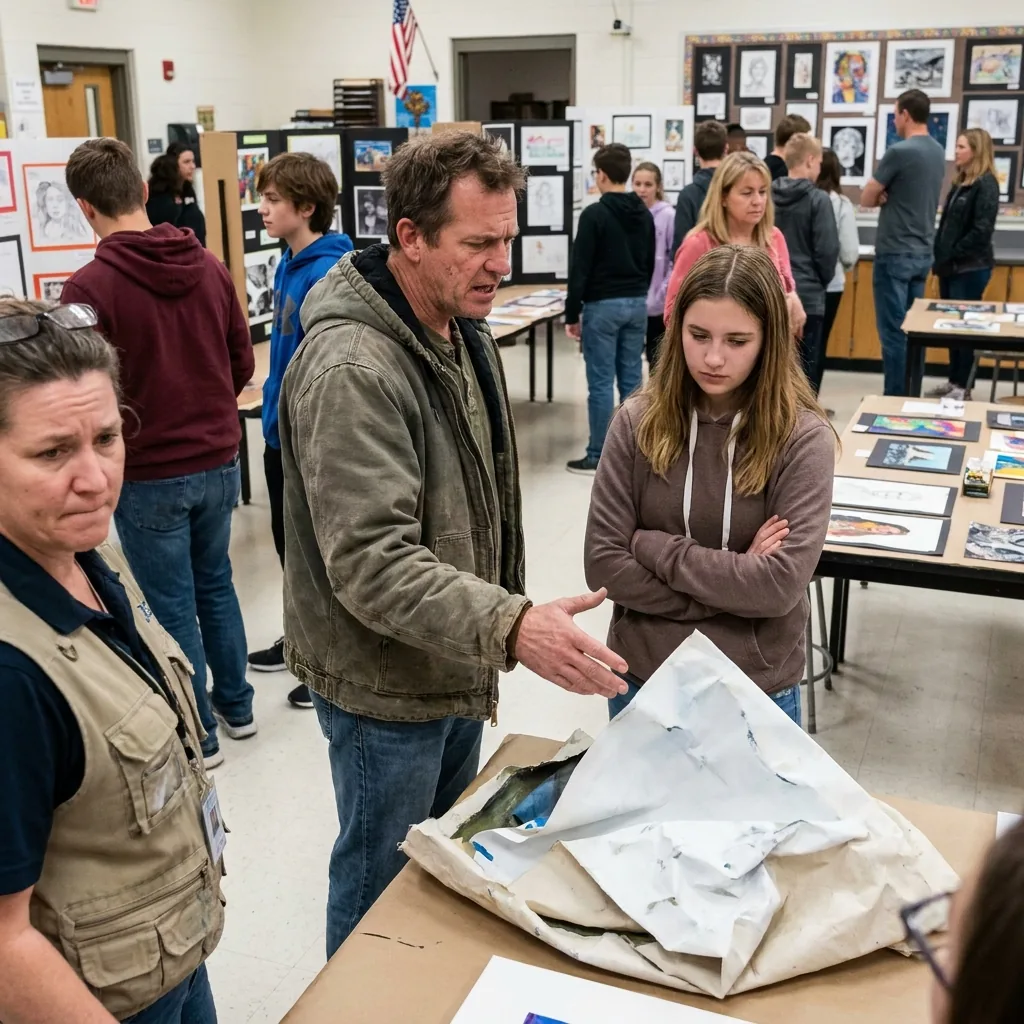
The minute Ms. Alvarez left that last canvas on the side table and put Greg in charge of it, the whole lane changed shape. Before that, every mistake had somewhere to go. It could drop onto Lila’s hands, onto my tape roll, onto the room’s hurry. Now the canvas was still wrapped, the clips were lined in a row, and the only person standing in front of the wall was the man who kept saying he didn’t know how any of it worked.
Lila moved to the smaller pieces like Ms. Alvarez had told her to. She took one frame out of its paper sleeve and started pressing the label smooth beneath it. Her shoulders stayed high and still. She did not come toward the side table.
I stayed where Ms. Alvarez had put me, near enough to hand over a tool if asked, not close enough to do the task for him.
Greg looked at me first. “So am I really not allowed to ask a question?”
“You were given the order,” I said.
He gave a soft breath through his nose and picked up the hanging bar. “Unbelievable.”
Then he stalled. He touched the wrapper seam. He shifted the clips half an inch. He looked at the blue center mark on the wall like it had appeared there by magic. Across the room somebody laughed at a different conversation, and a stapler snapped twice near the student photo display. Inside our little patch of floor, nobody filled the silence for him.
“Dad,” Lila said without turning around, “clips first.”
He answered immediately. “I know what clips are.”
He said it sharp, then seemed to realize how that sounded, because he reached for the canvas and added, louder, “I’m just trying not to damage your work since apparently that’s the concern.”
What he did next was slow on purpose. He set the bar along the top edge, but his hands did not fumble. They found the sleeve seam cleanly. He pinched the canvas through the wrapping in two exact places, like he already knew where the weight would pull once it opened. Then he stopped himself and went back to making a little show of checking which side was up.
I watched his thumbs more than his face.
He got one clip on crooked, glanced at me, and said, “That right?”
I didn’t answer.
From the next row, Ms. Alvarez called, “No coaching.”
Greg swallowed that and reset the clip. This time he slid it into place in one smooth push, square to the bar, no hunting. The second clip followed faster. He didn’t look confused now. He looked busy.
He lifted the wrapped canvas and carried it to the wall. The bar landed within an inch of the center mark on the first try. He shifted it left with two fingertips, then used his knuckle to tap one clip until the top edge balanced. It was the same kind of quick, practiced motion I had seen when he flicked out the measuring tape in Part 1, except now there was more of it and nowhere to hide it.
Lila had stopped labeling. She was standing with the paper backing still in one hand.
Greg cleared his throat. “Now what?”
Nobody answered.
He stared at the roll for a second, and then his hands made the decision before his mouth did. He braced the bar, loosened the kraft paper with his left hand, and controlled the drop with his right palm against the outer curve so the canvas unrolled under tension instead of slapping open. It came down flat and even. No skid. No folded corner. No panicked grab. He caught the lower edge just before it touched the wall and let it settle in a straight line.
That was not beginner luck. That was the exact move Lila had been trying to protect all morning.
I heard Ms. Alvarez’s shoes before she stepped back into our row. She stopped beside me and watched the last six inches unroll.
Greg must have heard her too, because he froze with one hand still on the lower corner. Then, like he remembered he was supposed to be lost, he said, “Okay, so, uh, does somebody tape the bottom now or-”
“Don’t,” Lila said.
Her voice cut across him so clean the room around us thinned out again.
She walked over, not rushing this time, and pointed at the lower edge without touching it. “You already counter-curved it on release. If you tape it now, you’ll trap the tension and bow the center. Let it breathe first.”
Greg kept his hand on the corner another second, then let go.
Ms. Alvarez looked from the canvas to his hand, then to the hanging bar seated flush on the clips. “Mr. Hart,” she said, very even, “I thought you told me you weren’t the art person.”
He gave a short laugh and spread both hands. “I just followed common sense.”
But the canvas was level. The spacing was right. The roll had opened exactly the way it should have the first time.
Ms. Alvarez stepped in, put her own level across the top bar, and checked it. The bubble stayed centered.
Then she said, without raising her voice, “Mara, note that Lila’s large feature canvas has a damaged corner from earlier handling. This one is display-ready. Mr. Hart, you’re done touching student work in this room.”
Greg opened his mouth, but she was already turning to Lila.
“Bring me the first canvas,” she said. “I need to see whether the crease can stay on the floor or whether we pull it from the wall plan.”
Lila didn’t answer right away. She just looked at the straight, perfectly opened canvas her father had mounted by himself, then at the bent corner on the first piece leaning against the easel table.
That was the first moment all morning when the damage had nowhere left to hide except on the painting itself.