Story code: ST-000596
Part 4: She Got Out of the Trap, but One Painting Paid for It
Once Ms. Alvarez said Greg was done touching student work, she enforced it like a room rule, not an argument. She moved him back with one palm held low and pointed him toward the folding-chair stack by the doorway.
“You can greet families when the show opens,” she said. “You are not handling canvases again.”
Greg gave that same volunteer smile he had been wearing all morning, but it sat wrong now because his hands had already told on him. “This is a little extreme.”
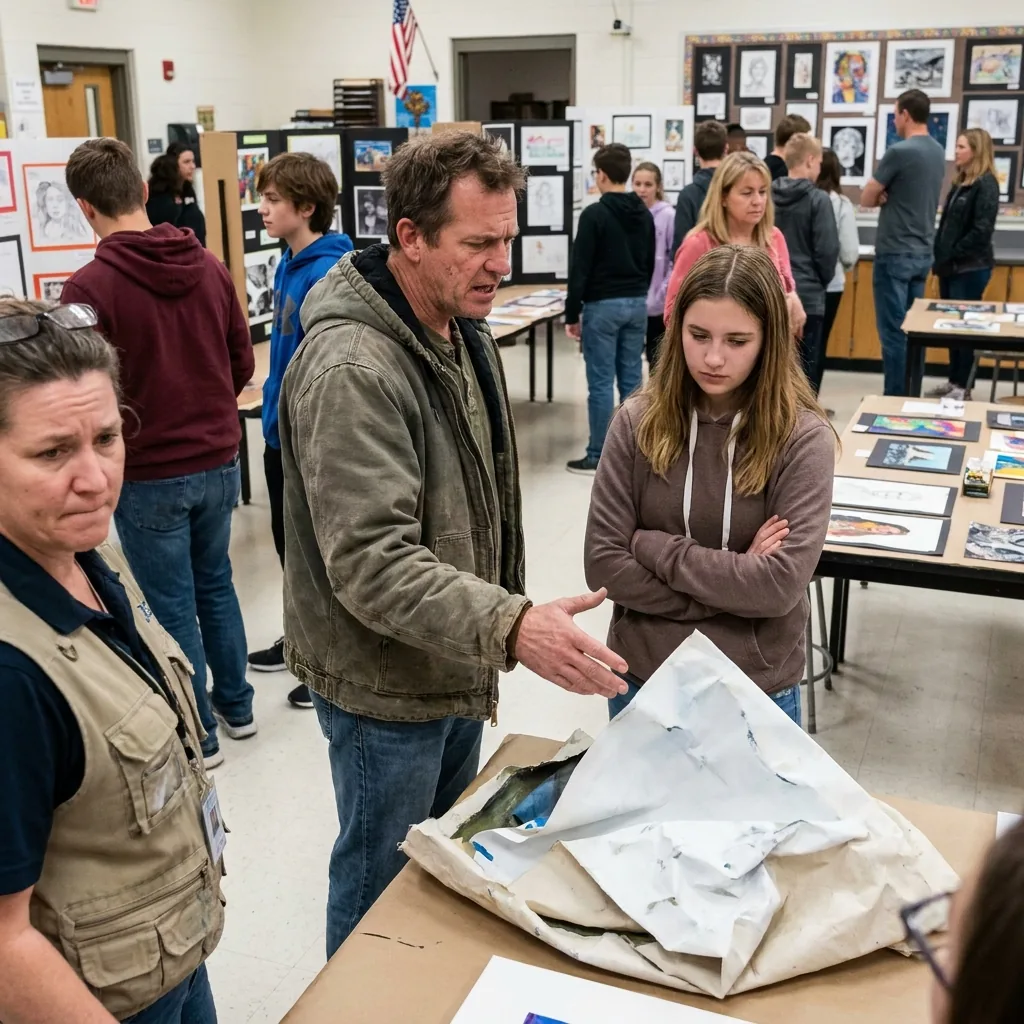
Ms. Alvarez didn’t answer that. She was already at the first large canvas, the one that had hit the floor at the beginning of the day. Lila and I brought it to the side table together. The crease at the corner was smaller than it had been an hour earlier because Lila had worked it out as much as she could, but under the overhead lights the line still caught.
Ms. Alvarez touched the damaged edge with two fingers, then tipped the piece upright and stepped back. “Turn it slightly.”
I rotated it for her. The crease flashed again.
Across the room, one of the sixth-grade parents asked where to set a sculpture riser. Somebody else dragged an extension cord past the sink cabinets. The art room kept moving. Our corner did not.
“Can it hang anyway?” I asked.
Ms. Alvarez shook her head once. “Not in the main row.” She looked at Lila. “I can put it on a side easel with the corner turned away from traffic, but not where your wall set was supposed to go. Under these lights it’ll read damaged from the aisle.”
Lila had one hand flat on the table edge. “Then don’t hang it there.”
Greg took two quick steps back toward us. “Come on. Nobody’s going to notice that but you people.”
Ms. Alvarez turned before he got close enough to touch the frame. “Stop right there.”
He did stop. He looked at the canvas, then at the one he had just mounted perfectly on the wall, and then at the badge clipped to his shirt.
“I was helping,” he said.
“You were told not to open the first piece on the floor,” I said before I could stop myself. “Then you mounted the second one clean the second you had to do it alone.”
He looked at me, but he didn’t answer me. He looked at Ms. Alvarez instead.
She kept her voice level. “The main wall slot for this damaged piece is gone. Lila keeps the space for the properly mounted canvas and the two small works. This one goes on a side easel near check-in if she wants it shown at all.”
That was the visible cost, plain as anything in the room. The original wall grouping was broken. Her full presentation was gone. The big feature piece she had checked in first, the one meant to anchor the set, was now either sidelined or absent.
Lila stood very still for a second. Then she nodded once. “Side easel,” she said. “Near check-in is fine.”
Her voice was steady, but she had to clear it before the last word.
Ms. Alvarez wrote something on her clipboard. “And for the rest of today, Mara is the only helper assigned to your display lane. If anything needs adjusting, Mr. Hart does not do it. He can stay as a guest or leave. Those are the options.”
Greg’s jaw moved. “You’re seriously putting that in writing over a misunderstanding?”
“I’m recording handling restrictions after visible damage,” she said. “That’s what I do when student work gets compromised during setup.”
No speech. No scene. Just a note on a clipboard and a reassigned lane.
He reached for his badge clip, took the volunteer sticker off his shirt, and folded it in half between his fingers. “Fine.”
But he didn’t leave right away. He had to stand there while I helped Lila carry the damaged canvas to the front side easel by the check-in table. It was a decent spot for overflow work, not a feature spot. Families entering the room would see it first, but they would also see that it wasn’t where the wall map said her large piece should have been.
Lila adjusted the easel arms herself. This time nobody took the hardware out of her hands. I held the frame steady while she found the angle that hid the worst of the crease from the doorway. She stepped back, checked the line once, and let her hands fall to her sides.
Behind us, Ms. Alvarez was rehanging Lila’s label order so the remaining wall pieces still made sense. One title card came down. Another shifted. The set looked cleaner than the chaos from an hour earlier, but smaller. Anybody with eyes could see something had been lost.
When the first families started coming through, Greg was by the door with his coat over his arm instead of a volunteer badge on his chest. He stayed long enough to hear one parent say, “Oh, I thought that big one was supposed to be in the center section,” and long enough for Ms. Alvarez to answer, “It was damaged during setup, so we adjusted placement.”
She didn’t say his name. She didn’t need to.
Lila stood beside her side-easel piece with her two smaller works and the one flawless canvas on the wall behind her. People stopped. They read. A couple of students called her brushwork amazing. She thanked them, quiet and brief.
What had changed was simpler than a victory. Every time somebody asked a setup question in that row after that, they asked Lila or me. Greg stayed out of the lane. The trap was over.
The price of getting out of it was sitting three feet from my check-in table, propped on black easel arms, with one corner turned just enough to hide what his first mistake had done.