Story code: ST-001075
Part 2: The Diagnostic Stand-Off
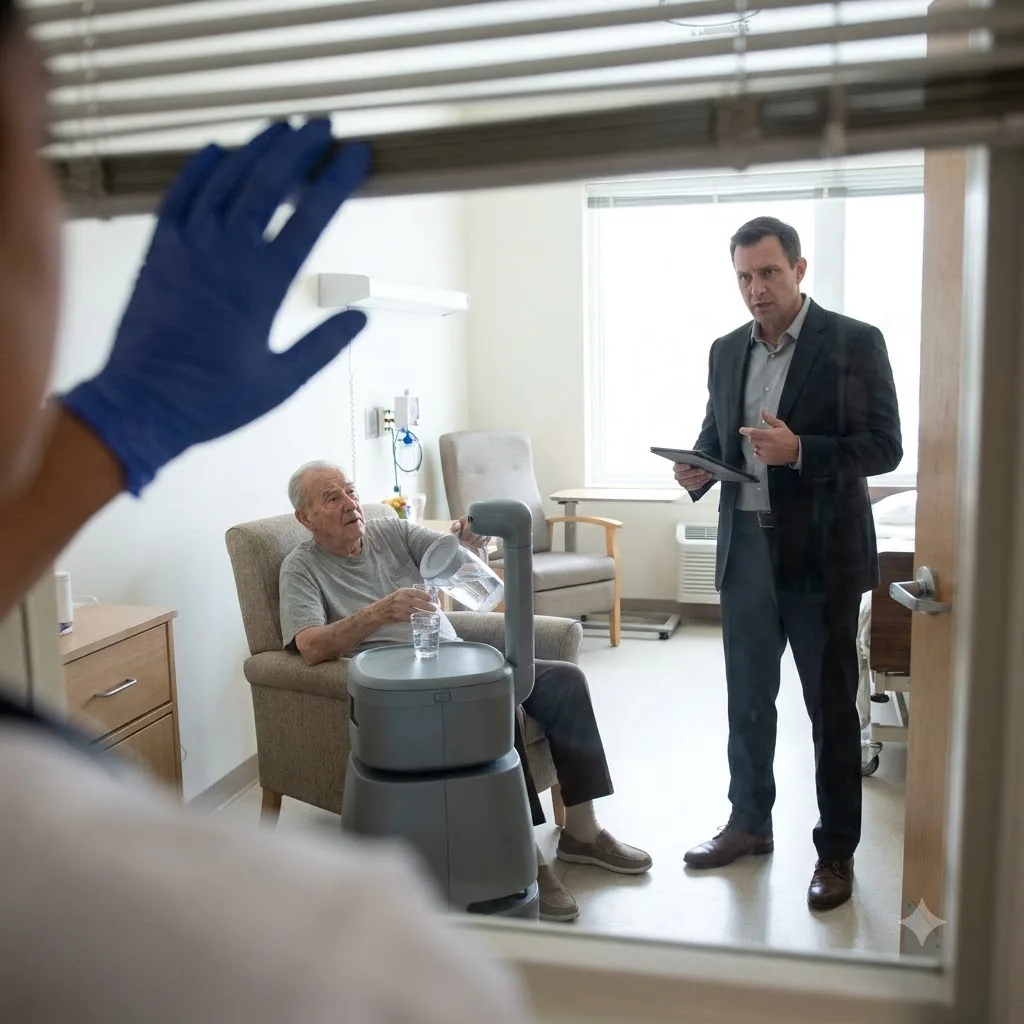
Marcus held his palm flat against the wall-mounted intercom, his shoulders tense. “Wait, don’t call them,” he said, his voice dropping to a quieter, hurried tone. “If you log a formal IT ticket, their automated system will flag the unit and put a forty-eight hour freeze on the hardware. We don’t need to involve central IT for a simple patch.”
I looked at his hand on the intercom panel, then back at his terminal. “If the motor relays are on the verge of critical failure, a freeze is exactly what the safety protocols require. The robot shouldn’t be operating at all if it’s unsafe.”
Arthur’s hand dropped back to his lap, the pen rolling onto the sheets. “A forty-eight hour freeze? But I need to go to physical therapy tomorrow morning. Marcus, you said it would only take five minutes to patch.”
Marcus shifted his weight, his eyes avoiding mine as he lowered the terminal slightly. “Well, ‘critical’ is a diagnostic term. It’s a preventative alert. It might run fine for a few more days, but the price for the software patch goes up after today. I’m trying to save you money, Arthur.”
The urgency that had filled the room moments before seemed to evaporate, replaced by a defensive posture. I pointed to the Model RX-9’s integrated diagnostic screen on its chest casing. The small LCD display was currently blank, awaiting user input. “The RX-9 has an independent local system status display. If the relays are failing, the local hardware log will show the voltage drop. Let’s run the onboard test.”
Marcus moved to stand between me and the robot, his arm extending to block my path. “The local test isn’t calibrated for this specific firmware error. Running it now could corrupt the boot sector and wipe the operating system entirely.”
I did not back down. “Facility guidelines require a local test before any vendor transaction is authorized. If the system is as unstable as you claim, the diagnostic routine will confirm it.”
I stepped around Marcus, reaching past his shoulder to press the physical diagnostic button on the side of the RX-9’s chest panel. Marcus reached out, tapping his terminal in an attempt to cancel the wireless connection to the robot, but the machine had already responded. The chest screen flickered, glowing blue as the local diagnostic routine initialized.
A status bar appeared on the screen, slowly filling from left to right as the system began checking the internal integrity of the motor relays. Marcus took a step back toward the door, his terminal still clutched in his hand, his eyes fixed on the blue light of the screen.
I watched the progress bar crawl to fifteen percent. “If there is a physical voltage drop in the actuators,” I said, “the log will record the exact timestamp. It will also send an automated report directly to the chief engineer’s office, creating a permanent record of the hardware state.”
Marcus checked his watch, then looked back at his terminal screen. “Look, I have five other rooms to visit on this floor. If you’re going to waste time running diagnostics that aren’t even authorized by the manufacturer, I can’t guarantee I’ll be back to help when this unit locks up.”
Arthur watched the blue light illuminate the dark corners of the room. “Casey, is the robot going to be okay?”
“We’ll know in a minute, Arthur,” I said, keeping my eyes on Marcus. Marcus didn’t leave, but he took another step toward the threshold, his fingers tapping against the casing of his device. The progress bar reached forty percent, the quiet hum of the RX-9’s cooling fans the only sound in the room.