Story code: ST-001581
Part 4: The Longer Recording
Daniel did not answer right away.
That delay changed the room more than any confession could have. Colleen’s posture tightened. Leon, by the door, looked less like an escort now than a man who wanted to know whether he should still be there.
“Was it recorded,” Colleen said again, each word separate.
Daniel kept his eyes on the table. “Some leadership sessions are archived for internal training review.”
Evan let out one short breath through his nose. Not relief. Something harder.
“So yes,” he said.
Daniel finally looked up. “I don’t know whether this specific file was retained.”
It was the first sentence in the meeting that sounded built instead of spoken.
Colleen heard it too. “Get me the source,” she said.
Daniel reached for his phone at last. He did not leave the room, but he turned slightly away while he made the call, voice low, using names Evan could not quite catch. Operations. Education. Media. The words came in fragments. Meanwhile Colleen asked Evan to walk through the exchange from the beginning, and this time she wrote without interrupting.
He told it as cleanly as he could. The fake softness of the session title. The talk about leave trends. The language of resilience used to sort staff into risks and burdens. The line from the front of the room. His own line thrown back with disbelief under it. The cut that removed everything that made the sentence mean what it meant.
When he finished, Colleen asked only two questions: who else had been seated near him, and whether he remembered anyone holding up a phone.
“No,” he said. “If I had, I wouldn’t have spoken the same way.”
That landed on all of them.
Twenty minutes later a woman from education services came in with a hospital-issued tablet and a face so fixed it looked painful. She handed it to Colleen, not Evan. On the screen was a file list with time stamps. One item had already been opened.
The full recording ran forty-three minutes.
They watched only a piece of it, but that was enough. The room on the screen was wider than the viral clip had shown. The facilitator stood by the projector, clicking through slides on retention pressure and attendance exposure. Voices came from around the table, some blunt, some careful, all of them too comfortable. One manager asked how to prevent units from becoming magnets for staff who learned how to use burnout language. Another said some supervisors were rewarding fragility. Then came the sentence, almost exactly as Evan had dragged it back into memory. A staffing management problem, not an individual crisis. A way not to work.
On the screen, Evan’s chair scraped. He leaned forward. Then his voice, unmistakable.
“At some point, if everybody says they’re burned out, it just becomes a way not to work?” he said, the laugh breaking out sharp and disbelieving. “That’s what we’re calling it now?”
In the recording, unlike the viral cut, nobody mistook the tone. Another manager murmured, “Come on,” in the strained voice people use when they want a thing unsaid without admitting it was said. Someone near the front laughed too, but nervously, trying to smooth over the ugliness. Evan kept talking, and the facilitator tried to redirect.
Colleen stopped the video there.
No one spoke for a few seconds. The vent clicked on overhead. Daniel’s phone buzzed in his hand and went unanswered.
The administrative leave did not disappear. Colleen was careful about that. She said the matter had widened. There would need to be a review of the session itself, the circulation of the edited clip, the source of the recording, the hospital’s response. She did not apologize. She did say the public narrative was incomplete and internal communications would reflect that.
Incomplete. As if that were the damage.
By the time Evan was allowed to leave the conference room, the practical parts of his life had already been stripped loose. His badge still did not work. His email stayed disabled. His access to staffing systems, unit schedules, and budget files remained cut off pending review. Daniel did not walk out with him. Leon did, but now from habit more than necessity.
At the front entrance his wife was waiting in the pickup lane, one hand gripping the steering wheel hard enough that her knuckles showed white through the glass. He got into the passenger seat and shut the door, and for a moment neither of them spoke.
“Well?” she said.
He told her the shortest true version. There was a longer recording. The clip was cut. The hospital knew enough now to stop pretending otherwise.
She stared through the windshield. “That doesn’t put you back upstairs tomorrow.”
“No.”
“It doesn’t get our daughter through school pickup without hearing your name.”
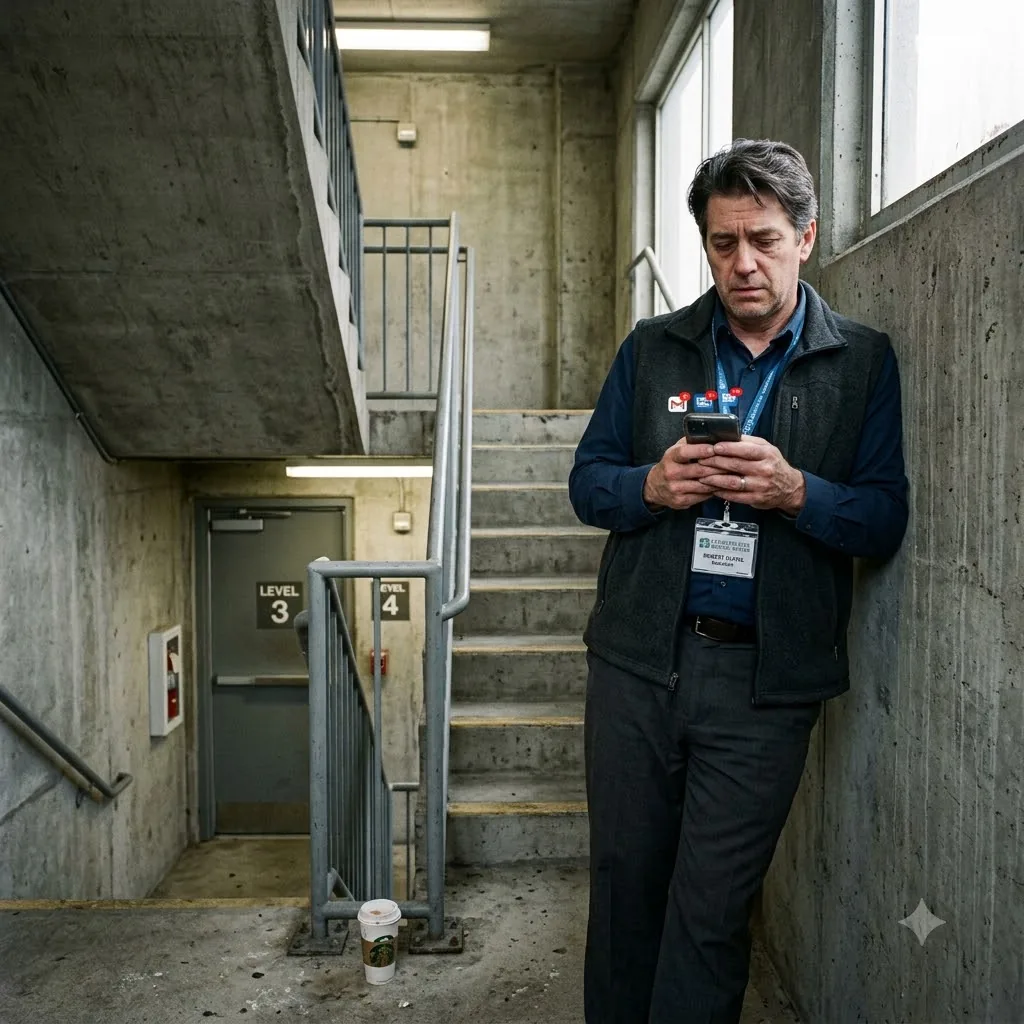
He looked down at his hands. There was still concrete dust in the seam of one thumb from the stairwell rail.
At home, the consequences kept arriving in small mean forms. His mother had answered the partial correction posted later by the hospital with a brittle, hopeful text-So people know now?-as if knowing and believing were the same thing. His sister sent screenshots of comments under a local news update. Some people had deleted their posts. More had only shifted tone, from outrage to suspicion. So why was he laughing then. Why was he in that room. Sounds like they’re all guilty. A neighbor who usually waved from across the street brought in her trash bin without looking at him.
The hospital’s statement came before evening ended. It said an edited video had circulated without full context. It said the employee heard in the clip had been responding critically to remarks made during an internal management session. It said the institution was reviewing both the content of that session and the unauthorized dissemination of footage.
No name-clearing. No reinstatement. No mention of being marched downstairs under guard before anyone checked.
His leave became, in effect, something he had not chosen and could not shape. He was told not to come in while they reviewed departmental climate. Staff who had gone silent on him stayed silent. Melissa sent one final message from an unknown number: They pulled Daniel out of tomorrow’s operations huddle. Then nothing more.
That night Evan sat at the kitchen table after everyone else had gone upstairs. His work phone, now useless, lay dark beside a stack of mail. Through the window he could see the reflection of his own face over the black yard, tired and older than it had looked that morning in the stairwell glass.
The fuller truth had slowed the pile-on. It had turned some eyes back toward the people who had built the room and cut the clip. But it had not restored what the day had taken. His job was still on hold. His name had still gone loose in public. His family had still spent the day carrying a version of him designed for strangers to hate.
He sat there long enough for the refrigerator to kick on and off twice, thinking about how quickly the hospital had counted on one thing above all: that a man publicly shamed would keep quiet if speaking required dragging the whole room into view.
They had nearly been right.