Story code: ST-000337
Part 1: Mara Asked Who Made That Rule
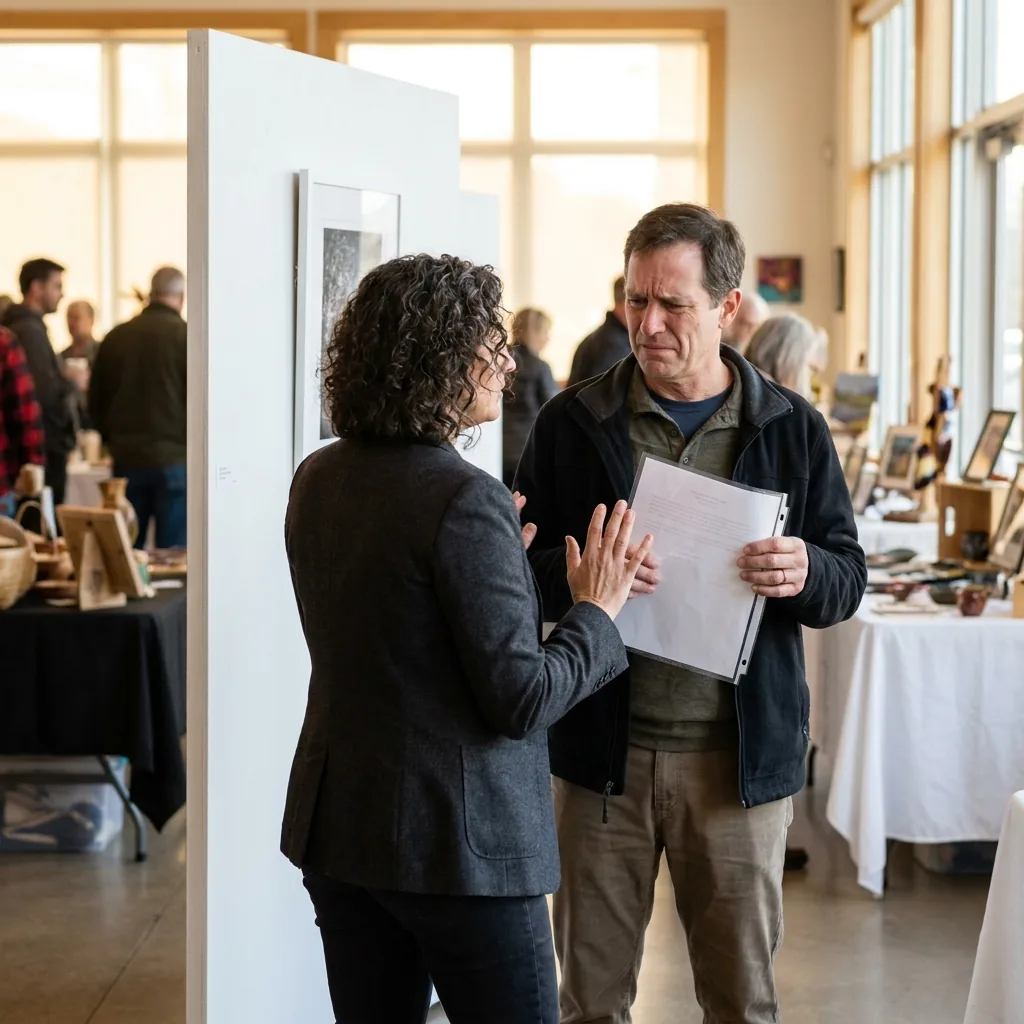
The gallery coordinator looked at the print certificate in my clear sleeve, looked past me to the display wall, and said I was not allowed to stand with my own piece because of a policy she could not show me. Jace Rook stayed near the label while people carried plastic cups through the preview, and Lena Ortiz said the rule applied to AI work only, even after I asked where it was posted. That was the first strange thing: she blocked me from access to my own work with a rule no one at the preview desk could point to.
The preview desk sat just inside the main room, a narrow table with name tags, a stapled checklist, and a stack of folded handouts that listed the evening schedule. People kept moving around us in the ordinary way people move at these events, leaning toward labels, taking phone photos, talking too loudly for a room full of white walls. My framed piece was already up on the display wall under a clean vinyl title line. The certificate in my hand matched the title, the print run number, the generation date, and the output dimensions.
Lena kept one hand on the checklist as if that settled it.
“You can stay in the room,” she said, “just not at the wall with the work until we resolve ownership protocol for AI-generated prints.”
I asked, “Where is that protocol?”
She tapped the checklist.
I asked again, “Is it on the invitation, the artist packet, the wall text, or posted here?”
She said, “It’s our rule tonight.”
That answer had the shape of an answer without being one. I held the clear sleeve up between us. The certificate paper was thick enough to catch the track lights. It showed the source files referenced by hash, the print details, and the registration number from the lab that produced the final archival print. None of that seemed to matter while she was saying the word rule.
Jace did not step in. He stayed where the piece hung, close enough that visitors would assume he belonged there. He had the habit of repeating whatever language was already floating in the room. A man in a navy jacket asked him, “Are you the artist?”
Jace answered, “There are ownership questions getting sorted out.”
That sentence traveled farther than it should have. Two women near the wall turned toward me, then toward Lena, then back to Jace. Daniel Price, the curator, was several feet away talking to a donor. He looked over once when Lena raised her voice, but he did not cross the room yet.
I said, “You’re denying me access to my own piece based on a policy you can’t show me.”
Lena straightened the checklist and said, “I’m following procedure.”
“Which procedure?”
She checked the list again, even though my question had nothing to do with names or arrivals. “The one for AI authorship disputes.”
“Where is it written?”
“It’s what we’re using tonight.”
A volunteer beside the desk pretended to rearrange wristbands. No one produced a binder, sign, email, or page from the handouts. The room had rules for coat check, photography, and bidding on a silent auction piece in the side alcove. Those were all printed. The one rule being used to keep me from my own wall existed only in Lena’s voice.
I stayed where people could see both me and the certificate. I did not lower my voice, and I did not raise it either.
“If the gallery has a rule,” I said, “show me the rule. If the gallery has a process, start the process.”
Jace finally came over, not all the way to the desk, just close enough to enter the conversation without owning it.
He said, “Nobody’s accusing anybody. They’re just being careful.”
I turned the sleeve so he could see the certificate number. “Careful would be reading this.”
He glanced at it and looked away almost at once. “A certificate doesn’t settle prompt origin.”
That was the second strange thing, because Lena had been calling it an access policy, not a prompt-origin policy. The rule had already shifted once.
I said, “So which is it? Am I blocked because AI work needs special handling, or because you think prompt origin controls who can stand by a wall label?”
Lena answered before Jace did. “The point is we can’t have the wrong person presenting the work.”
“Then check,” I said.
A couple standing nearby went quiet. Someone farther back laughed at an unrelated conversation, and the sound made this little circle by the desk feel even flatter. Daniel finished with the donor and started walking toward us.
Lena saw him coming and repeated, “This is standard.”
I asked one more time, clearly enough for Daniel to hear as he approached. “Standard where? On what list? In what packet? On whose wall?”
Daniel stopped at the edge of the desk. Lena opened her mouth, looked down at the checklist, then past me toward the display wall where Jace had already drifted back beside my piece.
And before she named a single source for the rule she had used on me, she said it would also affect anyone else connected to the work in the room.
The gallery coordinator looked at the print certificate in my clear sleeve, looked past me to the display wall, and said I was not allowed to stand with my own piece because of a policy she could not show me. Jace Rook stayed near the label while people carried plastic cups through the preview, and Lena Ortiz said the rule applied to AI work only, even after I asked where it was posted. That was the first strange thing: she blocked me from access to my own work with a rule no one at the preview desk could point to.
The preview desk sat just inside the main room, a narrow table with name tags, a stapled checklist, and a stack of folded handouts that listed the evening schedule. People kept moving around us in the ordinary way people move at these events, leaning toward labels, taking phone photos, talking too loudly for a room full of white walls. My framed piece was already up on the display wall under a clean vinyl title line. The certificate in my hand matched the title, the print run number, the generation date, and the output dimensions.
Lena kept one hand on the checklist as if that settled it.
“You can stay in the room,” she said, “just not at the wall with the work until we resolve ownership protocol for AI-generated prints.”
I asked, “Where is that protocol?”
She tapped the checklist.
I asked again, “Is it on the invitation, the artist packet, the wall text, or posted here?”
She said, “It’s our rule tonight.”
That answer had the shape of an answer without being one. I held the clear sleeve up between us. The certificate paper was thick enough to catch the track lights. It showed the source files referenced by hash, the print details, and the registration number from the lab that produced the final archival print. None of that seemed to matter while she was saying the word rule.
Jace did not step in. He stayed where the piece hung, close enough that visitors would assume he belonged there. He had the habit of repeating whatever language was already floating in the room. A man in a navy jacket asked him, “Are you the artist?”
Jace answered, “There are ownership questions getting sorted out.”
That sentence traveled farther than it should have. Two women near the wall turned toward me, then toward Lena, then back to Jace. Daniel Price, the curator, was several feet away talking to a donor. He looked over once when Lena raised her voice, but he did not cross the room yet.
I said, “You’re denying me access to my own piece based on a policy you can’t show me.”
Lena straightened the checklist and said, “I’m following procedure.”
“Which procedure?”
She checked the list again, even though my question had nothing to do with names or arrivals. “The one for AI authorship disputes.”
“Where is it written?”
“It’s what we’re using tonight.”
A volunteer beside the desk pretended to rearrange wristbands. No one produced a binder, sign, email, or page from the handouts. The room had rules for coat check, photography, and bidding on a silent auction piece in the side alcove. Those were all printed. The one rule being used to keep me from my own wall existed only in Lena’s voice.
I stayed where people could see both me and the certificate. I did not lower my voice, and I did not raise it either.
“If the gallery has a rule,” I said, “show me the rule. If the gallery has a process, start the process.”
Jace finally came over, not all the way to the desk, just close enough to enter the conversation without owning it.
He said, “Nobody’s accusing anybody. They’re just being careful.”
I turned the sleeve so he could see the certificate number. “Careful would be reading this.”
He glanced at it and looked away almost at once. “A certificate doesn’t settle prompt origin.”
That was the second strange thing, because Lena had been calling it an access policy, not a prompt-origin policy. The rule had already shifted once.
I said, “So which is it? Am I blocked because AI work needs special handling, or because you think prompt origin controls who can stand by a wall label?”
Lena answered before Jace did. “The point is we can’t have the wrong person presenting the work.”
“Then check,” I said.
A couple standing nearby went quiet. Someone farther back laughed at an unrelated conversation, and the sound made this little circle by the desk feel even flatter. Daniel finished with the donor and started walking toward us.
Lena saw him coming and repeated, “This is standard.”
I asked one more time, clearly enough for Daniel to hear as he approached. “Standard where? On what list? In what packet? On whose wall?”
Daniel stopped at the edge of the desk. Lena opened her mouth, looked down at the checklist, then past me toward the display wall where Jace had already drifted back beside my piece.
And before she named a single source for the rule she had used on me, she said it would also affect anyone else connected to the work in the room.