Story code: ST-000337
Part 3: The Record Did Not Help the Rule
Lena went through the side gate behind the preview desk and disappeared into the short hall that led to the prep shelves. Nobody treated it like a formal pause. The room kept moving. A server crossed behind us with a tray of sparkling water. Two men in front of the next wall argued about whether a diptych needed more space between frames. At our desk, though, everything had narrowed to the checklist, the certificate in my hand, and the empty place where a rule should have been.
Daniel stayed there.
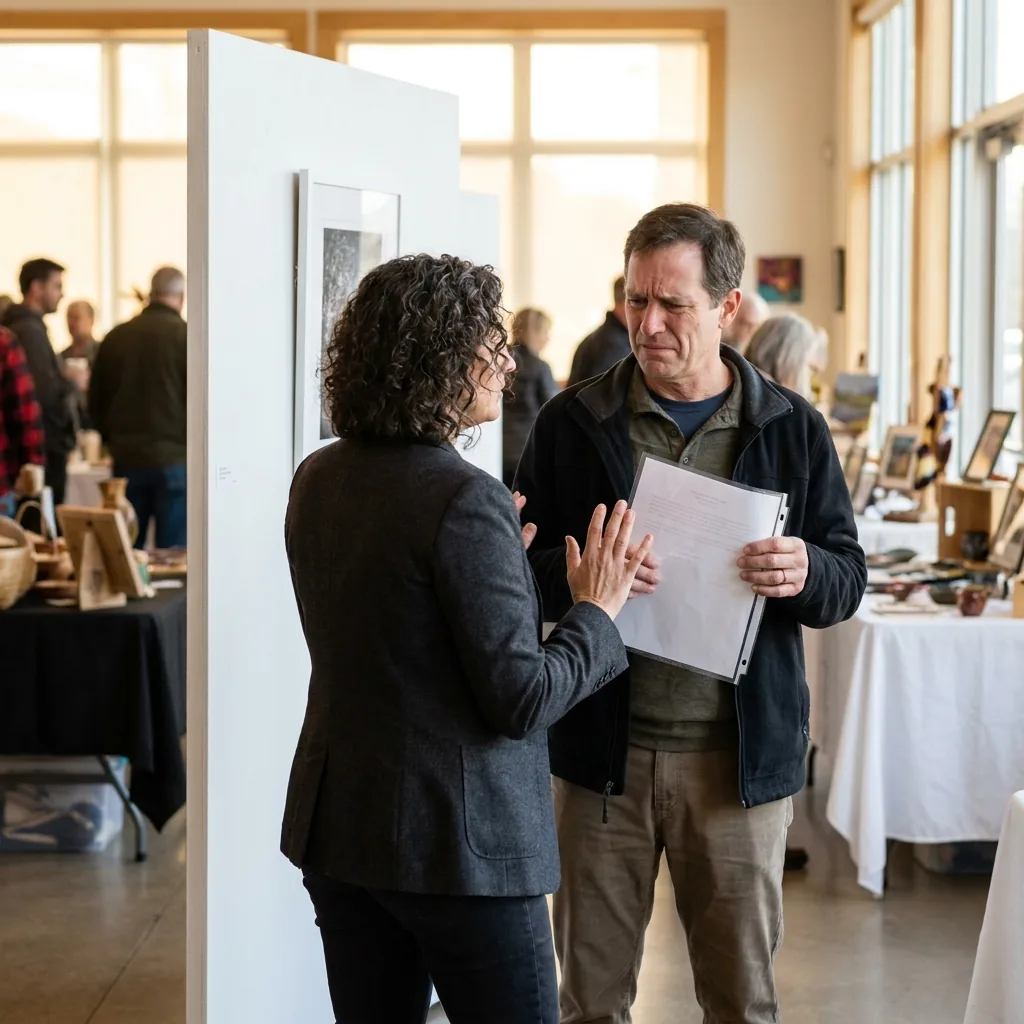
He did not wave people off or clear an area. He just said, “No one presents the piece until I see the intake record.”
That part mattered because he said it while looking at both me and Jace.
Jace gave a quick nod that looked cooperative from a distance. Up close, he kept shifting his weight toward the display wall as if his body had not accepted the instruction yet. He did not say anything for a few seconds. Then he said, “This could have been handled privately.”
I held the clear sleeve against my palm. “It could have been handled by reading the paper before inventing a policy around it.”
He looked at Daniel, not me. “I’m not inventing anything. I raised a concern.”
“What concern?” Daniel asked.
Jace answered with the same foggy wording he had used before. “Prompt origin, authorship chain, that kind of thing.”
Daniel said, “Do you have documentation in the room?”
Jace rubbed his thumb across two fingers, glanced at the wall label, and said, “I have the history of the work.”
“In what form?”
He did not answer that directly. “This piece came out of a collaborative prompt environment.”
That phrase had the same polished sound as Lena’s “ownership protocol.” It filled space without pointing to anything a person could check.
The woman with the red catalog stayed near enough to hear. So did the man in the navy jacket who had first asked who the artist was. Once people realize a rule may not be real, they stop drifting. They listen harder.
Lena came back with a thin folder, one stapled packet, and a single wall tag printout. She put them on the desk too quickly, like setting down hot dishes.
Daniel opened the packet first. It was the standard artist information sheet for the preview: title, medium, dimensions, list price, delivery date, install note. He flipped to the back page. Blank. No addendum. No AI-only restriction. No temporary presentation hold.
Then he read the intake sheet. I could see the piece title and inventory number from where I stood. He ran one finger down the typed fields, then stopped.
“This lists artist materials received,” he said.
Lena said, “Right.”
“It lists wall text confirmation, shipping photos, and print certificate reviewed at intake.”
The woman with the red catalog tilted her head. Jace looked at the refreshment ledge, then back to Daniel.
Daniel lifted the page. “Who checked certificate reviewed?”
Lena said, after a beat, “That would have been at receiving.”
“By whom?”
She leaned closer, found the initials, and named a registrar who was not in the room.
Daniel turned the sheet toward the desk lamp. “Then the certificate was not a problem at intake.”
Lena said, “The concern developed later.”
“Where is that noted?”
She reached for the wall tag printout instead. “The display label can be updated if needed.”
“That is not what I asked.”
He set the intake sheet flat and took the wall record. The title matched my certificate. The dimensions matched. The print run number matched. There was a small line for artist attribution and a small line for source documentation received. Both were filled.
He looked up at me. “Let me see the certificate again.”
I handed it over. Under the track lights, the paper showed every detail it had shown from the start: title, run number, generation date, output size, lab registration number, source file hashes. Daniel compared the line items one by one against the intake sheet and wall record without speaking. That silence did more than a lecture would have.
Then he asked Lena, “What exactly changed after intake?”
She folded her arms, unfolded them, and said, “A claim was raised.”
Daniel turned to Jace. “By you?”
Jace said, “I said there were authorship issues.”
“In writing?”
“I spoke to staff.”
“Do you have any material that matches this piece to your claim?”
Jace’s mouth tightened. “Not on me.”
That was the first time the advantage around him looked dependent on not being checked. The rule had blocked me because I had a document in hand. The room record now showed that same document had already been reviewed before the doors opened.
Daniel set my certificate on top of the intake sheet, perfectly aligned with its corners.
“Then what we have on this desk,” he said, “is a certificate the gallery already logged, a wall record that matches it, and an oral challenge with no record attached.”
Lena said, “We still need to be careful.”
Daniel’s voice stayed even. “Careful means documented. Not improvised.”
He tapped the intake sheet once and looked at Jace.
“If you want the gallery to act on your claim,” he said, “you can now put your name to it in the event record before this preview continues.”
Jace stopped moving altogether.