Story code: ST-001114
Part 2: The Variable
Through the glass, the manicured green of the lawn was interrupted by a chaotic splash of denim, safety yellow, and crushed hostas. Hector lay on his back, his right leg folded beneath him at an angle that defied human anatomy. A spiderweb of red was already spreading across the pristine white concrete of the driveway, leaking from a dark gash above his ear.
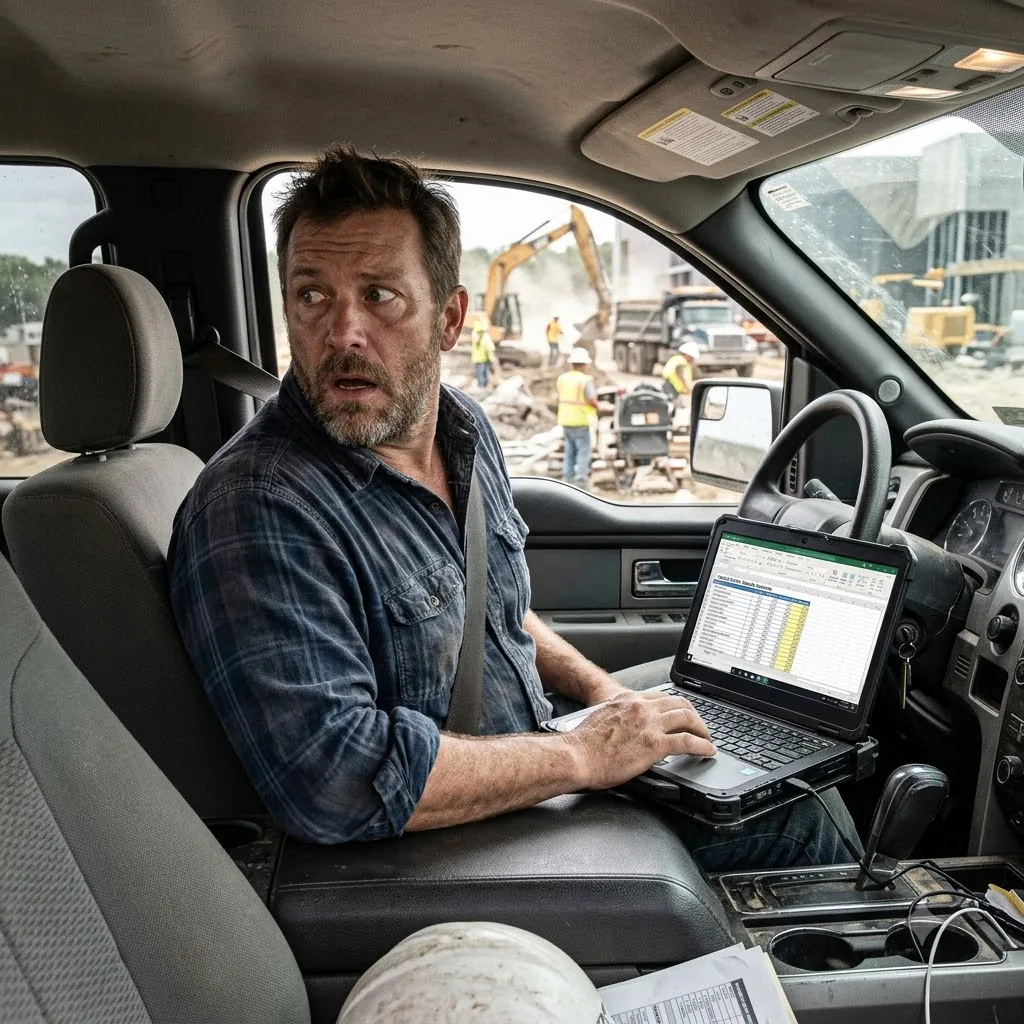
Arthur didn’t breathe. His hand remained suspended above the laptop trackpad. The spreadsheet on the screen was a neat, orderly matrix of black numbers, but right outside his door, the physical consequences of cell C14-‘fall protection harnesses’-were bleeding into the mulch.
Footsteps thundered on the plywood decking above. The aluminum extension ladder propped against the gutters rattled violently as the remaining three men scrambled down, abandoning their tools. Their boots hit the grass with heavy thuds, a frantic staccato that broke the suffocating silence.
Arthur opened the truck door. The blast of July heat hit him like a physical blow, carrying with it the sharp scent of melted asphalt and the metallic tang of fresh blood. He stepped out, his air-conditioned khakis clinging instantly to his sweating legs. He didn’t run. He walked with the measured, deliberate pace of a manager approaching a bottleneck on an assembly line. Panic didn’t solve logistical failures; containment did.
The three roofers surrounded Hector. They were yelling over each other in rapid, terrified Spanish. One of them, a young kid named Mateo whose name Arthur only knew because it was spelled wrong on the payroll sheet, dropped to his knees. Mateo grabbed Hector’s shoulders, shaking him. Hector’s head lolled lifelessly to the side. A wet, bubbling groan escaped the injured man’s lips, followed by a cough that sprayed a fine mist of red onto Mateo’s shirt.
“Don’t move him,” Arthur barked.
The command came out with the authoritative crack of a corner-office executive, silencing the men for a fraction of a second.
Arthur stared down at Hector. The roofer’s eyes were half-open, rolled back so only the whites showed. His chest was rising and falling in shallow, erratic jerks. Arthur’s mind, trained to process disasters in terms of quarterly losses and mitigation strategies, immediately began to compile a damage report.
An ambulance. That was the standard operating procedure. A 911 call meant paramedics. Paramedics meant an incident report. An incident report meant the Occupational Safety and Health Administration. OSHA would ask for the site safety log. They would ask for the fall protection gear. They would interview the crew. They would impound the records. They would look at the laptop sitting on the console of the Ford F-150.
They would see that Arthur had deliberately deleted the scaffolding and the harnesses twenty minutes before a man plummeted twenty feet onto the concrete.
Criminal negligence. Manslaughter, if the wet, rattling sound in Hector’s chest stopped. The razor-thin black margin on his screen would transform into a prison sentence. His house would be repossessed by the bank within sixty days. His entire life, already hanging by a frayed thread, would snap completely.
Mateo reached into his pocket and pulled out a phone with a shattered screen. His thumb hovered over the keypad. “Ambulancia,” he said, looking up at Arthur with wide, panicked eyes. “Police.”
The word ‘police’ echoed in the humid air.
Arthur looked at the other two men. They were staring at him, waiting for the project manager to manage. They were undocumented, paid in cash, invisible components of the machine. The word ‘police’ terrified them just as much as it terrified him, albeit for entirely different reasons.
“No,” Arthur said, stepping forward. “No police.”
Mateo blinked, confusion warring with the terror on his face. He pointed at Hector’s head, where the blood was now pooling into the dirt. “He die, boss. He need doctor.”
“I know,” Arthur said. He forced his voice to remain calm, steady, projecting a false certainty. “If you call an ambulance, the police come. They will ask for your papers. They will shut down the site. No one gets paid. The boss will fire everyone.”
He was weaponizing their vulnerability to shield his own. It was a hostile takeover of a crisis.
The two older men exchanged a rapid, nervous glance. They took a half-step back from Hector, the threat of deportation and lost wages acting as a powerful repellant. Mateo stayed on his knees, his thumb still hovering over the cracked glass of his phone screen, torn between loyalty to his bleeding coworker and the existential threat of the authorities.
“I will take him,” Arthur said, closing the distance and kneeling in the blood-soaked mulch. He ignored the way the wet dirt stained his trousers. He was committed now. “In the truck. We take him to the emergency room down the highway. I will drop him at the door. No questions. No police at the job site.”
It was a calculated gamble. If he dropped Hector at the hospital and drove away, he could return, scrub the spreadsheet, buy three cheap harnesses from the hardware store, and throw them in the dirt. He could say Hector was drunk-he had the beer bottle behind the garage as proof-and wasn’t wearing his provided gear. He could isolate the liability. He could save the margin. He could save himself.
“Help me lift him,” Arthur commanded.
Mateo hesitated, then slipped his phone back into his pocket. The algorithm of self-preservation was universal.
Together, the four men awkwardly hauled Hector’s limp, heavy body off the ground. Hector screamed-a sudden, piercing sound of agony as his broken leg shifted-before passing out completely. Arthur felt the warm, sticky seep of blood soaking through his own shirt sleeve where he gripped Hector’s torso. It was revoltingly intimate. The friction in his spreadsheet had weight, heat, and a failing pulse.
They dragged him to the passenger side of the F-150. Arthur yanked the door open, shoving his laptop roughly into the center console to make room. The screen briefly woke up, illuminating the cab with the bright white grid of the budget. Cell C14 stared back at him, blank and empty.
They wrestled Hector into the passenger seat. His head slumped against the glass, leaving a thick red smear. Arthur slammed the door shut, locking it from the inside.
“Go back to work,” Arthur told the men, wiping a bloody hand on his khakis. “Clean up the mess. Do not stop tearing off the roof. If the owner comes, tell him I went for materials.”
He didn’t wait to see if they obeyed. He sprinted around the front of the truck, his heart hammering against his ribs like a trapped bird. He threw open the driver’s door and climbed in. The air conditioning blasted Hector’s blood smell directly into Arthur’s face.
He put the truck in reverse, his foot trembling on the brake pedal. He just needed to get out of the neighborhood. He just needed to contain the variable.
Arthur looked in the rearview mirror, preparing to back out of the driveway.
Blocking the apron of the driveway, a black Silverado with the roofing company’s logo emblazoned on the side had just shifted into park. The company owner, a man who fired people for being five minutes late, stepped out of the cab, carrying a clipboard and a scowl, looking directly at Arthur’s truck.