Story code: ST-001114
Part 3: The Margin
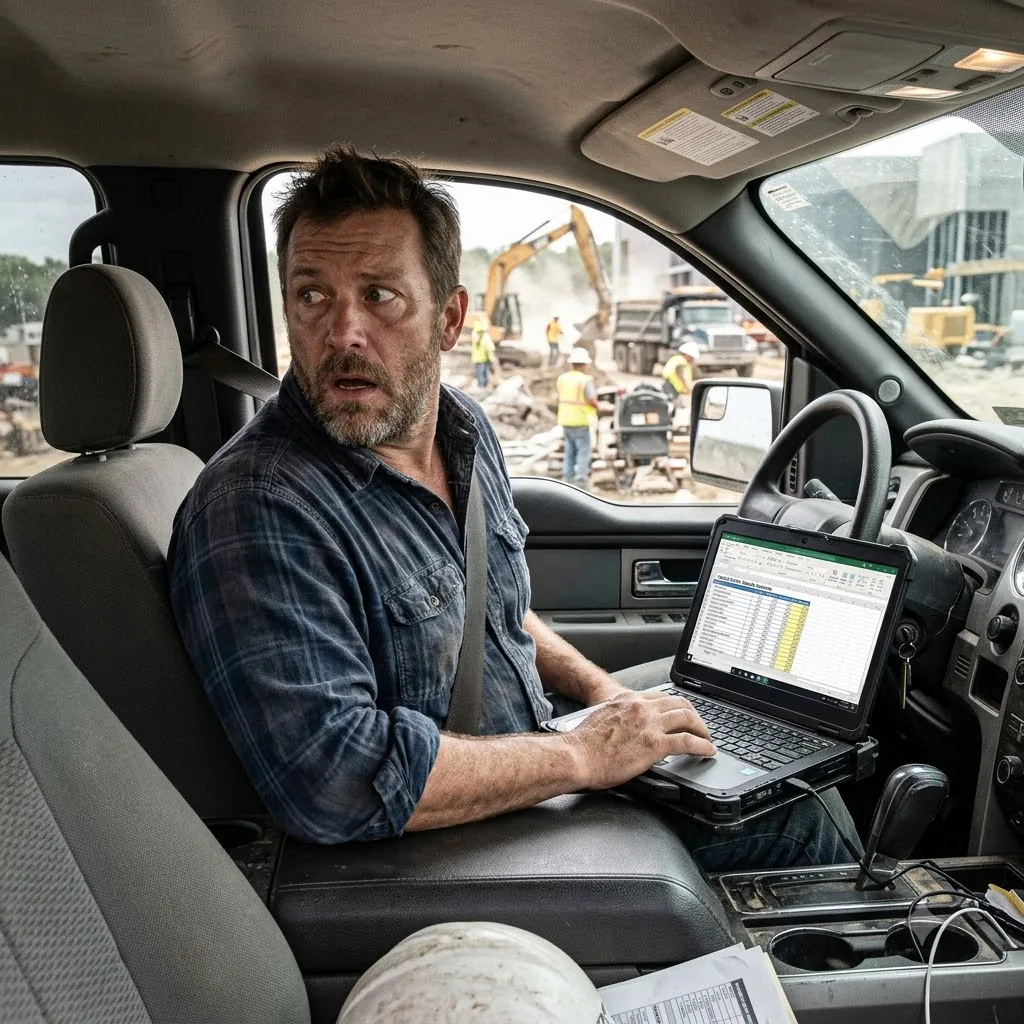
Arthur kept his foot planted on the brake pedal, the F-150 vibrating beneath him. In the rearview mirror, Marcus Vance, the owner of Vance Contracting, marched toward the truck. Vance was a man built like a cinderblock, wearing a polo shirt stretched tight over a barrel chest. He didn’t look angry; he looked intensely, dangerously inconvenienced.
Arthur’s hand hovered over the door lock. Beside him, Hector let out a ragged, gurgling breath, his head lolling against the blood-smeared passenger window. The copper smell of him was overwhelming in the enclosed cab.
Vance reached the driver’s side and rapped his knuckles sharply against the glass. Arthur rolled the window down exactly two inches. The blast of humid air felt suffocating.
“Why are my guys standing on the decking looking like they just saw a ghost?” Vance demanded, his voice a low, gravelly bark. “And why aren’t the nail guns running?”
“There was an incident,” Arthur said, his corporate-trained voice shaking. “A fall.”
Vance’s eyes darted from Arthur to the passenger seat. He took in the sight of Hector’s folded leg, the soaked collar of his shirt, and the alarming volume of red pooling on the vinyl seat. Vance didn’t flinch. He didn’t shout. His expression simply flattened into a mask of grim calculus. It was a look Arthur recognized intimately from a hundred boardroom meetings.
“Is he breathing?” Vance asked.
“Barely,” Arthur said. “I’m taking him to the hospital. I had to get him off the property before-”
“Shut up,” Vance snapped. He leaned closer to the two-inch gap. “You are not taking him to a hospital. You take him to an ER, they call the cops. The cops call OSHA. OSHA asks for the safety logs, which I know you’ve been butchering to juice your site margins.” Vance’s eyes flicked down to the laptop wedged in the center console. “You think I don’t know why my material costs are down twenty percent? I don’t care how you do the math, Arthur, but I care if I get caught for it.”
Vance dug into his pocket and produced a thick money clip. He peeled off five one-hundred-dollar bills, folded them in half, and shoved them through the crack in the window. The money fluttered onto Arthur’s lap.
“There’s a cash-only clinic off Route 41 in Hammond,” Vance instructed, his tone entirely conversational. “Run by a guy named Gault. He lost his medical license a decade ago, but he sets bones and sews people up without asking for Social Security numbers. You give him that cash. You leave the Mexican at the back door. Then you come back here, you hose off the driveway, and you buy whatever harnesses you need to make this site look legal. Understood?”
Arthur stared at the crumpled bills on his khakis. “Hammond is forty minutes away. He’s bleeding from the head, Marcus. He might not make it forty minutes.”
“Then drive fast,” Vance said. He slapped the door panel twice. “Fix your mess, Arthur. Or the authorities will find out exactly who signed off on the safety budget.”
Vance turned and walked back to his Silverado, entirely unbothered by the dying man in the truck. He got in and backed out of the apron, clearing the path to the street.
Arthur shifted the truck into drive. His hands were slick with sweat and blood. He eased out of the driveway, the tires crunching over the discarded shingles in the grass.
*Forty minutes.* If Hector died in the cab, Arthur could just leave him at the clinic anyway. Gault would dispose of the problem. Vance’s logic was airtight. It contained the liability. It protected the margin. It kept Arthur out of prison and in his house. It was exactly the kind of ruthless, clinical decision-making that had made Arthur a senior vice president before the crash.
He accelerated down the suburban street, turning toward the highway on-ramp. Hammond was straight ahead.
Hector convulsed slightly, a wet cough spraying a fresh mist of crimson onto the dashboard. The sound was horrifying-a mechanical failing of human lungs.
Suddenly, the smartphone mounted on the air vent chimed, cutting through the heavy silence. The screen lit up with a Google News alert. Arthur had set the notification eighteen months ago, a masochistic digital tether to the logistics firm that had unceremoniously fired him to appease their shareholders.
He glanced at the screen.
*MARKET WATCH: OmniLogistics Reports Record Q2 Margins; Stock Surges 14% Following Aggressive Restructuring.*
Arthur’s breath caught in his throat. He stared at the bold black text. *Aggressive restructuring.* That was him. He was the restructuring. Eighteen months ago, an executive looking at a spreadsheet had highlighted Arthur’s twenty-year career, pressed delete, and watched the margin turn a razor-thin positive. They hadn’t seen his mortgage. They hadn’t seen his daughter’s college tuition. They had only seen the friction in the machine.
Arthur looked at the five hundred dollars sitting on his lap. He looked down at his own laptop glowing in the center console, displaying the exact same kind of spreadsheet. Cell C14. Fall protection. Zero.
He looked at Hector. The roofer’s eyes were completely rolled back now, his chest barely moving. Hector was the fat being trimmed. And Arthur wasn’t the victim of the machine anymore. He was the executive pressing delete. He was Vance, handing cash through a window to cover up the blood. He had rebuilt the exact same algorithmic slaughterhouse that had destroyed him, just on a smaller scale, with cheaper materials and higher human stakes.
The truck approached the major intersection at the end of the off-ramp. Above the traffic lights, a massive green sign dictated his future. Straight ahead: *Route 41 South – Hammond.* To the right: *County General Hospital – Emergency – 2 Miles.*
The light turned yellow. If he went right, the hospital would save Hector. Then the police would come. Then OSHA. Then Vance would burn him. The spreadsheet would crash. The bank would take the house. The math was indisputable.
“Boss,” Hector breathed, a faint, terrified whisper escaping his bloody lips.
Arthur stared at the green sign for Hammond. He gripped the leather steering wheel, the blood on his palms acting like a terrible adhesive.
The light turned red.
Arthur slammed his foot onto the accelerator. The V8 engine roared, the heavy truck surging forward into the intersection. He didn’t go straight. He violently jerked the steering wheel to the right.
The tires shrieked in protest, burning rubber against the asphalt as the F-150 pitched hard into the turn. The lateral force launched the laptop from the center console. It smashed screen-first into the passenger-side floorboard, the glowing grid of numbers fracturing into a jagged web of dead pixels and black glass.
Arthur kept his foot buried in the floor, the speedometer climbing as the blue H sign of County General Hospital appeared on the horizon.