Story code: ST-000582
Part 2: The Tag Started Telling On Her
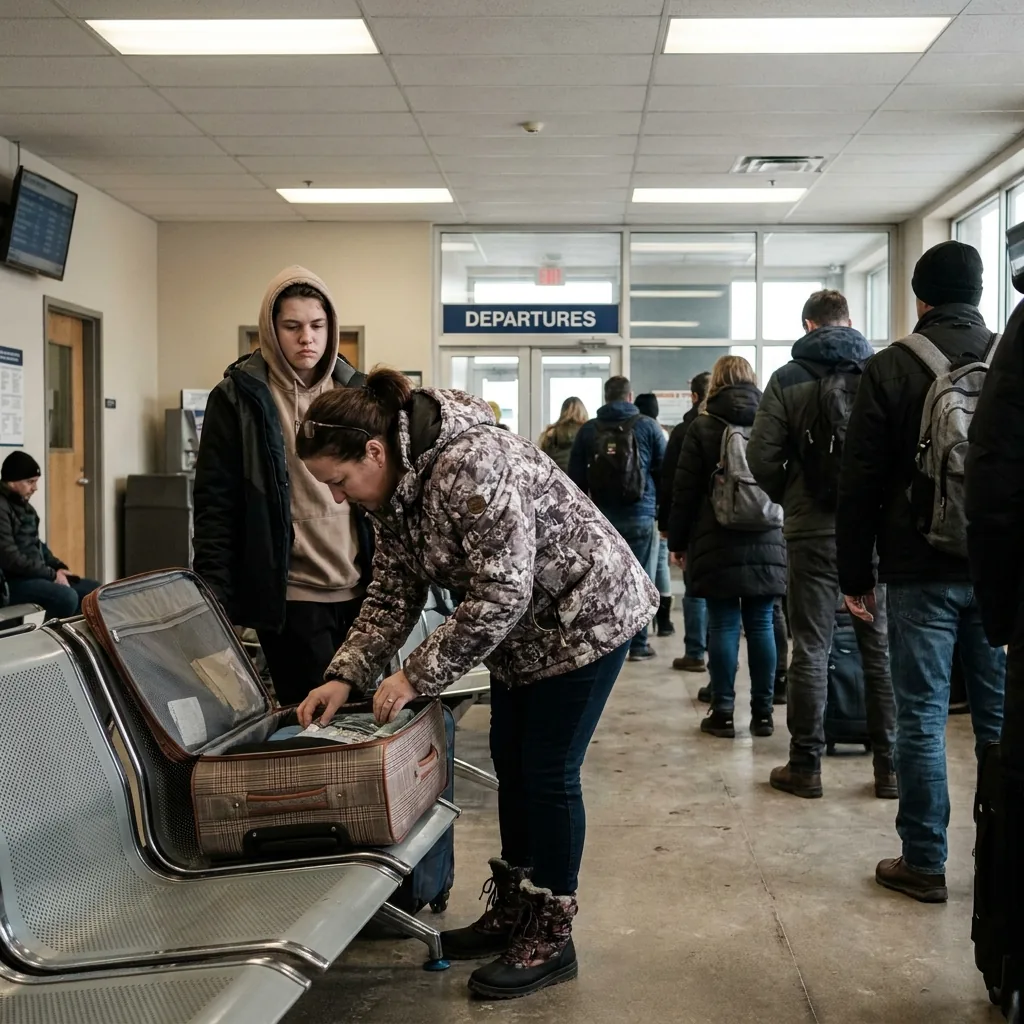
By the time the line tightened at the boarding rope, Dahlia Vega had already shifted from grabbing the suitcase to defending the grab, and that change is what made the proof start to show. Marisol was not arguing over a loose handle in a crowded bus station; she was checking a hard-shell case at the private threshold of departure because the tag and zipper line no longer matched the way she had packed them. Once Nico and the station employee fixed the timing, Dahlia’s version got smaller and smaller.
Part of what made the scene tense was that nobody wanted to turn a family sendoff into a public spectacle. You could see that in how Marisol kept her voice level and in how Nico hovered half a step back, looking from one adult to the other before answering anything. But the lane itself was doing its own work. Boarding compresses time. People remember positions because everyone is trying not to lose theirs.
Tanya Brooks remembered the order in practical terms. Passenger with the gray hoodie first. Woman with two kids next. Marisol with the silver hard-shell suitcase after that, not yet at the scanner point because there was a delay over a carry-on size check. Dahlia was not in line to travel. She was alongside the barrier, close enough to speak into Marisol’s shoulder and reach toward the bag if she wanted. Tanya had already told one family behind them, “Only the passenger takes property through from here.” That was standard station language, and she used the same tone with everybody.
When Marisol asked again, “Did you open anything?” Dahlia switched from “helping” language to rules language.
“I was making sure your tag was visible.”
“Then why is it under the handle?”
“Because you had it wrong.”
The problem with that answer was the bag itself. Nico had seen Marisol check the tag back at the seats. He said so carefully, without adding anything extra. She had looked at the printed name side, flattened it, and set the suitcase by her ankle. Then he had walked toward the vending machine. When he looked back, Dahlia was bent over the case with one hand at the tag and the other low near the zipper side.
He did not say he saw the suitcase opened. He did not claim what he could not claim. He only gave the positions and the sequence. That restraint made his account harder to brush aside.
Marisol tested the zipper again, this time at the corner nearest the tag loop. She did not pull it open. She pressed two fingers into the seam and looked at the slight gap where the teeth had not fully reseated on the first pass. That is a small detail, but it matters. A bag can be closed and still show a disturbance if someone has worked the edge and forced it back fast. The tag was looped in a way that crowded that same corner, almost like it had been in the way and then shoved into place.
Dahlia kept talking while Marisol checked. “You are making this bigger than it is.” “People are staring.” “You always do this right when it matters.” None of those statements answered the physical question sitting right there in Marisol’s hands.
Then Tanya added one clean piece of process, not as a judge, just as a witness to the lane. She said, “Ma’am, once the passenger has possession of the bag, family needs to let go of it.” She pointed to the other side of the barrier as she said it. No lecture. No intervention speech. Just station procedure.
That should have ended the touching. Instead, Dahlia reached once more, not for the handle this time but for the tag itself, and Marisol pulled the suitcase back so sharply the wheels clicked against the floor seam. A man behind them looked away on purpose. That is how public discomfort shows up in places like that. Not gasps. Not speeches. People suddenly studying the ceiling monitor because they know a line has already been crossed.
The first visible harm was not a missing object anyone could name right there at the rope. It was the fact that Marisol no longer had clean control over the packed space that represented her move, her room, her clothes, the ordinary private things nobody should have to defend in front of extended family. She stopped letting the suitcase stand between them and moved it fully behind her calves, body blocking it now.
Nico then repeated the sentence Dahlia had used earlier in the seating area: “If they stop you at the gate, don’t say I didn’t try to help.” When he said it, Dahlia cut her eyes toward him so fast even Tanya noticed and paused mid-gesture. It was not proof by itself. It was support. Same phrase, same timing, same person nearest the bag before the tag turned inward and the zipper corner started showing disturbance.
Marisol looked from the twisted tag to Dahlia and asked one last question that nobody answered directly: “Why would you need to fix a tag that was already flat unless you needed a reason to keep your hands there?”
Tanya called for the next passenger. The lane moved. Dahlia stepped back half a pace, but not before saying, “Go, then,” in a voice that had lost its earlier certainty. Marisol took her suitcase through without opening it in public.
And that was where Part 2 left the real pressure: the tag, the timing, and the repeated reach had narrowed the access path until it pointed almost entirely at Dahlia, but Marisol still had not said the worst part out loud at the gate-so what exactly was she about to find once she checked that suitcase somewhere private?