Story code: ST-000080
Part 2: What the Postcard Knows
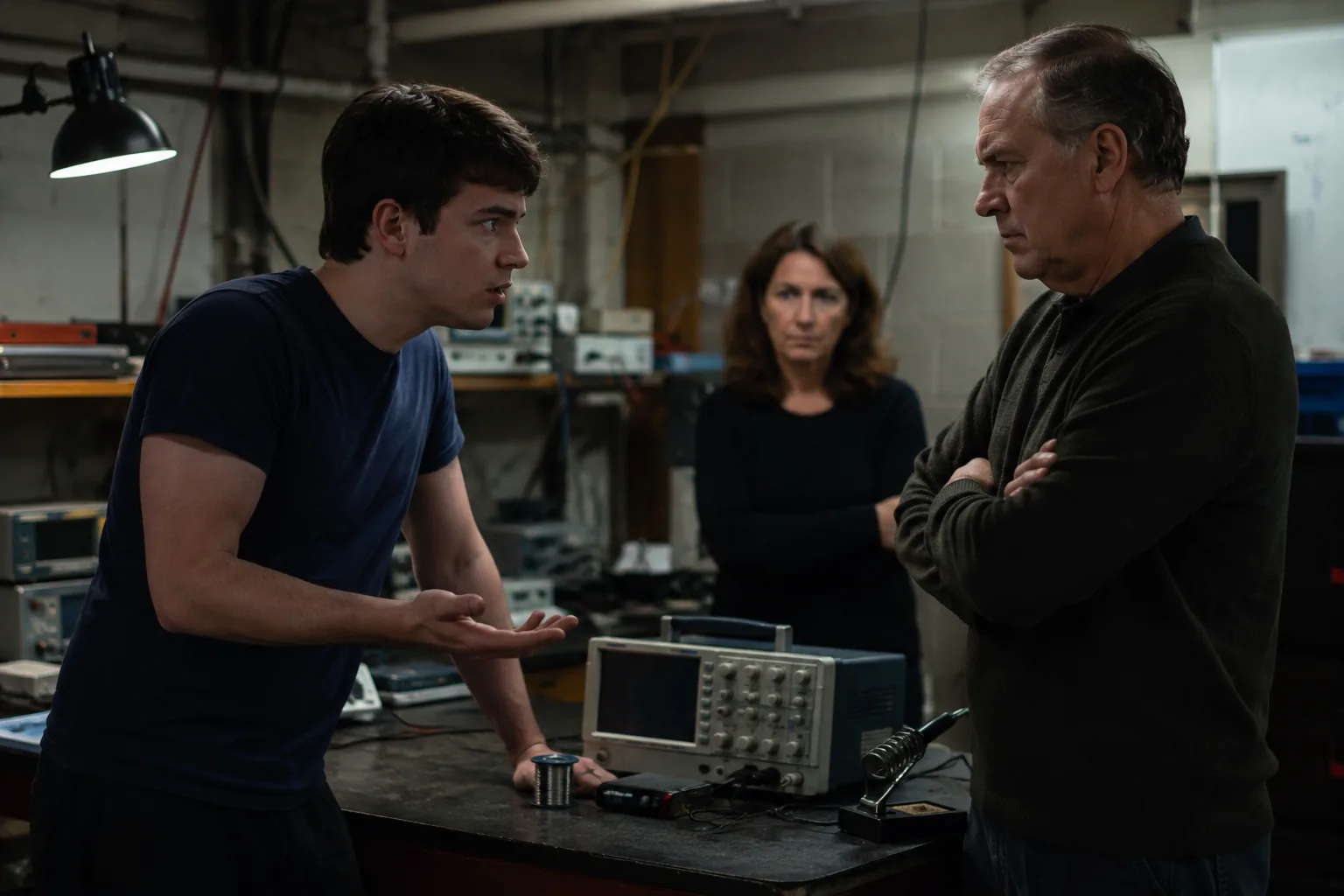
I kept the postcard in my palm while I finished reattaching the sensor housing, because letting Evan see me set it down felt like giving him the next move. The basement was still busy in the ordinary way that makes a bad conversation harder to stop: a fan rattling near the furnace, Doris stacking folded tarps on a table, the washer shifting against the floor with every spin. Evan stayed close enough to make his point without needing to raise his voice.
“You’re making this harder than it is,” he said.
“I’m not making anything,” I said. “You brought a postcard from the future into a basement and told me I owed you for a favor I haven’t verified.”
He gave a short laugh that had no humor in it. “There it is. You always want to make it sound complicated.”
“It is complicated.”
“It’s simple,” he said. He nodded at the postcard in my hand. “You were the one who needed me. I covered for you. I pulled you out before it got ugly. That’s all this is.”
Doris looked over from the folding table. “What got ugly?”
Evan did not answer her. He kept his eyes on me and said, “You know exactly what.”
I did not, and I said that too.
So he pointed at the postcard again, slower this time, like the paper itself was supposed to persuade me. “Read the address,” he said.
I did. The return address was a house on Birch Street, two towns over. The postmark was legible. So was the handwriting. On the lower edge of the card, where the ink had pressed a little harder, was a tiny grease stain shaped like the crescent wrench hanging from our tool wall. I knew the wrench. I had used it this morning. That same morning.
Then I saw the timestamp on the back more clearly. It was not just future-dated. It was dated for the night of the basement storm shutoff, the night Doris lost power to half the house and Evan had been down here with a flashlight and a ladder. I knew that because I had been here for that part. I had been the one holding the lamp while he got into the panel.
I turned the postcard over again and read the message a second time: thanks for letting me borrow your time.
That line hit different when I looked at the ladder leaning by the wall. The rubber feet had plaster dust on them. There was a scuff on one rung at shoulder height, fresh enough to catch the fluorescent light. That was the height where someone would steady themselves if they were reaching into the crawlspace hatch.
I walked to the hatch and looked up at it. The hinge pin was out by a fraction, enough that it had started to pull. Nobody had said anything about the crawlspace yet. Nobody had opened it while I was watching. But there was a streak on the edge of the frame, same white plaster, same fresh scrape.
I asked Evan, “What did you go up there for?”
“Nothing you need to worry about.”
“That’s not an answer.”
“It is if you trust me.”
Doris set the folded tarps down harder than she meant to. “He said he was checking the line,” she said, and then, after a pause, “That’s what he told me.”
I looked back at the postcard, then at the hatch, then at Evan’s boots. The card from the future was not sitting there like proof anymore. It was sitting there like a label on a box I had not opened yet, and the label pointed backward at the exact night Evan said he had saved me.
Except the dust on his boots matched the crawlspace now, not the night I supposedly needed saving, and the blue tape on the repaired bracket was mine, not his. If he had already pulled me out of a mess, why did every visible thing in the basement point to him going in first?