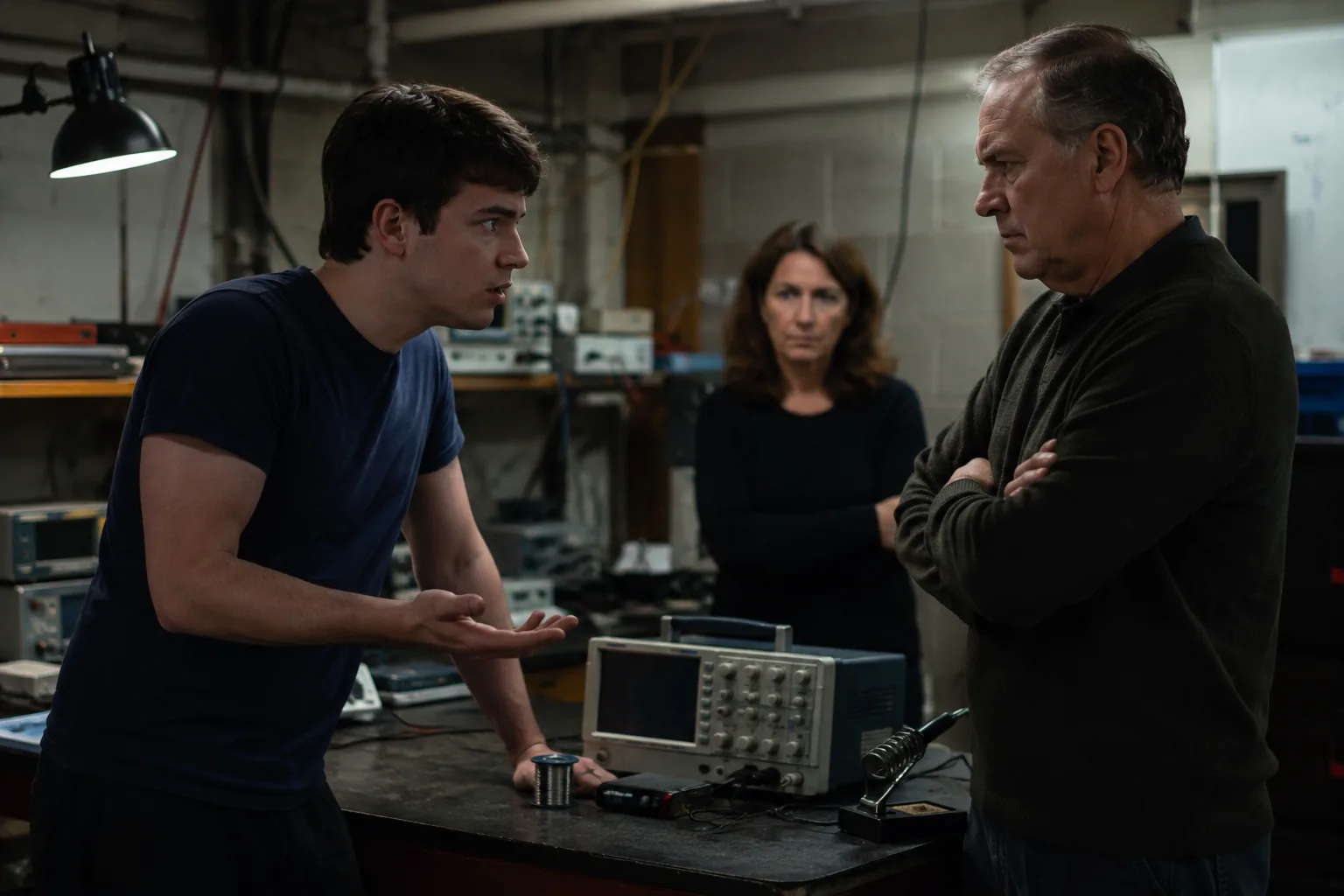
Story code: ST-000080
Part 4: The Lock I Changed
I did not raise my voice.
I slid the postcard into the plastic parts sleeve taped to the side of the workbench, right beside the spare fuses and the label maker tape, and I took the basement key off the nail by the steps. Evan watched me do it. So did Doris.
“What are you doing?” he asked.
“Ending the part where you use this room as leverage,” I said.
He took one step toward the steps. I held up the key but did not hand it over. The key was old brass, the kind that fits the basement lock with a hard click. I had used it enough times to know how it felt in my palm, how it dragged cold against the skin.
Doris looked between us. “Maya?”
“I am changing the basement lock,” I said. “Tonight.”
That got Evan’s attention fast. “You can’t just do that.”
“Watch me.”
He gave me the same tight smile he had worn all afternoon, but it had gone thin around the edges. “This is ridiculous. I helped you. You know I did.”
I reached into the drawer under the bench and pulled out the small box where we kept spare hardware. The new deadbolt cylinder had been sitting there since last month, still wrapped in paper. I had bought it when the side door started sticking. I had not put it in because I had not needed to. Until now.
Doris said, “If you’re changing it, do it right.”
She said it like she was talking about a leaky valve, and maybe that was the only way to keep the room from turning into a show.
I took the old cylinder out of the basement door with the screwdriver, one screw at a time. Metal scraped. The spring caught, then gave. Evan stood there with his hands open at his sides, watching each piece come free. Nobody touched him. Nobody yelled. The washer kept spinning upstairs. The fan kept buzzing by the furnace.
When the new cylinder went in, it caught on the first turn. Clean. Solid. The key turned without a hitch.
I handed the spare key to Doris instead of Evan.
“Maya,” he said, softer now.
“No,” I said. “You do not get the spare. You do not get to keep calling a favor a debt when the card says you were the one who needed the ladder.”
He looked at the workbench, at the sleeve with the postcard inside it, at the new lock, and then at the basement steps. The only thing he did after that was stand still.
Doris took the key and slipped it into her pocket. “I’ll keep it,” she said.
That was the changed boundary. Not a speech. Not a scene. Just a key leaving his reach.
I tested the lock twice, then shut the basement door behind me until the latch caught. The click sounded small, but it changed the whole frame. Evan was still on the other side of the door, still in the basement, still in the house, but he was no longer standing in the path between me and the room.
I came back down one more time only to pull the postcard out of the sleeve and put it in a box with the broken sensor bracket and the blue tape roll. Then I closed the box and locked it with the new key.
Doris did not ask me to explain it again. She only said, “You want the shelf cleared now?”
“Yes,” I said.
So we moved the shelf. We stacked the bins. We kept working. Evan did not get the last word. He did not get the room. He did not get the debt.
By the time I carried the last toolbox to the top step, the new lock was set, the spare key was gone from his reach, and the postcard was sealed away where his version of the night could not reach it anymore. That was enough. It left a hard edge in my chest and a clean line through the door, and I could finally breathe around it.