Story code: ST-000381
Part 2: No Thursday Window
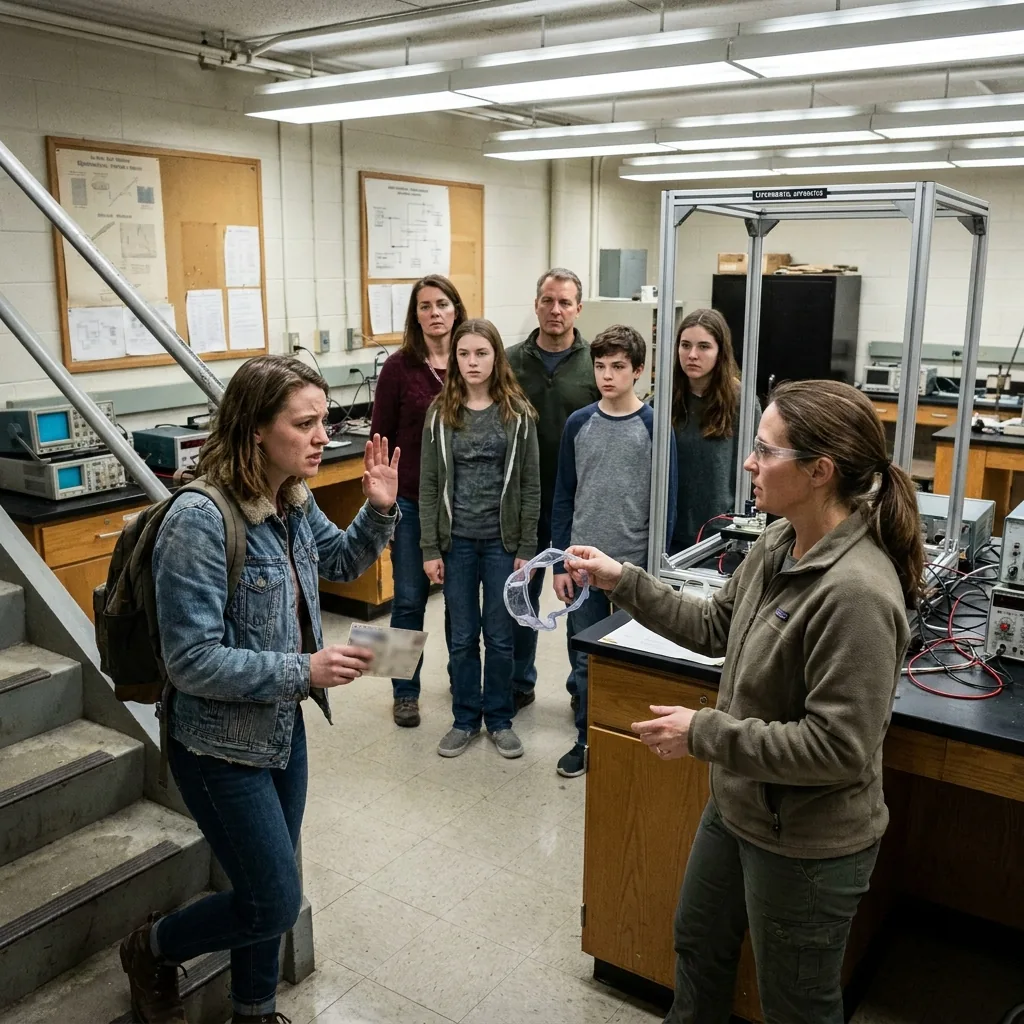
By the time Professor Rusk stepped in front of the demo table, the damage was already out in the room. Leah had said “my cousin stole a day from me” in a public physics basement with a future postcard in her hand, and people were still treating Nora Bell like the machine might answer for her. The schedule board behind Eli Navarro now had a clear blank where Leah’s story needed a Thursday send window, but the crowd had heard the accusation first, and that was still doing most of the work. Professor Rusk lifted one palm. “Nobody adds details. We use what is visible in this room.” That should have slowed things down. It did not stop the whispering by the stair door or the pair of visitors inching closer to see the postcard again. Leah faced the room instead of the professor. “The board changes,” she said. “Everyone here knows it changes. Nora runs half these demos. She knows how to make things disappear.” Nora stood with both hands flat on the folding table, not gripping the edge, just resting them there beside the labeled bin of cable ties and the tray of safety badges. “I can erase dry-erase marker,” she said. “I cannot erase a postal cancellation.” Eli heard two different reactions to that. Someone behind him gave a quick breath like the point had landed. Somebody else said, “Unless she mailed it later.” The room was now doing what public rooms do when they want the first exciting version to survive: offering Leah extra arguments she had not needed to make herself. Professor Rusk took the postcard back and held it under the task lamp. “No one is mailing anything later if the claim is that this object proves a future send from my basement. The object has to survive its own details.” That line made the visitors go quiet for a second. Leah moved closer. She kept one hand half raised, fingers opening and closing like she wanted the card back. “Read the message again,” she said. “She signed her name. Ask her why she wrote to me. Ask her why she knew I was missing a day before it happened.” “Say the relationship out loud,” a student near the corridor called. “How do you know each other?” Leah answered before anyone else could. “She’s my cousin.” That changed the room again. Family made the accusation feel older, deeper, more informed. Eli could see it happen in faces that had not made up their minds a minute earlier. A stranger accusing Nora might have looked theatrical. A cousin saying it in a basement that housed an actual time-transfer rig sounded like the kind of ugly truth people claim they can always spot. Nora did not reach for the card this time. “Yes,” she said. “She’s my cousin. That still doesn’t create a Thursday window.” Professor Rusk pointed at the schedule board. “Eli. Read this week’s windows exactly as written.” He uncapped the marker still in his hand, then realized he did not need it. He read the board instead. “Tuesday, fourteen-twenty. Friday, nine-ten. Saturday maintenance receive-only test. No Thursday listed.” “Read next week,” Leah said fast. He read next week. Then the week after. The board showed correction marks, initials, and one crossed-out Sunday calibration, but no Thursday public send at all. Leah gave a small shrug that looked too quick to be casual. “Then it was private.” Professor Rusk’s voice sharpened. “There are no private sends without my authorization, and not during public hours.” Nora finally stepped away from the table and moved to the peg rail where access lanyards hung. She did not take one down. She only pointed at the color tags. “Every authorized send requires two people in the bay and an active rig key. Public staff wear blue tags. Faculty carry red. Visitors get yellow. Leah, what color tag did I have the day you think this happened?” Leah looked at her, then at the lanyards, then back at the crowd. “I wasn’t taking inventory of your neck.” Eli noticed that answer because it skipped the simpler route of naming a color at random. One of the middle-school kids tugged his mother’s sleeve and said, not quietly enough, “But she said she saw her do it.” The mother hushed him, but not before half the room heard. Professor Rusk asked, “Did you see Nora send this object or not?” Leah’s chin lifted. “I saw what she took from me.” “That is not the same answer,” Nora said. The task lamp buzzed. Somewhere behind the shield partition, the rig let out its usual clicking cooldown sequence, a sound everyone in the basement knew. Eli looked from the postcard to the machine housing. The postcard’s paper had a soft wave along one edge, not the brittle curl he saw in anything left near the vents for long. The cancellation stripe on the stamp was clear enough now under the lamp to read the station code from the town post office above the river, the one that processed morning walk-in mail. He said, carefully, “If it came through the rig first, somebody still put it through regular mail after that.” Nobody answered him right away. That silence did not clear Nora. It only changed the pressure. Now the postcard was still real, still central, still ugly in Nora’s direction, but it had picked up two incompatible histories: a future-window accusation and an ordinary Monday postal route. Leah put her hand out toward Professor Rusk. “Run the bay log, then. Right now. If you’re all so confident.” Professor Rusk did not hand the postcard back. “Bay logs do not leave the console during public programming.” “Then take us in there,” Leah said. “Open the rig. Set the same window. I’ll show you exactly how she did it.” Eli looked at Nora. She had gone very still beside the access lanyards. She was not speaking now. She was watching Leah, the machine bay, and the.