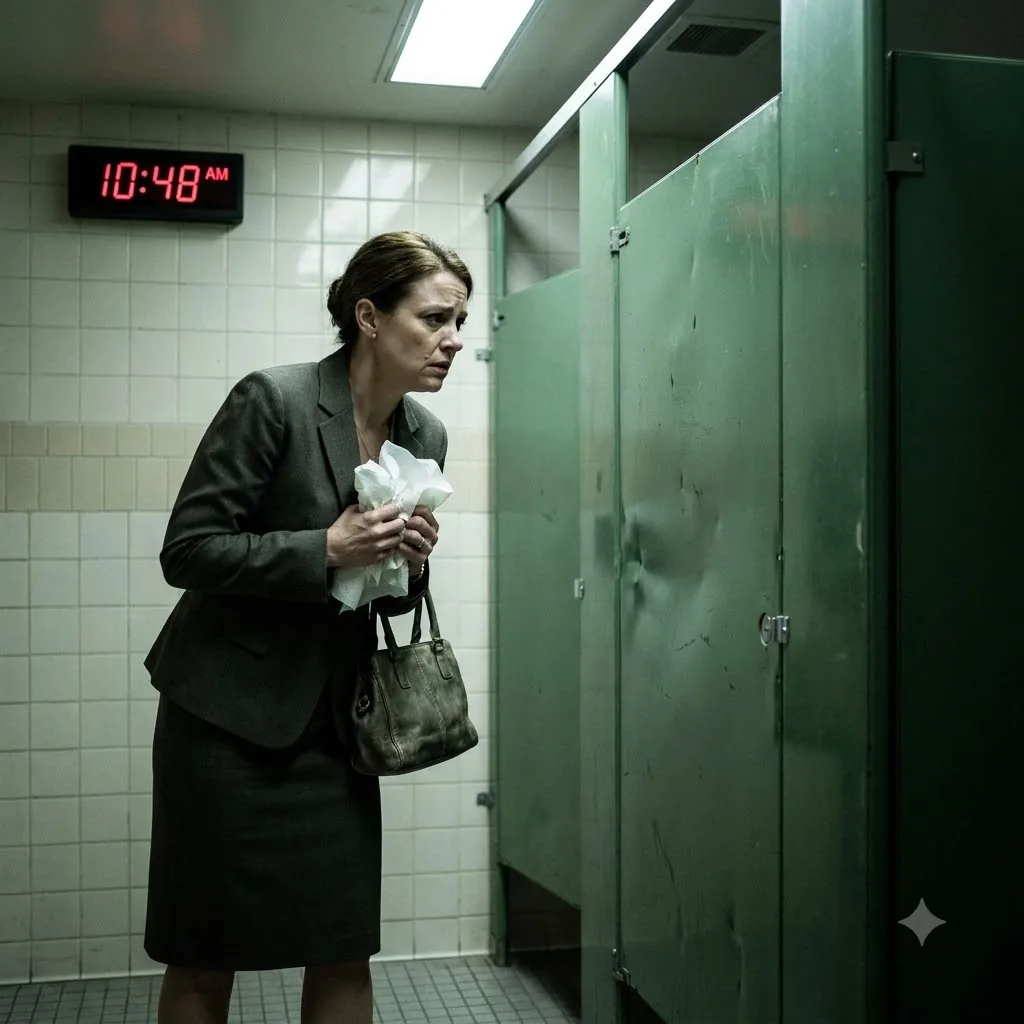
Story code: ST-000421
Part 2: The Witness Stand
Every muscle in my body locked. The humming of the overhead fluorescent lights suddenly sounded like a swarm of hornets in my ears. I slowly followed the bailiff’s gaze down my body, bracing myself for the sight of dark red soaking through the light gray fabric of my skirt.
Instead, I saw a jagged ribbon of brown paper towel stuck to the damp heel of my left shoe.
“You’re trailing trash,” the bailiff said, his voice flat. “Courtroom is a clean zone.”
Relief was a fleeting, dizzying wave. I exhaled a shaky breath, hastily scraping my shoe against the linoleum to dislodge the paper. “I’m sorry. Thank you.”
I tried to step around him, but he didn’t move. He leaned forward slightly, his eyes narrowing as he scanned my pale face, the dark shadows under my eyes, and the violent tremor in my hands.
“You’re sweating profusely,” he noted, his hand dropping casually to the radio on his belt. “Parolees are subject to random sobriety checks before entering this courtroom. Have you ingested any controlled substances this morning, ma’am? You look like you’re going into withdrawals.”
Panic flared hot and bright in my chest. A sobriety check meant an immediate trip to the court nurse. The court nurse meant a mandatory blood pressure cuff and a heart rate monitor, which would instantly reveal I was bleeding out and entering hypovolemic shock.
“No, sir,” I forced out, keeping my voice as level as possible while a fresh cramp tore through my abdomen like barbed wire. “I have been entirely sober for three years. I’m just terrified of losing my children today. It’s just nerves.”
He stared at me for three agonizing seconds, weighing my answer, before finally stepping aside. “Take a seat at the witness stand. They’re waiting.”
I walked through the heavy oak doors. The courtroom was a sprawling chamber of polished mahogany and dark carpeting, freezing cold and deathly quiet. My ex-husband, Marcus, sat at the plaintiff’s table. He didn’t turn to look at me, but I saw the corner of his mouth twitch upward in a faint, knowing smile. He had purposely filed for this emergency custody hearing to coincide with the most brutal week of my cycle, weaponizing my chronic condition against me. He knew the sheer stress of the legal threat would trigger a hemorrhage.
I bypassed the defense table-I couldn’t afford my own lawyer anymore-and walked straight to the wooden witness box next to the judge’s bench. Lowering myself into the hard wooden chair was a delicate, terrifying negotiation. The makeshift toilet-paper pad was already heavy and soaked, shifting precariously against my underwear. I pressed my knees tightly together, praying the agonizing pressure would staunch the flow.
Judge Hanover peered at me over his reading glasses. “You’re late, Corinne. We are on a very tight schedule today. Mr. Davis, you may proceed.”
Davis stood up, casually buttoning his tailored suit jacket. He didn’t ask about my studio apartment or my new job at the bakery. He walked slowly toward the center of the room, his eyes fixed intensely on my face.
“Corinne, your parole stipulations require you to maintain full physical and mental stability,” Davis began, his voice echoing in the cavernous room. He paced slowly in front of the empty jury box. “Are you feeling entirely well today?”
“Yes,” I lied, gripping the wooden railing of the witness stand. The polished wood felt slick beneath my sweating palms. Every second that ticked by was a battle against gravity and my own failing biology.
“Really?” Davis stopped pacing and tilted his head, studying me like a specimen pinned to a board. “Because let the record reflect that the witness is incredibly pale, trembling, and sweating profusely. You look like you might pass out, Corinne. Are you experiencing a medical crisis right now?”
“Objection,” I whispered, though I didn’t even have an attorney present to formally object on my behalf. I was entirely alone in this fight. “I am perfectly fine.”
“Your Honor,” Davis said, turning to Judge Hanover with a theatrical, sickening display of concern. “My client is deeply worried about the safety of his children in her care. If she is hiding a medical episode to avoid the state compliance registry, that is a felony under the new statute. I request we pause these proceedings and have the court physician evaluate her immediately. It is for her own safety.”
Marcus looked up at me from the plaintiff’s table, his eyes gleaming with quiet triumph. He was springing the trap. If I accepted the doctor, my condition would be coded, my parole revoked, and I would be handcuffed to a hospital bed. If I refused the doctor, I looked uncooperative, erratic, and unfit to the judge.
“That isn’t necessary,” I said, my voice rising in a desperate, breathy pitch. Another wave of cramping hit me so hard my vision fractured into tiny black spots. “I am completely fine. I don’t need a doctor. Please, Your Honor, just ask me the questions about my housing.”
Judge Hanover frowned, his expression hardening with clear disdain. “Corinne, if you are ill, the court clinic is on the first floor. Refusing basic medical assistance does not reflect well on your decision-making abilities as a mother. This court does not look kindly on parents who neglect their own health and create dangerous environments for their children.”
“I’m not ill,” I insisted, biting the inside of my cheek until I tasted copper just to keep from screaming. “I want to proceed with the hearing.”
“Very well,” Judge Hanover said, though his tone was icy and dismissive. “Mr. Davis, present Exhibit C.”
“Of course,” Davis said. He picked up a stack of papers from his table. “Corinne, I’m going to hand you a copy of your recent employment records. Please stand and read the highlighted portion for the court.”
My heart stopped.
*Please stand.*
I couldn’t. The moment I released the pressure of my knees and shifted my weight, the fragile paper barrier I had built in the bathroom failed entirely. I felt the horrifying, unmistakable rush of warm fluid bypassing the pad, pooling beneath me on the hard surface.
“I can read it from here,” I rasped, my fingernails digging furiously into the oak railing.
“The microphone doesn’t reach that far when you lean back,” Davis said smoothly, closing the distance between us. He stopped right at the edge of the witness box, holding the papers out. “Stand up, please.”
I had no choice. I slowly pushed myself up on trembling legs, my breath catching in my throat. As I rose, the cold, conditioned air of the courtroom hit the damp back of my thighs.
I glanced down at the seat of the chair.
A dark, wet smear of crimson was stamped directly onto the light oak grain, glaring under the bright courtroom lights. And Davis, standing just two feet away, was already following my line of sight down to the seat.