Story code: ST-001356
Part 2: The Nullification Clause
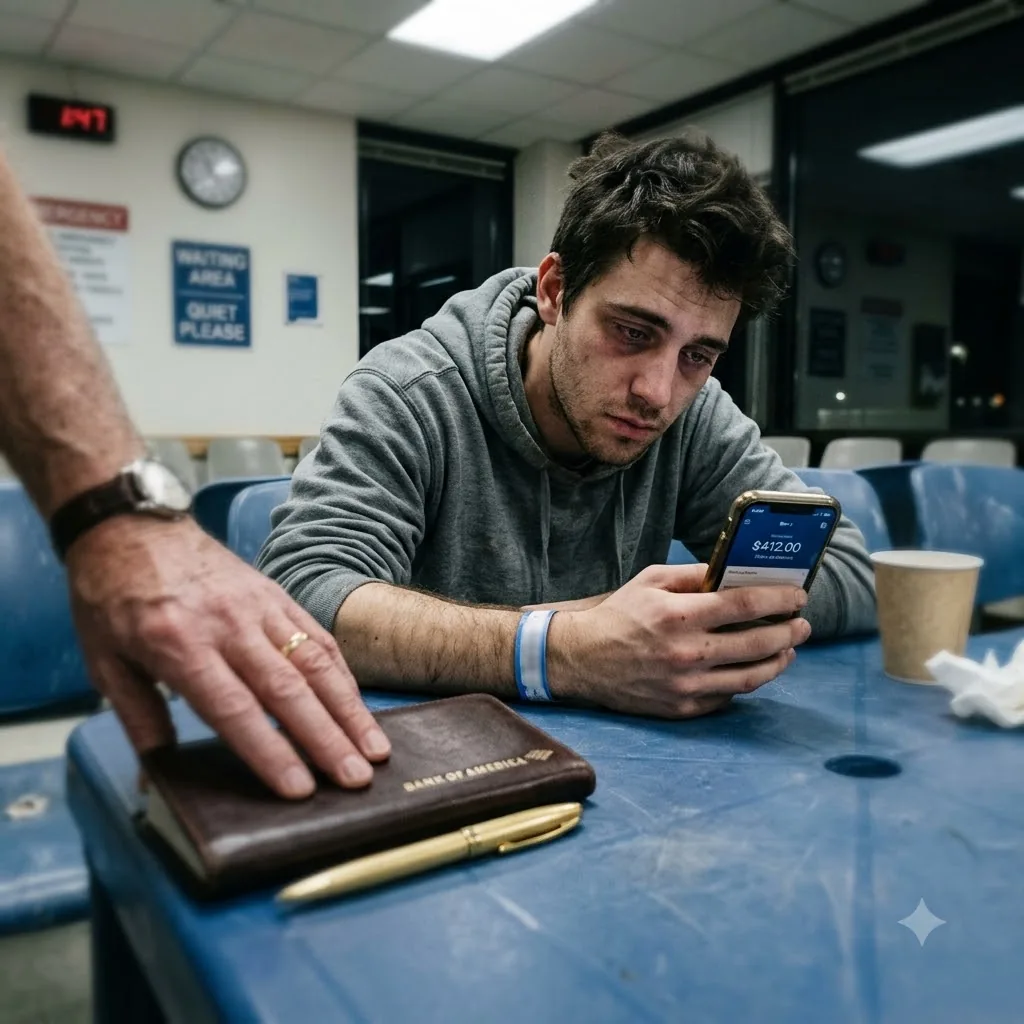
Caleb stared at the man’s impeccably buffed fingernail pressing into the six-figure sum. The words hung in the frigid air, heavy and incomprehensible. He asked the stranger what a transfer of ownership meant, his voice cracking on the final syllable.
The man did not answer immediately. With his free hand, he reached into the inner breast pocket of his charcoal suit and produced a trifolded sheaf of heavy, watermarked paper. He laid it flat on the laminate table, deliberately smoothing the creases with the palm of his hand. He turned the document so it faced Caleb.
Caleb looked down. The bold font at the top read *Deed of Relinquishment, Annulment, and Transfer of Medical Proxy*. Below it were dense paragraphs of legalese, but certain phrases jumped out, bolded and undeniable. *Irrevocable dissolution of marital bond.* *Complete forfeiture of visitation, contact, and legal standing.* *Permanent reassignment of patient identity.*
Caleb felt the blood drain from his face, a cold numbness spreading from his cheeks down to his fingertips. He told the man he was insane. He stammered that you could not just buy a person, let alone someone’s husband. Pushing his chair back, the plastic legs scraped a violent, grating sound across the linoleum. Caleb threatened to scream for security, to have the man arrested for extortion and fraud.
The older man remained perfectly still, a statue carved from ice. He softly suggested that Caleb read page three, paragraph four before raising his voice. Caleb hesitated, his chest heaving, his fists clenched at his sides. Despite his anger, his eyes were drawn back to the pristine papers on the table. He reached out with a trembling hand and flipped to the third page.
The clause explicitly stated that upon administration of the life-saving treatment, Julian’s current legal identity would be terminated. He would be issued a new name, a new social security number, and a new life as a permanent, classified ward of a private medical research trust. Caleb would be permanently barred by federal injunction from ever approaching, contacting, or acknowledging him. To the world, to their friends, and to Caleb, Julian would legally die in this hospital.
Caleb dropped the papers as if they had burned him. He asked why they were doing this. Out of all the people in the world, why Julian?
The man folded his hands over the document, his pale gray eyes unflinching. He calmly explained that Julian possessed a very specific, incredibly rare genetic anomaly in his immune system. It was the exact reason standard treatments had failed, but also the reason the experimental immunosuppressant was viable for him. The trust the man represented had invested over two billion dollars in the therapy’s development. They needed a living, long-term test subject who belonged entirely to them, free from the messy complications of sentimental spouses, prying family members, and local media attention. They needed an exclusive biological asset, not a patient. Julian was the perfect, and only, candidate.
Caleb shook his head frantically. He argued that Julian would never agree to it. Julian had spent years fighting for their right to be married, fighting to build a life together. He would rather die than wake up isolated in a sterile facility, erased from his own life, belonging to a corporate entity.
The man tapped the gold fountain pen against the table. The rhythmic clicking sounded like a metronome ticking down the seconds. He reminded Caleb that Julian was currently unconscious, intubated, and actively experiencing multiple organ failure. Julian could not consent to anything. Caleb held the medical proxy. Caleb, and Caleb alone, had the power to make the choice for him.
The man looked toward the ICU double doors, then back to Caleb’s pale face. He stated the reality of the situation with brutal clarity. Caleb could keep his marriage, his husband’s name, and his moral pride, and in roughly six hours, he would have a corpse to show for it. Or, Caleb could sign the papers, walk out of the hospital tonight, and live the rest of his life knowing that somewhere in the world, the man he loved was breathing.
Caleb stared at the check still pinned to the table. One hundred and fifty thousand dollars. It was a cashier’s check made out directly to the hospital’s pharmacy. The man had orchestrated everything flawlessly. There was no way to cash it, no way to run, and no loophole to exploit. The money would clear instantly, releasing the drug. It was a perfect trap.
He looked at his phone, the dark screen hiding the pitiful four hundred and twelve dollars. He thought of Julian’s laugh, the way his eyes crinkled in the morning sun, the life they had built in their tiny walk-up apartment over five years. He imagined Julian waking up in a locked ward, surrounded by doctors he didn’t know, crying out for a husband who would never come. It felt like a betrayal worse than death.
A sudden, piercing alarm shattered the quiet of the waiting room.
The noise echoed from behind the heavy ICU doors-a rapid, high-pitched continuous tone that Caleb had learned to dread over the last week. It was the sound of a heart monitor flatlining. Caleb’s head snapped up. Nurses burst from the central station down the hall, shouting rapid-fire codes as they sprinted toward Room 4. Julian’s room.
Caleb stood up so fast his chair toppled backward, hitting the floor with a loud smack. His heart hammered against his ribs, sheer panic rising like bile in his throat. He took a desperate step toward the swinging doors, needing to be there, needing to see.
A hand clamped around his wrist.
The older man’s grip was startlingly strong, his fingers digging into Caleb’s skin like iron clamps. He pulled Caleb back, halting his momentum instantly. The man checked his heavy silver wristwatch, his expression entirely unbothered by the chaos erupting down the hall.
He stated that the crash cart was currently entering the room. That gave Caleb perhaps three minutes before the oxygen deprivation caused irreversible brain damage, rendering even the new drug useless.
The man let go of Caleb’s wrist and picked up the gold pen. He held it out, the nib catching the harsh fluorescent light, pointing it directly at Caleb’s chest. He told Caleb it was time to decide if his husband’s survival was worth his husband’s life.