Story code: ST-000813
Part 2: The Sequence Would Not Behave
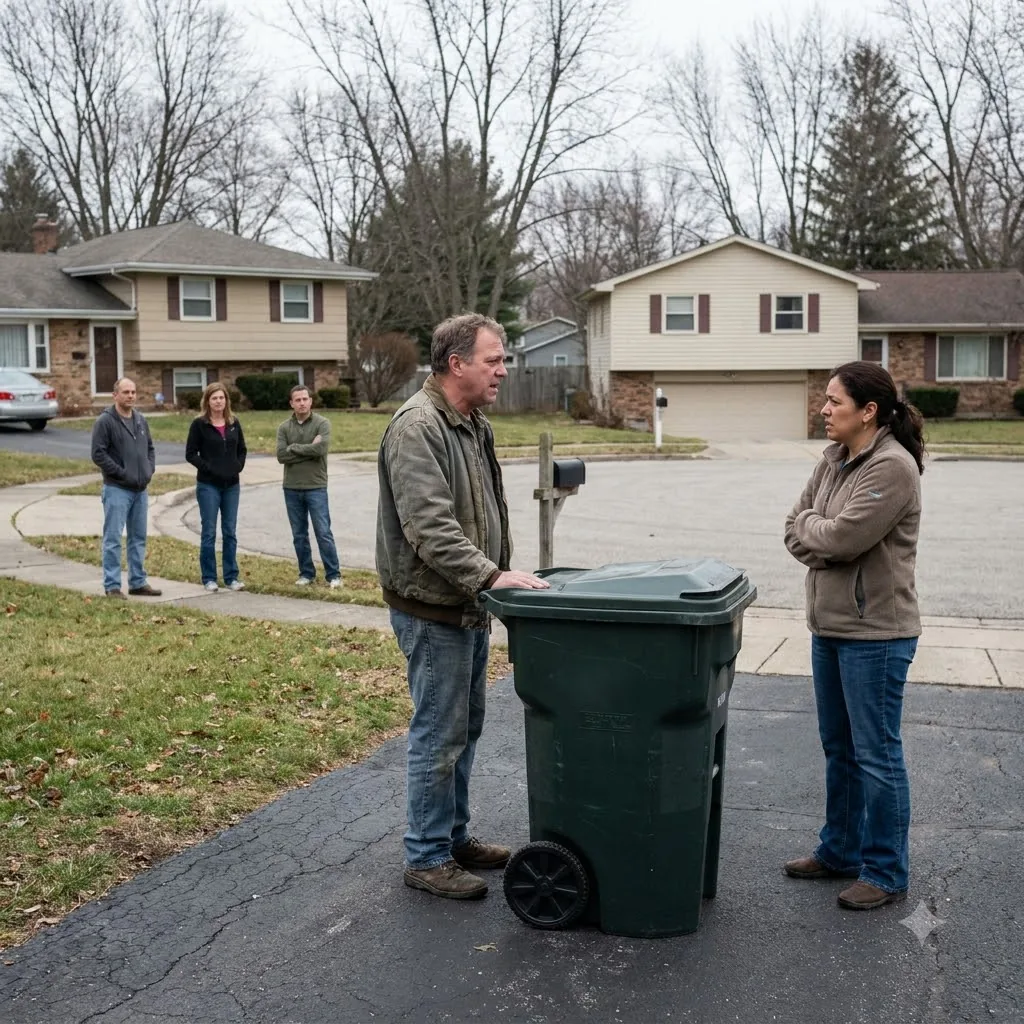
By the next pickup morning, people on that end of the cul-de-sac were looking at the shared driveway before they meant to. Not staring, not gathering, just slowing down in ordinary ways. A jogger adjusted an earbud near the mailboxes. Renee wiped out her hatchback while watching the curb in pieces. Mara carried a small bag of mulch from her trunk and set it down twice without opening it.
Nothing had been settled after Mark’s denial. Nina had moved her own bin only after Evan backed the car out the long way over the lawn edge, leaving two pale tire cuts in the grass. Mark had gone inside as if the subject had closed. But the practical details he had pointed to kept hanging around the apron like something left out overnight.
That Tuesday, Nina set her trash bin and the blue recycling bin out before seven, keeping both against the Alvarez side of the curb approach. Mara saw her do it while walking her own can down. Nina did not say anything to Mark’s house. She lined the wheels up straight, left a clear lane through the narrow center, and went back inside.
Mark’s truck was already gone.
The sanitation truck reached the street a little after eight-thirty. Its mechanical arm grabbed bins in a clattering line, set them down with uneven thumps, and rolled on. Mara watched Nina’s black bin come back from the grip nearly square to the curb, a little closer to the driveway mouth than before but still outside the apron. The blue recycling bin landed behind it at a slant.
Renee, who was carrying a case of bottled water from her hatchback, stopped and looked the same way. “There,” she said quietly, more to mark the moment than to start a conversation. “That’s where they leave it.”
Mara nodded. The truck did not push either bin up into the shared driveway. It never crossed the curb line at all.
Fifteen minutes later, Nina came out in work clothes with her bag over one shoulder. She looked at the curb, then at the open space behind it, and paused. The black trash bin was no longer near the curb line. It was halfway up the apron, turned broadside again, with its lid facing Mark’s side of the property. The blue recycling bin still sat where the truck had dropped it.
Nina did not touch the black bin. She set her bag down on the hood of her car and called toward Mark’s side door, “Mark.”
He came out almost at once, coffee mug in hand. “What now?”
She pointed. “It was at the curb after pickup.”
“Okay,” he said.
“Now it’s here.”
He took one look at the bin and shrugged. “Then move it.”
Renee had crossed the street by then, not close enough to join them, but close enough to hear. Evan stepped out from the garage and stopped beside Nina’s rear bumper.
“Did you touch it?” Nina asked.
Mark gave the same answer as if he had practiced keeping it the same size. “No.”
Evan looked at the recycling bin still down by the curb. “Funny how only one of them climbed the driveway.”
Mark sipped from the mug. “Maybe your wheels are bad. Maybe the slope took it.”
That drew everybody’s eyes down. The apron did slope, but toward the street, not up toward the houses. Even standing at the mailbox area, Mara could see the gutter line and the slight grade where rainwater usually ran after storms. The black bin had moved against that grade. Its wheel tracks showed two faint arcs through dust and tire grit, starting near the curb and ending where it now blocked the exit line.
Nina spoke slowly. “The slope goes the other direction.”
Mark answered quickly, “Not enough to matter. Bins wobble.”
Renee set the bottled water down in her trunk and closed the hatch. “If it wobbled from the curb,” she said, careful with each word, “why didn’t the recycling bin move too?”
Mark looked at the blue bin, then back at the black one. “Because they’re different weights. This is exactly what I’m talking about. People see one thing and build a whole courtroom around it.”
There was no courtroom. Just the narrow driveway, the blocked backing angle, the truck timing, the two bins, and four adults standing in a space that only worked when nobody lied about ordinary things.
Nina walked to the black bin, crouched, and pointed without touching. One wheel had a fresh smear of dirt on the outer edge, as if it had rubbed along the raised lip where the concrete met Mark’s side strip before being pulled straight. The other wheel was cleaner. The lid handle was turned inward toward his garage-side walkway.
Evan said, “If it rolled by itself, it didn’t stop, pivot, and line up like that.”
Mark’s reply came a beat later this time. “You’re both desperate to make this my problem.”
Nobody answered him. The silence that followed was not dramatic. It was the kind that comes when a simple explanation has started failing in too many places at once.
Mara looked from the wheel tracks to the curb to the side of Mark’s house. Mounted under his eave, angled toward the apron and the curb approach, the small driveway camera sat with its dark lens aimed at exactly the stretch everyone had been arguing about for a week. It was not hidden. It had probably been there the whole time.
Renee saw it in the same second and lifted her chin toward it. Nina followed her line of sight. Evan did too.
Mark did not say anything for a moment. He stood with the coffee mug halfway up, the black bin between the houses, the recycling bin still resting by the curb where the truck had left it, and the camera pointed straight at the only path his story had left available.