Story code: ST-000813
Part 4: He Finished the Lie Himself
Mara did not need to move closer to see what was happening.
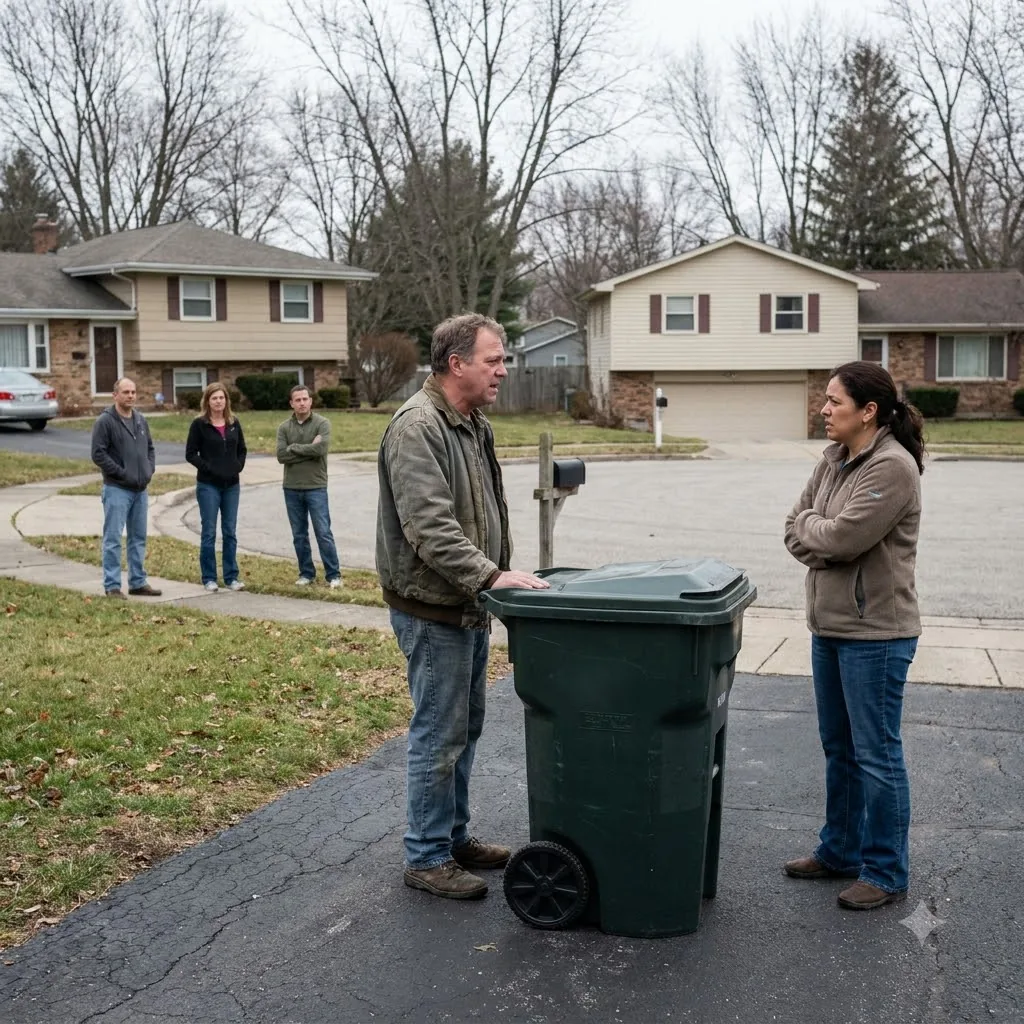
The black bin stood just outside the driveway mouth, square to the curb, exactly where the truck had set it down. The blue recycling bin remained behind it at a mild angle. Tasha Greene stayed inside her crossover for a second longer, writing something against the steering wheel. Nina had just stepped out of her front door with her work bag. Evan stood inside the garage opening with one hand on the car frame.
Mark Delaney crossed the apron without looking at any of them.
He took hold of the black bin’s handle, tipped it back, and rolled it up the slope of the shared driveway. Not far. Just enough to carry it over the curb line, across the center of the apron, and into the familiar broadside position that cut off Nina’s backing angle. Then he set it down, gave the wheels a short correcting tug, and turned the lid toward his garage-side walkway.
The act was small. That made it worse.
No one shouted. The only loud sound was the plastic lid knocking once as it settled shut. Mark straightened and finally saw Nina standing by her car, Evan in the garage, Renee near her hatchback across the street, Mara by the mailboxes, and Tasha now stepping out of the crossover with her clipboard already in hand.
For a moment he stayed with one hand still half raised from the handle.
Tasha looked from the bin’s new position to the curb marks it had just left behind. Two fresh wheel tracks cut cleanly through the dust where the truck had deposited it. The path ran in one unbroken line from the street to the blocked exit angle.
“Thank you,” she said.
That was all.
Mark let go of the handle and looked toward the camera under his eave, then back at Tasha. “I was moving it out of the way.”
Nobody argued with him. The bin was visibly in the way. His own hands had just put it there.
Tasha wrote for several seconds. Then she spoke in the same administrative tone she had used the week before. “Documented intentional obstruction of shared egress. Repeated manipulation of another resident’s container within the shared apron. Prior warning given on site.”
Nina did not step forward. She stayed by the car with both hands on the strap of her bag and watched.
Mark tried once more. “This is ridiculous. It’s a trash bin.”
Tasha kept writing. “As of today, your apron-use exception is revoked. No staging bins, vehicles, or equipment beyond your property-side boundary line. The association will install center delineator posts and curb markings for the shared access run. Cost assigned to your lot. Future obstructions are separate violations.”
That was the consequence, plain enough that even the older man two houses down, who had wandered out with his mail again, stopped pretending not to listen.
Mark stared at her. “You’re putting posts in the driveway?”
“Low reflective delineators on the seam,” Tasha said. “They preserve the egress lane. You will receive the notice by email and door posting this afternoon.”
He looked down the apron as if seeing its width for the first time. Without the extra cut across the center, his pickup would have to stay tighter to his own side backing in. His bin would have to remain at the curb edge until he brought it straight back. The shared middle he had been treating as flexible was about to become measured in white paint and short posts.
Renee bent to lift her grocery tote from the passenger seat of her hatchback. Mara rolled her own empty bin toward her garage. Evan backed his car out a few inches after Nina moved the black bin clear, and this time there was room.
No one asked Mark for an apology. No one gave Nina a speech about being right. The camera remained under the eave, still facing the apron it had watched all along.
By late afternoon, a laminated notice in a clear sleeve was fixed beside Mark’s side door. Mara saw it when she walked past with her dog. The next week a contractor arrived in a county-fair vest, snapped chalk on the center seam of the shared driveway, and bolted in three short reflective posts from the curb approach up the narrow apron. Fresh white boundary marks followed. The work took less than an hour.
Mark stood in his garage while it happened. He did not come out to supervise. He did not wave anyone over to explain. When the contractor finished, the center lane was no longer a matter of neighbor memory or somebody’s calmer voice. It was a narrow, visible rule running straight between the houses.
On the next pickup morning, Nina set her black bin at the curb, square and clear. After collection, she rolled it back along her side and left the center open. Mark brought his own bin in on his side without crossing the posts.
From the mailbox area, the whole change looked almost boring.
That was what made it final.