Story code: ST-000813
Part 3: The Only Way His Story Worked
Nobody moved for a few seconds after everyone noticed the camera.
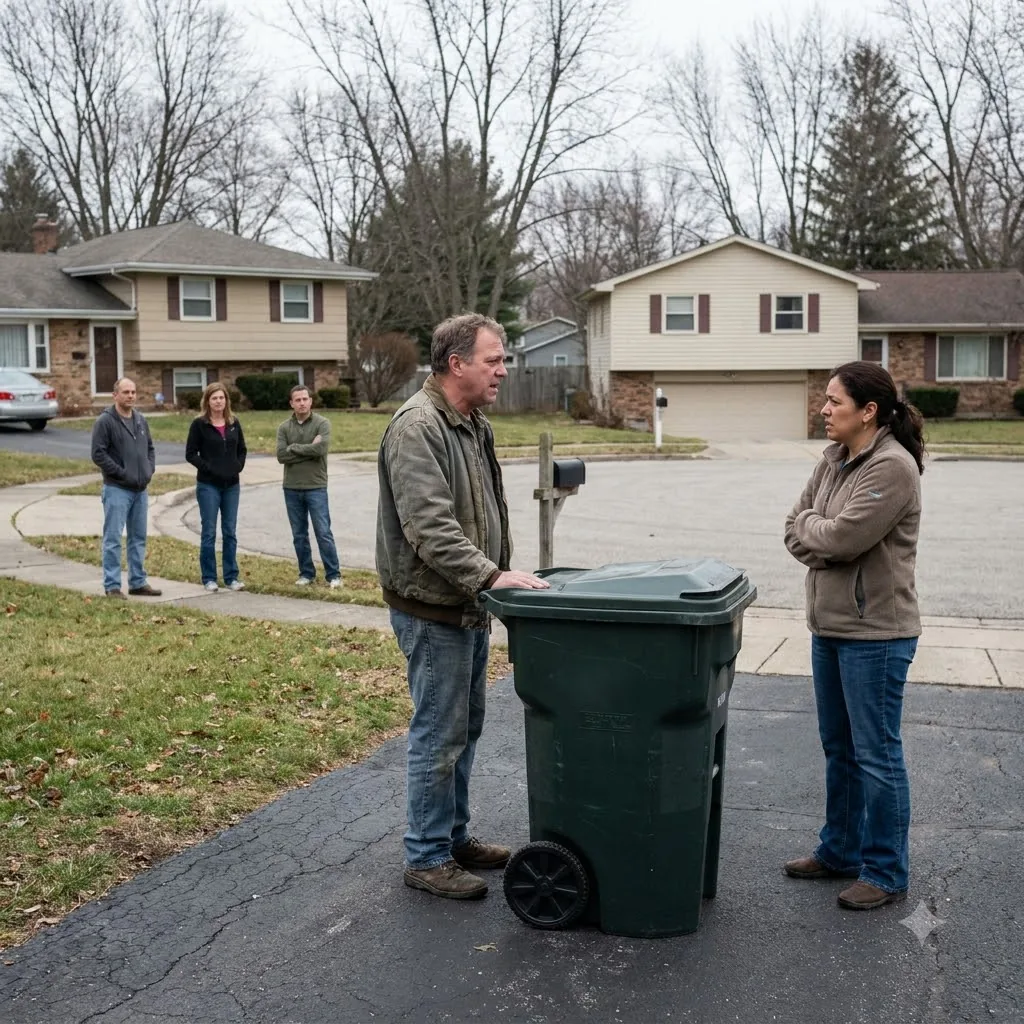
It sat under Mark Delaney’s eave in plain view, aimed across the apron and the curb approach where Nina’s black bin had somehow traveled twice now without help from wind, slope, or the sanitation truck. The lens caught the morning light. A small blue indicator glowed under it.
Nina was the first one to speak. She did not raise her voice.
“Then let’s look at it.”
Mark kept the coffee mug in one hand and looked up at the camera only briefly. “It doesn’t matter,” he said. “That thing is for my truck.”
Evan pointed at the apron. “Your truck isn’t parked at the curb.”
Mark gave a short shrug. “It catches motion, not every little thing.”
Renee glanced from the light on the camera to the black bin still blocking the exit angle. “It caught the truck this morning,” she said. “I saw the light blink when the arm came down the street.”
Mark answered too fast. “That doesn’t mean it saves anything.”
Mara stayed near the mailboxes with one hand on her own emptied recycling bin and watched the exchange narrow. Mark had gone from never touched it, to maybe it rolled, to maybe the slope mattered, to maybe the collectors moved it, and now to reasons the one device pointed at the dispute might not help. The bin stayed where it was, lid handle turned toward his walkway, one wheel still marked with a fresh dirty rub.
Nina took out her phone. “Fine,” she said. “Then I’ll ask the association to document the obstruction and request whatever the camera has.”
That brought his eyes back to her. “For a trash bin?”
“For blocked shared access,” Evan said.
The wording changed the scene. That driveway had always been treated like a neighbor habit, the sort of thing people were expected to work out with a few sentences and some decency. Once Evan said shared access, it sounded less like bickering and more like a usable space with a rule attached to it.
By noon, Tasha Greene’s white crossover was parked near the curbside pickup zone. She wore a county-fair polo with the homeowners association name stitched over the chest and carried a slim clipboard instead of any kind of dramatic authority. Mara watched from the shade of her own driveway as Tasha stood at the mouth of the apron, looked at the tire marks, the gutter slope, and the two houses, then asked each person for times instead of speeches.
Nina kept to the sequence. She had set the bins out before seven. The truck came after eight-thirty. The black bin had been near the curb after pickup. Fifteen minutes later it was halfway up the apron, broadside.
Renee repeated only what she had directly seen. Mara did the same. Evan described how the blocked angle kept him from backing out cleanly.
Mark folded his arms and stayed with his calm voice. “I never touched her bin. This is getting turned into a whole file because people want me to admit to something I didn’t do.”
Tasha wrote for a moment, then looked up at the camera. “Does that device retain footage of the shared apron?”
Mark said, “Not really.”
“Does it record motion events?”
He shifted his weight once. “Sometimes.”
Tasha’s pen paused. “If it captures the shared access area, preserve anything from this morning and last week’s pickup. Do not alter or delete it while a blockage complaint is open.”
The sentence landed dry and flat. No threat in it. No performance. Just process.
Mark looked toward his garage side door. “You’re acting like this is criminal.”
“No,” Tasha said. “I’m acting like two homes need passable egress. If the blockage is intentional, that changes how the association handles apron use.”
That was the first time Mara saw Mark lose the smooth rhythm he had been using. He opened his mouth, shut it again, then pointed at the black bin as if starting over from the beginning might still help.
“I can’t control where her bin ends up.”
Tasha followed his gesture without reacting. “Then next pickup morning should be easy. Leave all containers where the truck leaves them. I’ll document the result myself.”
Nobody answered right away. A lawn service trailer rattled past at the end of the cul-de-sac. Somewhere farther down, another garage door opened and closed.
Tasha flipped the page on her clipboard. “Tuesday. Eight-fifteen to nine. Do not reposition anything until after I arrive.”
Nina nodded once.
Renee said, “I’ll be home.”
Mark looked up at the camera again. The blue light stayed on over his shoulder.
When Tasha walked back to her crossover, the driveway did not feel like a place for arguing anymore. It felt measured. The curb, the grade, the truck timing, the camera angle, the wheel tracks-every ordinary detail had been pinned in place. Mark finally stepped to the black bin and rolled it out of the exit line so Evan could leave, but he did it under four sets of eyes and without saying another word.
The following Tuesday, just after the sanitation truck cleared the cul-de-sac, Mara saw Tasha’s white crossover pull in near the mailboxes and settle into a parking space with the engine off. Nina’s black bin stood square near the curb where the truck had left it. The blue recycling bin rested a few feet behind it. Mark came out of his side door, looked once toward Tasha’s windshield, then down at Nina’s black bin, and started walking toward it with his empty hand extended.