Story code: ST-001034
Part 2: He Would Not Let Go of the Burden
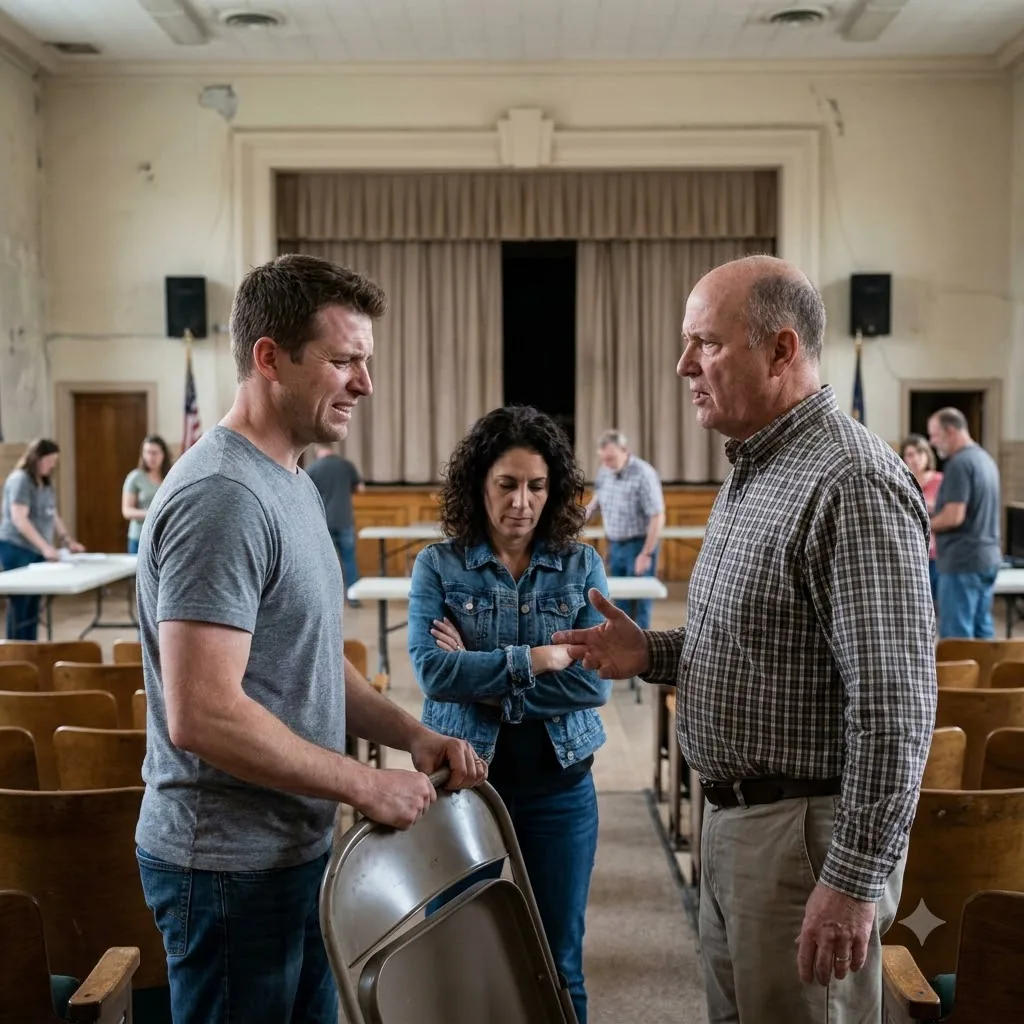
I had just offered to take every task off Rick’s hands, and he reacted like I had slapped him in front of the whole auditorium. That was the first clean crack in the story he kept telling about what COVID had cost him. If the burden was really the problem, he had just been handed a way out.
He did not take it.
“That’s not what this is,” he said, sharp enough that Ms. Brooks looked up from her phone again. “Don’t twist my words.”
I kept my voice flat. “I’m not twisting anything. You said this place and all of this still bothers you. I’m saying you can go home. I’ll finish setup.”
He let out a hard breath through his nose and pointed at the registration table, then the chairs, then the old mask box by the wall like he was connecting all of it into one argument only he could see.
“That is exactly how people erase what happened,” he said. “First they use you. Then they act generous when they cut you out.”
Denise stepped in half a pace, one hand on the nearest chair back. “Nobody’s cutting you out,” she said quietly. “We’re just trying to get the room ready.”
“I know what this is,” Rick said. “She wants to make me look unstable because I remember what was done to people who wouldn’t fall in line.”
I said, “I asked about welcome packets.”
He turned to Ms. Brooks. “You hear how she talks? Like none of the context matters. Like the last few years never happened.”
Ms. Brooks did not bite on the family part of it. She glanced at the clock above the stage, then at the boxes by the wall. “I need the packets stuffed and the side aisle clear in fifteen minutes,” she said. “I don’t need the history lesson. I need the answer.”
There was a pause long enough for chair legs to scrape loud across the floor behind us.
Rick said, “Fine. I’ll do the packets. But don’t stand there pretending you’re rescuing me.”
That should have ended it. It did not.
I moved to the side wall to clear the extra boxes from the aisle. The old mask box was lighter than it looked. When I picked it up, the cardboard dipped in the middle, and I could hear loose packages shifting inside. Not many. Just enough to make a dry, soft rattle. Some had been opened. Some were still sealed. It looked like the kind of leftovers every school and church seemed to have for years after the emergency part was over, too useless to display and too ordinary to throw away.
Rick looked over immediately.
“Leave that there,” he said.
I stopped and looked at him. “It’s blocking the aisle.”
“It’s fine where it is.”
Ms. Brooks answered before I could. “No, it isn’t. We need the aisle open for check-in flow. Put anything extra in storage.”
She held up the storage key, then crossed to unlock the side room. The metal door gave a tired click. I carried the mask box toward her with two sign bundles stacked on top.
Behind me Rick said, louder now, “See? That’s what I’m talking about. Everybody wants to pack it all away and act like some of us didn’t pay the price.”
I set the box just inside the storage doorway and went back for the poster board. He had abandoned the packet table and followed us halfway across the room.
“Rick,” I said, “if looking at that box is so upsetting, why are you the only person insisting it stay out?”
His mouth tightened. He pointed at the box again, but this time he did not touch it.
“Because people should have to look at it,” he said. “People should remember what happened.”
“We’re in a school auditorium with folding chairs and old supplies,” I said. “Nobody forgot there was a pandemic.”
“That’s not the point.”
“Then what is the point?”
He did not answer that directly. He started talking again about what he had lost, but the numbers shifted inside the same speech. First it was two contracts. Then it was three years of work. Then it was entire seasons of family events he said he had single-handedly kept alive. I had heard versions of this before at cookouts, graduations, and one awful Thanksgiving, but standing there with the storage door open and the mask box in my hands, I noticed how he kept refusing the simplest fix in front of him.
If the room was the insult, he could leave.
If the task was the insult, I could take it.
If the object was the insult, it could go in storage.
He rejected every one.
Denise looked at him, then at me. She lowered her voice. “Alyssa offered to handle it,” she said. “Maybe just let her.”
He swung toward her so fast she took her hand off the chair back. “So that’s it? Now you too?”
No one said yes. No one said no. The packet table sat untouched. Ms. Brooks held the storage door and waited exactly three seconds before speaking in that clipped coordinator tone again.
“Alyssa, put the extra supplies inside,” she said. “Then come get the updated volunteer login from me for check-in. We’re changing who handles front table access today.”
Rick stopped talking mid-sentence.
He looked at Ms. Brooks, then at me, then at the open storage room where the old mask box was now sitting just inside the threshold.
I had not asked for a change yet. But the way he went still told me more than his speech had, and by the time I slid the box farther onto the shelf, I knew the next move could not happen in front of everybody.