Story code: ST-001034
Part 3: I Finally Saw What the Box Was Doing for Him
Rick stopped talking the second Ms. Brooks said updated volunteer login.
It was not subtle. His mouth stayed slightly open for a beat, and his eyes cut to the storage room like he had just remembered something was sitting in there besides old supplies. Then he put his voice back on like a jacket.
“Why would that need to change?” he asked.
Ms. Brooks slipped the key ring around two fingers and checked her clipboard again. “Because I need the front table handled without interruptions,” she said. “Alyssa already knows the flow. That’s the change.”
He gave a short laugh. “So this is how it works now. Somebody gets emotional, and suddenly passwords change?”
I was still standing at the storage shelf with the old mask box in my hands. The flaps had sagged inward. One side was bowed from age, and somebody had written OPEN in black marker across the top months or years ago. When I shifted it to make room for the poster board, a folded paper slid from under the box and landed against my shoe.
It was not some secret file. It was just a printed supply sheet, the kind people tape to shelves and forget about. But I picked it up because it had the school letterhead at the top and handwritten notes along one side.
MASKS – REMAINING BULK STOCK.
Under that, in pen, were short lines with dates and initials. Moved to side wall. Save overflow for winter concert. Do not leave in lobby. Rick wants them visible for parent night. EB.
I read that last line twice.
Not because it was dramatic. Because it was stupidly plain.
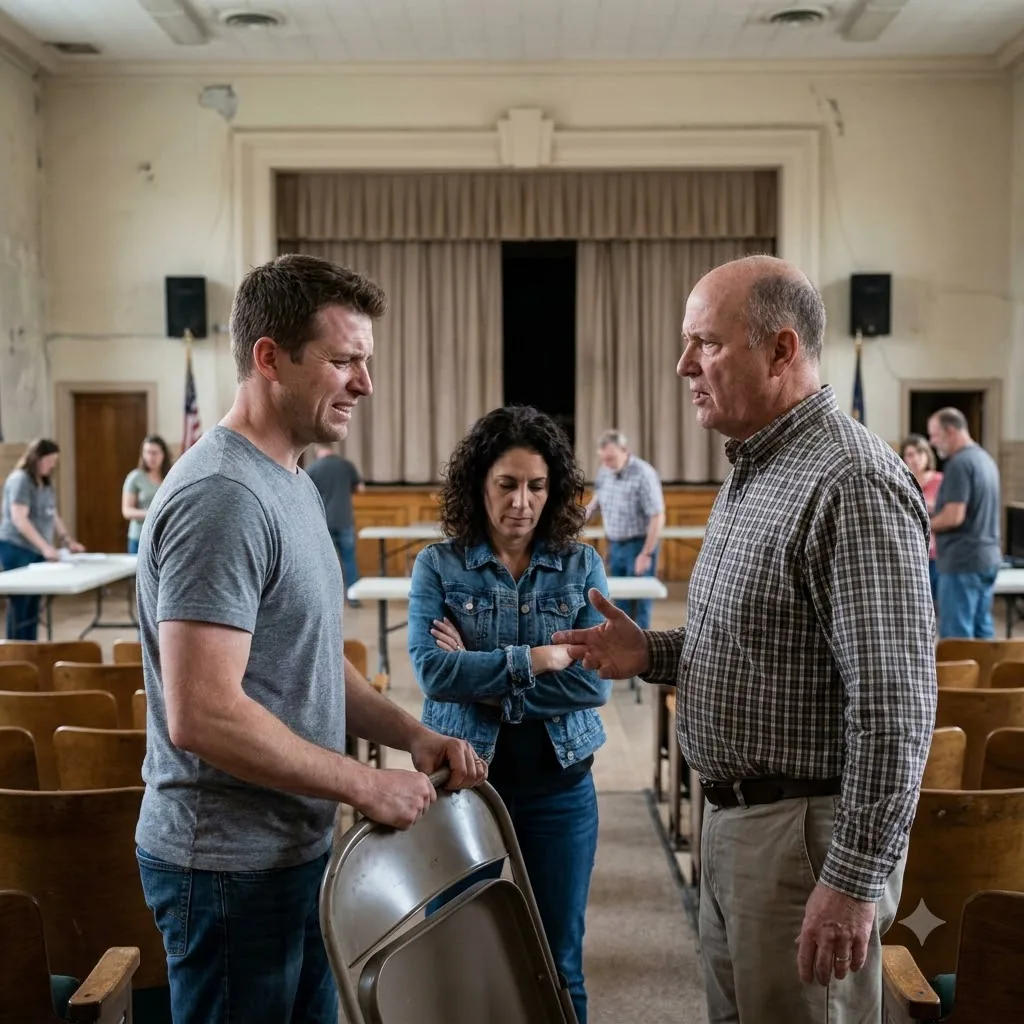
I looked out through the cracked-open storage door. Rick was still near the packet table, talking too fast now, telling Ms. Brooks he had been helping with community events longer than most volunteers had even known the school. Denise had gone back to aligning chairs, but she kept looking over every few seconds. The auditorium still sounded like an auditorium: metal chair legs, paper rustling, somebody testing a microphone near the stage and getting a burst of feedback.
Ordinary room. Ordinary noise. And in the middle of it, one scribbled line changed the shape of the whole morning.
He had been pointing at that old box like it was proof of what the world did to him. But at least once, in this same building, he had asked for it to stay where people could see it.
I did not walk out holding the paper over my head. I did not call him a liar across the room. That was exactly the kind of scene he could feed on. He would turn it into another speech about disrespect and being attacked.
Instead I folded the sheet once and put it under my phone case.
Then I slid the mask box all the way onto the back shelf.
When I came out, Ms. Brooks held up her phone. “New login for check-in app,” she said. “I’m texting it to you now. Use your number for the verification code. Not a shared contact.”
Rick stepped closer before I could answer. “Why are we acting like I’m a problem?”
I said, “We’re acting like we need the table covered.”
“By you. Convenient.”
“By whoever can do it without turning packets into a speech.”
Denise let out one quick breath and looked down at the chairs. Ms. Brooks did not react at all except to tap send.
My phone buzzed in my hand.
Rick saw it. He saw me look at the screen, then lock it again.
“I have always had that login,” he said.
Ms. Brooks answered with a flat, practical tone. “Not today. Today I need one point person. That’s Alyssa.”
He started in again about fairness, about loyalty, about how people were quick to erase the ones who had stood firm during COVID. But now I had that folded sheet pressing against my palm through the back of my phone, and his words had lost something. Not volume. Just force.
Because I could see the pattern cleanly now.
He did not need the room to believe every detail. He just needed the room held in place long enough for his version to stay useful.
I walked to the front table and started stuffing welcome packets. Three flyers, one map, one donor card, one pen. Count it out. Keep moving.
He came over and lowered his voice for the first time all morning. “You think getting a password makes you in charge?”
I kept my hands on the packets. “No. I think it means I don’t need your permission to do the job.”
He leaned in enough that only I could hear him over the chair noise. “Don’t do something petty and make this permanent.”
That was the line that landed.
Not because it scared me. Because he had skipped right past the story and gone straight to access.
I looked at him, then at the storage doorway, then at Ms. Brooks’s phone still in her hand.
For the first time that morning, I knew exactly where the end of this had to happen.
Not in front of the room.
At the storage door, with the key, the login, and one clear sentence he could not turn into a performance.