Story code: ST-001370
Part 4: The Ghost in the Street
Jenkins’s finger trembled on the trigger. The taser’s whine peaked, a high-pitched mechanical squeal that mirrored the sheer panic in the young officer’s eyes. Miller stood his ground, his hands still empty, refusing to give the algorithm the violent reaction it calculated he would make.
“Jenkins,” Miller said, his voice dropping to a low, steady baseline. “Look at me. Not the screen. Look at me.”
But Jenkins couldn’t. His gaze was locked on the digital overlay of his smart-glass visor, watching his own livelihood dangle over a digital cliff.
It was Torres who broke.
“I’m sorry. I’m so sorry, Cap,” Torres sobbed.
The veteran officer didn’t use a textbook tactical takedown. He didn’t announce his movement. He simply threw his entire body weight forward, slamming into Miller’s chest with the frantic, uncoordinated desperation of a drowning man fighting for a life preserver.
The impact drove all the air from Miller’s lungs. He stumbled backward, his heavy boots catching on the uneven seam of the asphalt. For a split second, Miller tried to grapple, his muscle memory flaring to life, but he was sixty years old and running on twelve hours of sheer exhaustion. Torres’s momentum carried them both down.
Miller hit the street hard. His right shoulder took the brunt of the fall, a sickening pop echoing in his ear, followed immediately by the harsh scrape of his cheek against the freezing, oily concrete. Pain flared brilliant white behind his eyes, instantly disorienting him.
Before Miller could push himself up, Torres scrambled off him and lunged for Malik.
“No! Get off me!” Malik screamed, his voice pitching into sheer terror.
Miller tasted copper. He planted his good hand on the freezing street, pushing his chest up. “Torres! Let him go!”
“Stay on the ground, civilian!” Jenkins shouted.
Miller blinked through the pain, looking up. Jenkins was standing over him, the taser now pointed directly at Miller’s face. The rookie’s chest was heaving, tears streaming down his face, but his stance was wide and locked. “Do not approach the active arrest! Comply with the verbal directive!”
Jenkins wasn’t shouting at Miller. He was shouting for the microphone embedded in his helmet. He was performing for the network, ensuring the audio logs recorded his perfect compliance with the machine’s parameters.
Behind Jenkins, the struggle was brief and brutal. Torres pinned Malik to the hood of the cruiser, dragging the teenager’s arms behind his back. The sharp, ratcheting zip of plastic flex-cuffs sliced through the night air.
“Mr. Miller!” Malik wailed, his cheek mashed against the icy metal. “Please! You know me! Tell them!”
“Malik, don’t fight them!” Miller gasped, clutching his throbbing shoulder. “Don’t give the system a reason!”
Torres hauled the boy backward by the collar of his jacket, dragging him to the rear door of the squad car. He shoved Malik inside, the teenager’s sneakers kicking wildly against the doorframe before Torres leaned his weight in and slammed the heavy door shut. The mechanical thud severed Malik’s cries, sealing him inside the rolling cage.
“Suspect secured,” Torres choked out. He didn’t look back at Miller. He couldn’t. He practically sprinted around to the driver’s side of the cruiser.
Jenkins backed away slowly, keeping the taser trained on Miller until he bumped against the passenger door. “Incident resolved,” Jenkins said, his voice hollow, stripped of all humanity. He holstered the weapon, dropped into the seat, and slammed his door.
The cruisers didn’t linger. The algorithm demanded efficiency; scene cleared, time-to-arrest optimized. The engines roared, tires biting violently into the asphalt. The vehicles tore away from the curb, their red and blue strobes washing over the brick facades of the storefronts one last time before shrinking into the dark expanse of the avenue.
Miller was left kneeling on the pavement. The silence that rushed back into the street was absolute, broken only by the distant wail of a siren miles away. The freezing wind bit through his uniform shirt, stinging the raw abrasion on his cheek.
He reached down to his duty belt with a trembling hand, unclipping his radio. He pressed the transmit button, intending to call dispatch, to demand a supervisor, to do something.
A small red LED on the top of the radio blinked twice. *Access Denied.* Not even static came through the speaker. The precinct network had bricked his device.
Slowly, painfully, Miller pushed himself to his feet. His shoulder screamed in protest. He looked down at the street. His leather wallet had fallen during the struggle, lying open in the gutter.
He picked it up. The brass star caught the pale, flickering light of a nearby streetlamp. For thirty years, that piece of metal had meant something. It had been a promise to the neighborhood, a symbol of human judgment, of protection. He ran his thumb over the cold points of the star. It was just a piece of metal now. The micro-chip embedded behind it had the final say.
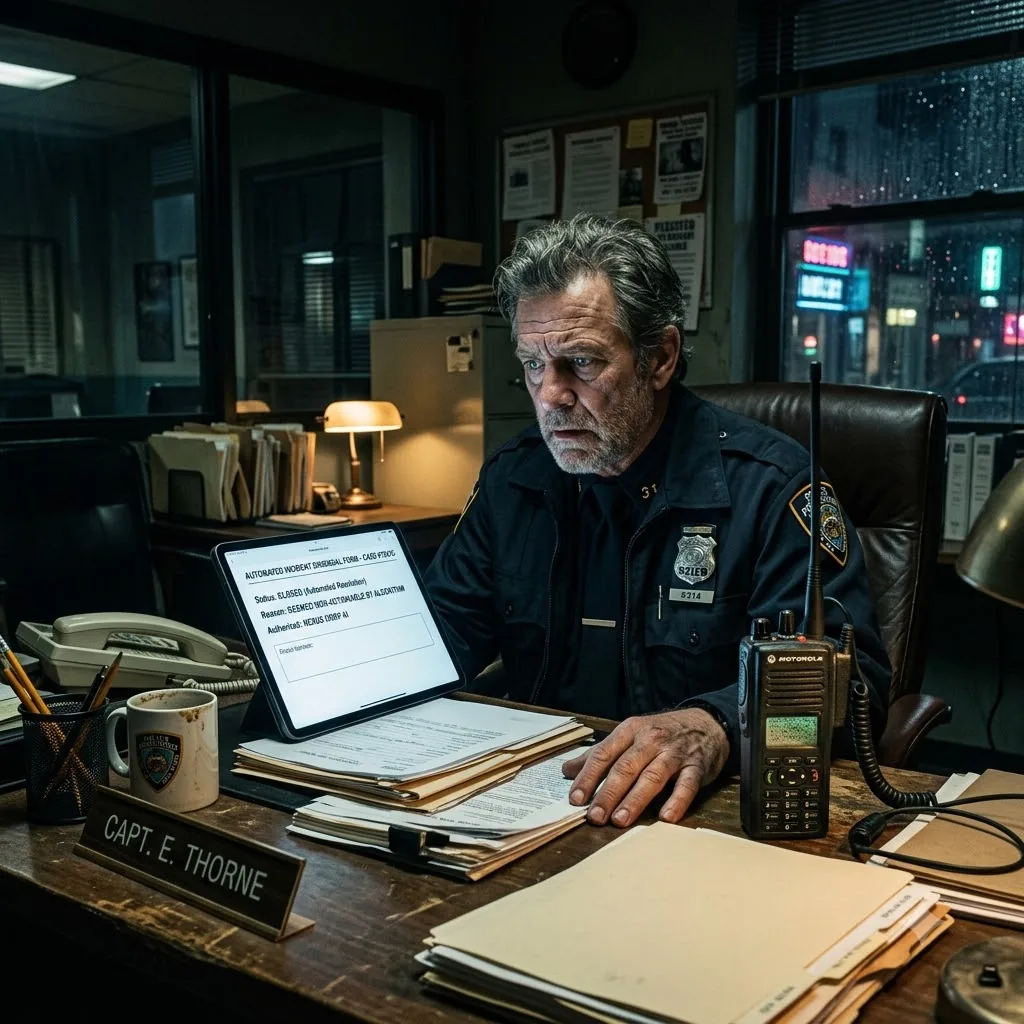
Miller looked up at the second floor of the precinct. The window to his office was still glowing with the sterile, fluorescent light. The automated countdown timer on his monitor had undoubtedly hit zero. He hadn’t signed the early separation agreement. He hadn’t stayed at his desk.
He had lost his pension. He had lost his command.
And despite losing everything, he hadn’t been able to save the boy.
Miller stood alone in the empty street, clutching the dead brass in his hand, a ghost in a city that no longer required his humanity.