Story code: ST-001686
Part 4: The Unmonetized End
Jessica’s manicured hands fluttered wildly over her keyboard, her corporate composure entirely annihilated by the visceral reality spilling through her monitor. She opened her mouth to speak, but only a sharp, panicked intake of breath made it through the microphone. “I… I think there has been a profound misunderstanding of our grant parameters,” she stammered, her eyes darting away from the camera lens. “We will be keeping you in our thoughts, David.”
The video conferencing software chimed a flat, synthesized tone. The feed cut to black. The pulsing red recording dot in the corner of the screen vanished instantly.
David’s cold fingers slipped off Emily’s wrist. He collapsed backward against the mountain of stiff hospital pillows, his chest heaving violently against the fabric of the green Henley shirt. The sudden, desperate surge of adrenaline that had fueled his rebellion evaporated just as quickly as it had arrived, leaving him a hollowed-out shell. He closed his eyes, his breathing shallow and jagged.
Emily sat frozen, her pulse hammering in her ears. She stared at her own terrified reflection in the dark monitor. Her thumb hovered over the laptop’s trackpad, trembling as she swiped over to her email inbox. She hit refresh. Once. Twice. On the third refresh, a new message appeared from the Carter Foundation’s automated system. It was a standard form letter, devoid of Jessica’s chirpy enthusiasm, coldly stating that their social impact initiative was moving in a different direction for the quarter.
The fifty thousand dollars was gone. The experimental trial was gone.
Emily’s hands shook as she reached out and flipped the switch on the portable ring light clamped to the tray table. The flattering, warm illumination died instantly. Without the artificial glow, the recovery bay was plunged back into the harsh, sickly fluorescence of the hospital ceiling. The forest-green shirt she had bought him to convey vitality on camera no longer looked vibrant; it just looked like a cheap costume draped over a deteriorating skeleton. The deep, bruised hollows under David’s eyes were stark and undeniable.
She reached for the top edge of the laptop screen. She pulled it down, the plastic hinges whining faintly before the machine snapped shut. The laptop was slammed shut, stopping the money and the digital noise instantly, leaving the siblings in absolute silence to face his impending, unmonetized death.
A charge nurse stepped quietly into the corner of the bay, holding a digital tablet against her chest. She looked at Emily with a tight, deeply sympathetic smile-the specific, practiced smile the hospital staff reserved for the defeated. “Emily? The billing office just called up. They said the wire transfer for the experimental infusion didn’t clear by the four-thirty cutoff.”
Emily stared at the closed lid of her laptop. “It’s not coming,” she said. Her voice sounded incredibly small, stripped of all the buzzwords, the marketing resilience, and the manufactured hope she had wielded for months.
“Okay,” the nurse said softly, tapping the screen of her tablet. “Dr. Evans will be by in an hour to talk about adjusting his pain management. And the social worker will come up to discuss the discharge paperwork for hospice. We’ll aim to have him moved by Friday morning.”
The nurse walked away, her soft-soled shoes squeaking faintly against the linoleum.
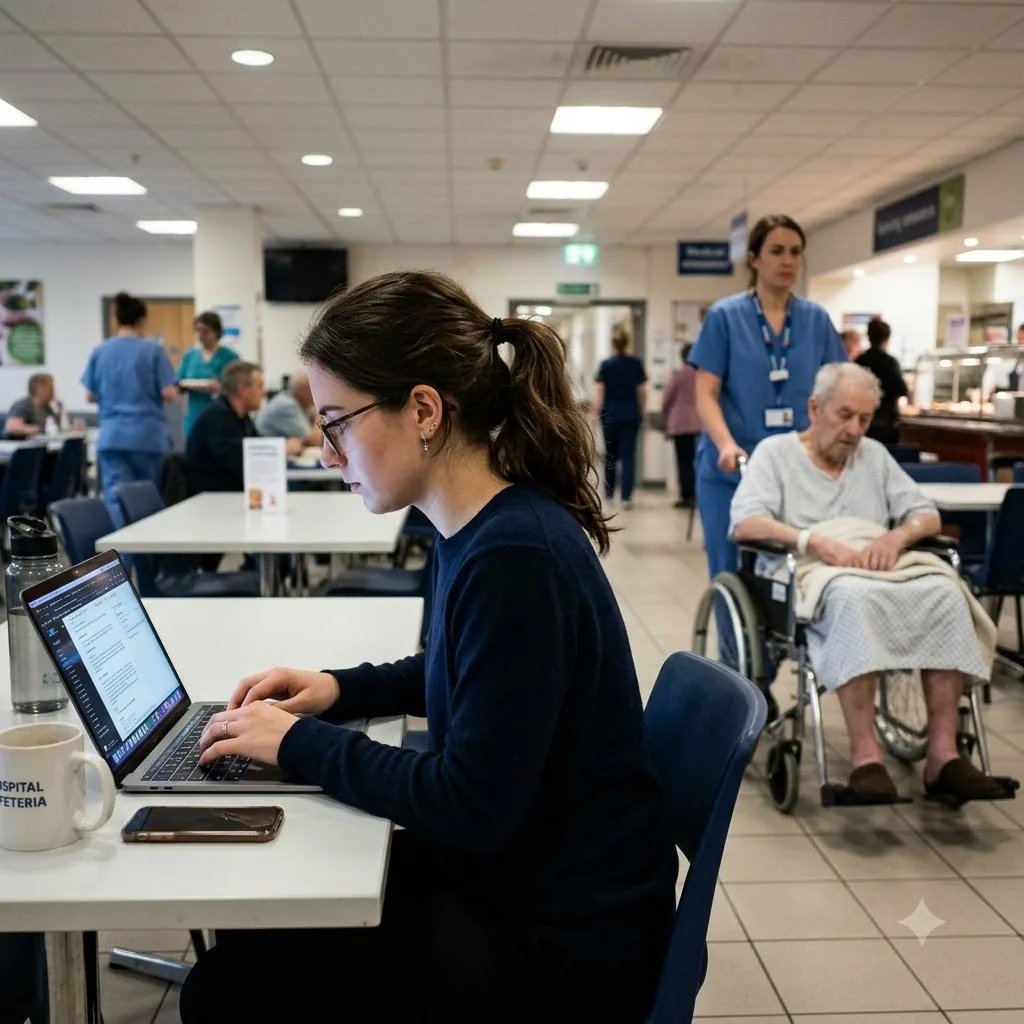
Emily sat in the plastic chair beside the bed. She looked at her tote bag, where the laptop now rested like a heavy, useless brick. For weeks, that machine had been her impenetrable shield. It had allowed her to translate his agonizing suffering into digestible metrics, to distance herself from the smell of industrial bleach and the sight of black vomit by hiding behind engagement numbers and fabricated quotes. She had built a fortress of digital noise to drown out the terrifying sound of his rattling breath.
Now, the noise was entirely gone. There were no more updates to draft. No more metrics to check. No more algorithms to appease. The audience had left the theater, taking their digital wallets with them.
She looked at David. He was not a warrior. He was not an inspiration. He was just her little brother, and he was shivering under a thin cotton blanket.
Emily reached out, carefully moving past the clear plastic tubing of the oxygen cannula, and took his bruised hand. He did not flinch away this time. His skin was freezing, the pulse at his wrist weak and fluttering wildly against her palm.
“I’m sorry,” she whispered, the tears finally spilling hot and fast down her cheeks, entirely unrecorded.
David didn’t open his eyes, but his fingers curled weakly around hers. “Can we just go home now?” he rasps, his voice barely rising above the steady, mechanical hiss of the oxygen concentrator.
“Yes,” Emily said, the word catching painfully in her throat. “We’re going home.”
She sat with him in the dim, sterile corner of the recovery bay, holding his hand as the hospital rushed on around them. The laptop remained shut in her bag, the screen dark, the illusion completely shattered. There was nothing left to sanitize, nothing left to spin. There was only the absolute, suffocating silence of the room, and the terrible reality of sitting beside him in the dark, finally waiting for the end.