Story code: ST-001119
Part 3: Project Treehouse
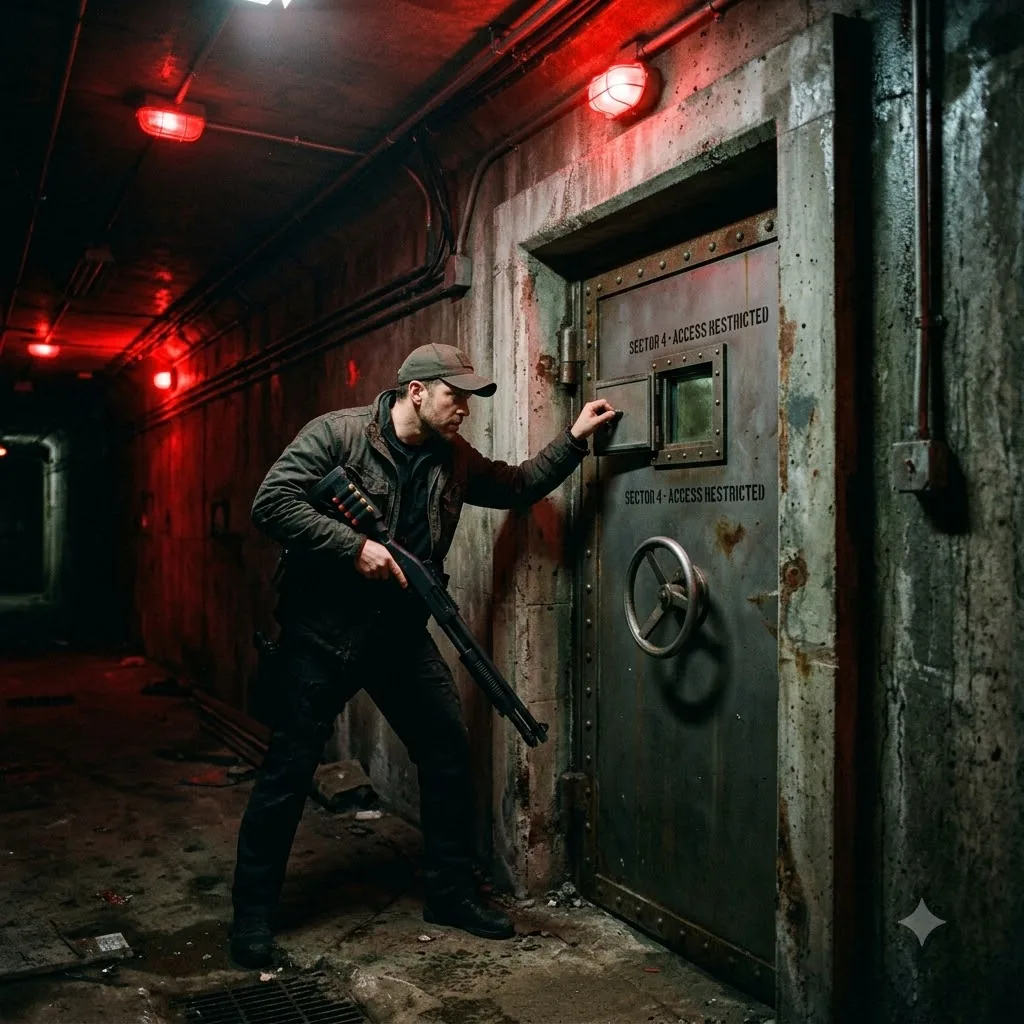
Arthur’s hand remained clamped around the red hydraulic release lever, his knuckles white against the steel. The blue targeting laser of the thermal drone cut through the rain, resting directly on the center of Elena’s muddy tactical jacket. The bunker’s automated systems hummed beneath his feet, a symphony of perfect, calculated survival. If he pulled the lever, the titanium door would take twelve seconds to retract and twelve seconds to seal. Twenty-four seconds of absolute vulnerability.
His mind, honed by a decade of ruthless isolation, instantly ran the caloric and oxygen math. His carbon dioxide scrubbers were optimized for two resting adults. Five panicked adults would overwhelm the filtration medium in sixteen months. Rations would deplete in eight. Inviting them inside was not a rescue; it was a slow, collective suicide. He stared at his daughter through the three-inch ballistics glass, his jaw locked. He could not pull the lever. The survivor in him simply would not allow it.
Through the viewport, Elena waited. One second. Two seconds. The heavy steel door remained motionless.
Arthur expected her to scream, to hammer her fists against the unyielding glass as the drone hovered closer. Instead, the raw desperation simply evaporated from her face. Her shivering stopped. She wiped a mixture of rain and clay from her eyes, looking at Arthur not with the pleading gaze of a terrified child, but with the cold, diagnostic stare of someone confirming a disappointing hypothesis.
She turned away from the glass. “He’s not going to do it,” she said over her shoulder.
Arthur frowned, leaning closer to the viewport. “Elena, run! The drone-”
She ignored him entirely. She gestured to the woman with the hollowed-out stare, who immediately dropped her heavy canvas duffel bag onto the wet concrete of the kill box. The woman unzipped it, revealing not clothes or scavenged food, but a ruggedized, military-grade field terminal.
Arthur watched in mounting confusion as Elena pulled a steel pry bar from her coat. She jammed the tool behind the hardened exterior intercom panel-the very panel Arthur had spent three agonizing days soldering to ensure an impenetrable perimeter loop. With a violent, practiced jerk, she snapped the housing right off the concrete wall, exposing the raw telemetry trunk lines.
“Elena! What are you doing? Step away from the circuitry!” Arthur shouted, slamming his palm against the console intercom.
The audio feed immediately shrieked with static, then cut out entirely.
On Arthur’s command console, the primary diagnostic monitors flashed a brilliant, blinding yellow. *EXTERNAL PORT BREACH – SECTOR 4.* Elena grabbed a thick data cable from the duffel bag and spliced it directly into the exposed hardwiring.
Panic, cold and sharp, finally pierced Arthur’s methodical calm. He lunged for his keyboard, his fingers flying across the keys to initiate the physical air-gap protocol. He needed to electrically isolate the outer perimeter from the subterranean core before she triggered a short circuit.
He slammed the enter key. A red dialog box snapped onto his screen. *ACCESS DENIED.*
“Impossible,” Arthur whispered, typing furiously. “System lock. Protocol Omega. Execute.”
*ACCESS DENIED.*
The main screen of his console suddenly went black. A single, blinking white cursor appeared in the top left corner, completely bypassing his state-of-the-art security suite. It was the foundational command line of the bunker’s base operating system-the closed-loop smart-grid architecture he had built from scratch a decade ago.
A prompt materialized on his screen, the letters appearing in rapid succession as they were typed from the field terminal outside.
`ENTER MASTER ADMIN OVERRIDE:`
Arthur’s breath caught in his throat. He hadn’t seen that specific command prompt in ten years.
Characters began to populate the password field, masking as asterisks on the external terminal but displaying in plain text on Arthur’s master console.
`P-R-O-J-E-C-T-T-R-E-E-H-O-U-S-E`
Arthur staggered back, his hip catching the edge of the steel desk. *Project Treehouse.* It was the codename they had come up with together when she was fourteen, sitting at the kitchen table with graph paper and colored pencils. It was back when this bunker was just a blueprint, a shared father-daughter engineering puzzle, long before it metastasized into his paranoid obsession. He had hard-coded it into the master firmware and never bothered to change it, absolutely certain no one on earth would ever reach the physical port to type it.
`ACCESS GRANTED.`
His entire console shifted from red emergency lighting to a calm, steady green.
Outside, the blue laser of the thermal drone violently jerked. Arthur looked up at the viewport monitor just in time to see the pneumatic cover of his Sector 4 automated kinetic turret snap open. He hadn’t authorized the deployment. The heavy machine gun swiveled upward, its tracking servos whining loudly enough to penetrate the thick glass. It locked onto the tree canopy.
A deafening, three-second burst of tracer fire illuminated the dark ravine. The thermal drone exploded into a shower of burning lithium and shattered plastic, tumbling uselessly into the mud beyond the thorn bushes.
Arthur stood completely frozen, his hands hovering over a dead keyboard.
The intercom crackles back to life, but the audio was no longer tinny or distorted. Elena had routed the external mic directly through his central command speakers. Her voice filled the underground room, stripped of all earlier panic, echoing with an authoritative steel that made Arthur feel entirely obsolete.
“Target neutralized,” Elena said.
The man with the rifle lowered his weapon, nodding. He reached into his pack and pulled out heavy-duty steel mounting brackets. The wounded man stepped forward, unspooling thick coils of heavy-gauge copper transmission wire.
“Elena,” Arthur stammers, pressing the dead microphone button out of pure muscle memory. “What are you doing? You just fired my turret.”
“Your external smart-grid is severed from the inner bunker, Arthur,” she said, staring directly into the lens of the one camera she hadn’t blinded. “You can keep the blast doors shut. You can keep your air scrubbers and your eighteen months of perfectly calculated rations. We never wanted them.”
Arthur stared at the monitors in horror. The trio wasn’t trying to breach the physical door. They were climbing the steel scaffolding of his outer perimeter wall.
“Then why are you here?” Arthur whispered, watching the telemetry screens systematically lock him out of his own surface sensors.
“There are three hundred displaced people camped two miles up the ravine,” Elena’s voice rang through his flawless, empty sanctuary. “We have water, and we have tents. But our medical ward needs electricity, and the militias have drones. I’m commandeering your perimeter wall to bolt on our solar arrays, and I’m tying them into your deep-cycle battery banks to power my camp.”
On camera three, the man with the splint began drilling heavy masonry bolts directly into Arthur’s reinforced concrete, preparing to link the refugee camp’s makeshift grid to the bunker’s massive power reserves.
“You can’t do that,” Arthur said, his voice trembling. “The surface grid is my primary defense line. You’re leaving me blind.”
“Don’t worry,” Elena replied, the rhythmic tapping of her keyboard bleeding through the audio feed. “I’m leaving your internal life support untouched. You have exactly what you always wanted. Enjoy the quiet.”
The intercom snapped off. One by one, the exterior camera feeds went black, leaving Arthur staring at his own pale reflection in the monitors, perfectly safe, and entirely powerless.