Story code: ST-001167
Part 2: The Threat Response
Elias recognized the posture instantly. He had seen civilians and combatants at checkpoints make that exact same subtle shift in weight just before triggering a concealed device. The silent panic button. A cold, heavy knot dropped into his stomach.
He peeled his hands off the bulletproof glass, leaving damp, smudged prints on the pristine surface. He took one deliberate step backward, raising his open palms to his chest. He kept his movements slow, consciously telegraphing his lack of hostility.
“I am stepping back,” Elias said. He pitched his voice higher to hear himself over the high-pitched whine in his skull. “I am not a threat. I am just trying to file my paperwork.”
The clerk stared at him, her lips pressed into a bloodless line. She wasn’t seeing a man fighting to keep a roof over his head; she saw an incident report, a reason to lock down her station.
The heavy, metallic thud of the waiting room’s double doors disengaging sounded like a gunshot.
Elias’s combat instincts surged, flooding his veins with ice water. His peripheral vision snapped toward the movement. Without thinking, his mind categorized the new variable: male, late forties, armed. A federal security contractor in a crisp navy uniform walked briskly down the empty row of bolted chairs, his right hand resting on the butt of a yellow Taser, his left hand gripping a lapel microphone.
Elias’s jaw locked. He smelled the ozone scent of the air conditioning mixed with harsh pine soap. The absurdity clawed at his throat. There was no one else here. No crowd to disturb. Just a broken machine, a terrified clerk, and a man three days away from living on the pavement.
“Everything alright, Brenda?” the guard asked, his eyes locked on Elias.
The intercom crackled. “He’s refusing to leave the counter. He doesn’t have a ticket.”
“Alright, buddy,” the guard said, stopping exactly ten feet away. A textbook safe reactionary gap. “Let’s take a walk.”
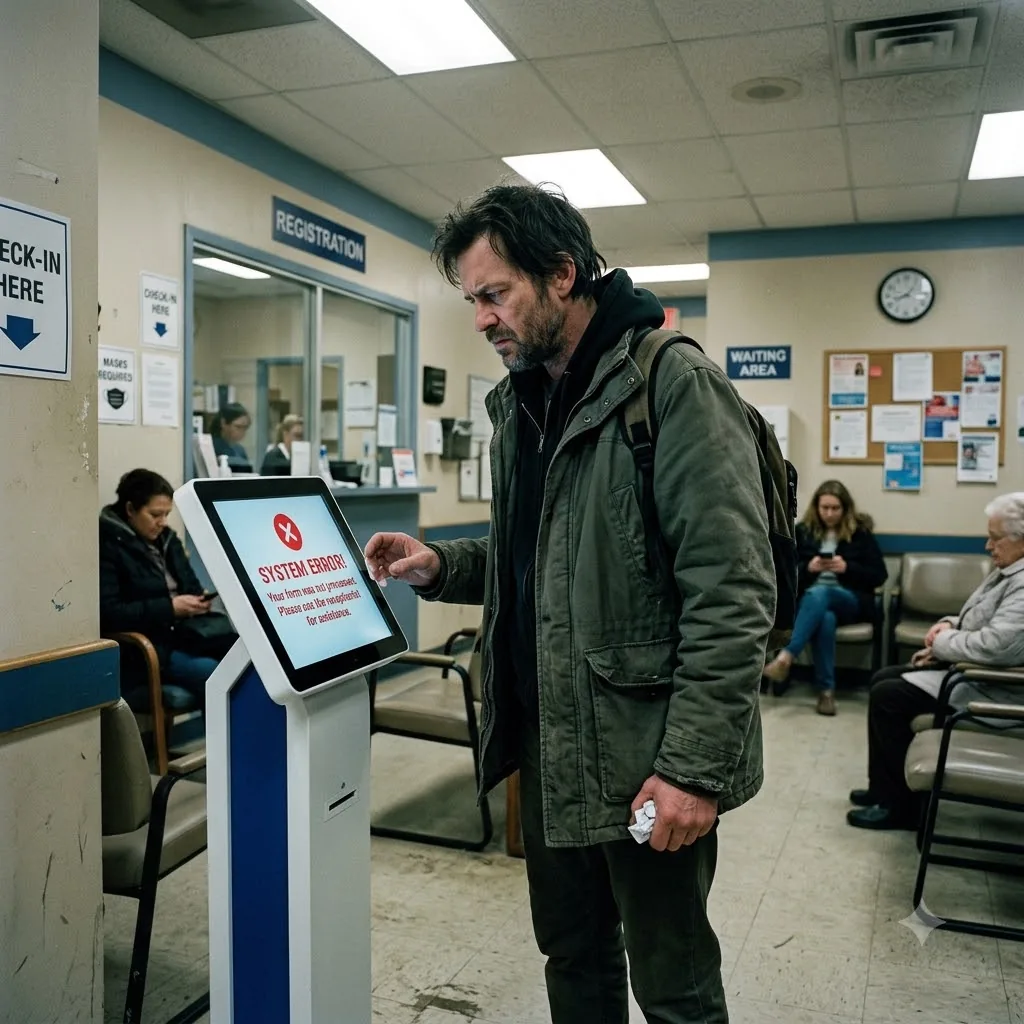
“My ID and my appeal form are in the tray,” Elias said, hands visible. The tremor in his vocal cords crept into his fingers. “I just need her to stamp it. The intake kiosk is broken. I tried it four times.”
“I’m not going to ask twice,” the guard said, unsnapping the rigid retention strap on his Taser holster. The sharp snap of heavy leather echoed harshly. “Step away from the counter and exit the building.”
The ringing in Elias’s left ear flared into a deafening siren. The fluorescent lights strobed, casting jagged shadows across the edges of his vision. His breath hitched, turning shallow. He recognized the physiological cascade ripping through his nervous system. His amygdala screamed that he was trapped, backed against a wall by a hostile force. His muscles coiled automatically, preparing to close the distance, to control the weapon hand, to neutralize the threat.
*No,* Elias told himself, digging his fingernails into the calluses of his palms until the dull pain pierced through the panic. *No. If you touch him, it’s over. If you get arrested, you lose everything.*
“Look,” Elias choked out, trying to physically soften his rigid posture, trying desperately to make himself look smaller. “Look at the machine. Please. It’s flashing an error code. I exist. I’ve been in the VA system for six years. Just watch me scan the card.”
The guard didn’t look at the kiosk or the empty chairs. He looked only at Elias’s broad shoulders, his tightly clenched jaw, and his worn utility jacket.
“Sir, if you do not comply, you will be forcefully removed,” the guard warned, speaking into his mic. “Control, I have a non-compliant male at intake window three. Requesting backup.”
“Wait,” Elias pleaded, his voice cracking. “Please. It’s Thursday afternoon. If I don’t get this stamped by five, the sheriff locks me out on Friday morning. I have nowhere else to go. Just tell her it’s broken so she can manually enter the ID.”
Elias risked a glance at the glass. The clerk had finally brought her hand up. She was typing rapidly on her keyboard, her eyes fixed exclusively on her monitors. She was ignoring him entirely.
“Step away from the tray,” the guard ordered, closing the gap to five feet.
Elias looked at his worn plastic ID and the creased eviction notice sitting in the steel depression. If he walked away, he was homeless. If he stayed, he was going to be violently restrained. The blind bureaucratic machinery had caught him in its gears, entirely indifferent to crushing him.
He slowly lowered his hands. He took a deliberate half-step toward the counter to retrieve his documents. He needed his ID.
The guard severely misinterpreted the sudden movement.
“Hey!” The guard barked, lunging forward.
The guard’s heavy hand clamped down hard on Elias’s left shoulder, thick fingers digging into the jacket, yanking him forcefully backward.
Before Elias could process the conscious command to stay limp, his body violently rebelled. Years of deeply ingrained muscle memory bypassed his logical brain. The instant the guard’s grip tightened, Elias pivoted sharply. His right hand shot up in a blur to trap the guard’s wrist, while his left arm drove up, breaking the hold with a rigid, punishing block.
It was a defensive maneuver, perfectly executed to break a hostile grapple. But the sheer kinetic force sent the guard stumbling backward. The man’s black boots squeaked wildly on the freshly waxed floor as he desperately fought for balance.
The guard caught himself against a row of plastic chairs. His face flushed a deep crimson with sudden fear and adrenaline. Without hesitating, he ripped the bright yellow Taser from its holster and leveled it at Elias’s chest.
Two trembling red laser dots danced frantically across the center of Elias’s faded jacket.