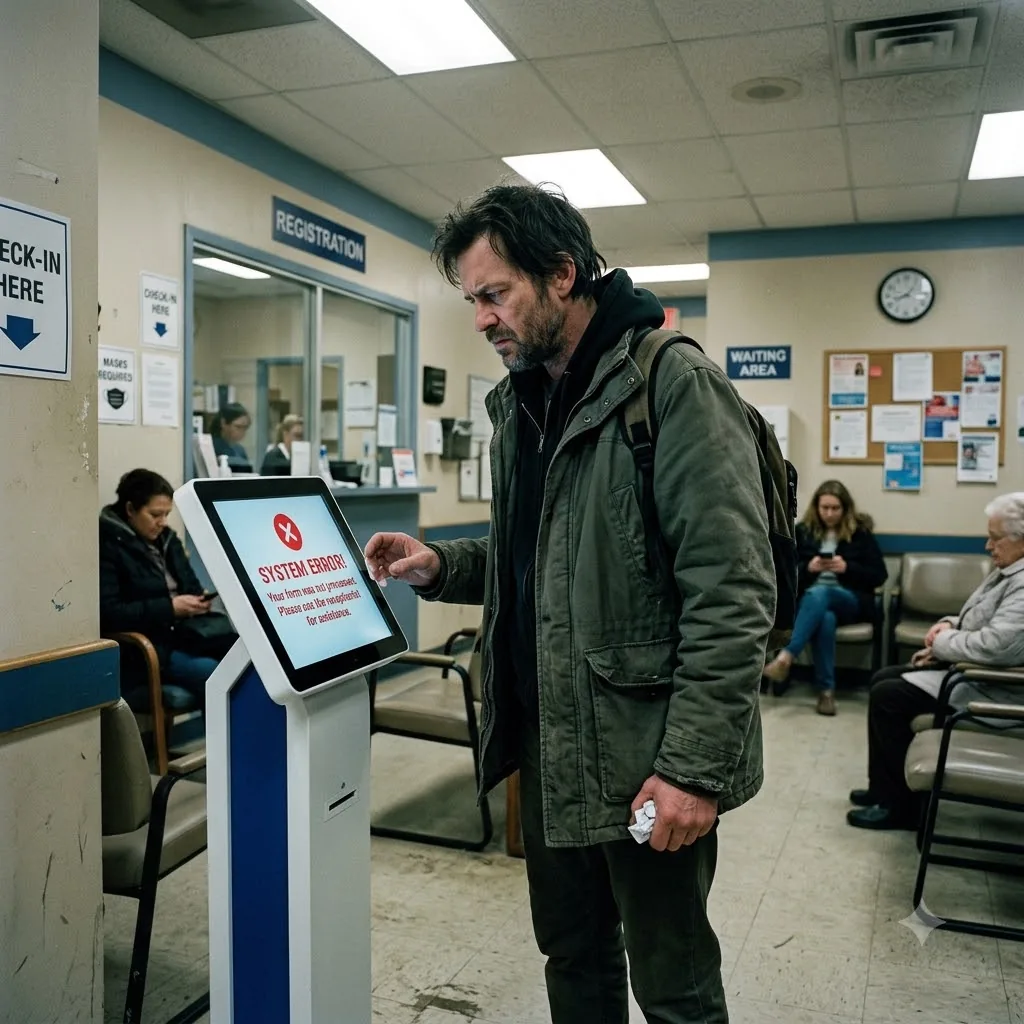
Story code: ST-001167
Part 3: The Reflection
The two red laser dots danced violently across the faded canvas of Elias’s jacket. They tracked erratic figure-eights over his sternum, exposing the severe tremor in the guard’s hands. The sharp tang of ozone and nervous sweat cut through the sterile waiting room air.
“Get on the ground!” the guard screamed. His voice was an octave higher than it had been a minute ago, entirely stripped of its authoritative baseline. His knuckles were bone-white around the yellow plastic grip of the Taser.
Elias did not flinch. The roaring in his ears-the physiological siren of a triggered fight-or-flight response-began to compartmentalize. The sheer proximity of the weapon forced his mind into a cold, hyper-focused tactical clarity. He kept his hands raised, palms open, completely motionless.
“I am complying,” Elias said. His voice was a low, resonant rumble, purposefully engineered to de-escalate. “I am moving slowly. I am going down to one knee.”
“Face down on the linoleum! Now!”
“Kneeling,” Elias narrated, ignoring the panicked command. Moving too fast, even to surrender, would trigger the guard’s twitching index finger.
Elias sank slowly. His right knee met the cold, scuffed linoleum with a soft thud. He kept his torso perfectly vertical, maintaining his center of gravity.
From this lowered angle, the harsh fluorescent glare of the waiting room shifted. The heavy bulletproof glass separating him from the clerk no longer caught the overhead lights. Instead, the darkened waiting room transformed the thick acrylic pane into a massive, shadowy mirror, perfectly reflecting the brightly lit interior of the clerk’s booth.
Elias kept his head perfectly still, his eyes locked forward. The guard stood just out of his peripheral vision, breathing in ragged, shallow gasps. But Elias wasn’t looking at the guard anymore. He was staring at the reflection in the glass.
Because the clerk had rolled her chair backward in fear, her primary monitor was fully visible, mirrored in high definition across the bulletproof pane.
Elias’s eyes tracked across the reflected interface. It was not the stark, utilitarian blue of a standard federal database. At the top of the mirrored screen sat a crisp, silver logo: a stylized osprey clutching a geometric wave.
The breath caught in Elias’s throat. His chest tightened, the cold clarity of his tactical focus instantly shattering.
He knew that logo. He had stared at it every day for six months. It was Pacific Vanguard Management. The coastal private-equity firm. Two years ago, they had bought the steel plant that anchored his hometown, immediately gutted the workers’ pensions, chained the gates, and liquidated the blast furnaces for scrap. He remembered that silver osprey printed on the heavy, weather-resistant padlocks that locked him and four hundred other men out of their livelihoods.
Now, that same silver bird sat perched at the top of the Department of Veterans Affairs intake software.
Elias’s eyes darted down the reflected screen. Beneath the corporate logo, a harsh block of red text dominated the interface. The letters were backward, but Elias had spent ten years in command tents reading troop movements written in grease pencil on the opposite side of transparent tactical boards. His brain flipped the mirrored text effortlessly.
`ID_SCANNED: [REDACTED]`
`ZIP_CLASSIFICATION: TIER 4 RURAL`
`STATUS: MANUAL OVERRIDE LOCKED`
Elias blinked, his mind struggling to bridge the gap between the broken kiosk in the waiting room and the bright red text on the clerk’s private monitor.
He looked at the kiosk in the corner. Then back to the reflection.
The kiosk wasn’t broken. It wasn’t failing to recognize his card. It was working perfectly.
Elias traced the next line of red text in the glass.
`RURAL_QUOTA_MET. INTAKE_DISABLED.`
`AGENT_ACTION: REDIRECT TO KIOSK.`
The heavy, invisible weight pressing down on his chest suddenly vanished, replaced by a scorching wave of clarity. The blind, crushing bureaucracy wasn’t a glitch. It was a feature. The system was actively filtering out the expensive, geographically distant rural claims. It was designed to force attrition. To make them give up. To turn them into ghosts.
“Hands behind your back!” the guard yelled, stepping laterally, trying to establish a better angle. “Do it now!”
Elias ignored him. He lowered his hands and placed them flat on his raised thigh. He looked through the reflection, directly into the eyes of the clerk on the other side of the glass.
She had frozen in her chair. She wasn’t looking at her monitor. She was staring at Elias, watching his eyes track the reflection.
“It’s not broken,” Elias said. His voice echoed across the empty, quiet room. It held no anger, only a devastating, hollow realization.
The guard paused, confused by the sudden shift in tone. “I said hands behind your back!”
“Pacific Vanguard Management,” Elias said, speaking directly to the glass, projecting his voice through the perforated speaker grill. “They wrote the software. They bought the contract.”
The clerk’s shoulders stiffened. Her hand drifted away from her keyboard.
“Manual override locked,” Elias continued, reading the reversed text aloud, word for word. “Zip classification: Tier Four Rural. Rural quota met. Intake disabled.”
The clerk’s face drained of color. Her jaw clamped shut. She looked desperately down at her keyboard, refusing to meet his gaze.
“You couldn’t punch my number in even if you wanted to,” Elias said, his voice rising, slicing through the heavy air. “You didn’t need a ticket from the kiosk. The kiosk just reads my zip code and locks you out. The software won’t let you process a rural claim.”
“Hey!” the guard barked, stepping closer. The red laser dots drifted up to Elias’s throat. “Shut up and turn around!”
“Look at her screen!” Elias yelled, pointing a single, rigid finger at the thick glass. “Look at what she’s looking at!”
The guard flinched, his eyes darting involuntarily toward the clerk’s booth.
Through the glass, the clerk slammed her hand against her mouse, furiously trying to minimize the intake window. But the system lagged, frozen on the bright red error screen. The silver osprey glared down at them, a silent monument to the algorithm quietly erasing Elias’s life.
Elias stood up slowly, ignoring the frantic dancing of the lasers on his chest.
“It tells you to redirect me to the kiosk,” Elias said, his voice dropping back to a quiet, dangerous whisper. “You knew it would just kick me out again. You were just waiting for me to leave.”
The clerk sat utterly paralyzed behind her impenetrable wall, staring at the man she had been instructed to ghost, with absolutely nowhere to hide.