Story code: ST-001248
Part 2: The Liquidation Vulture
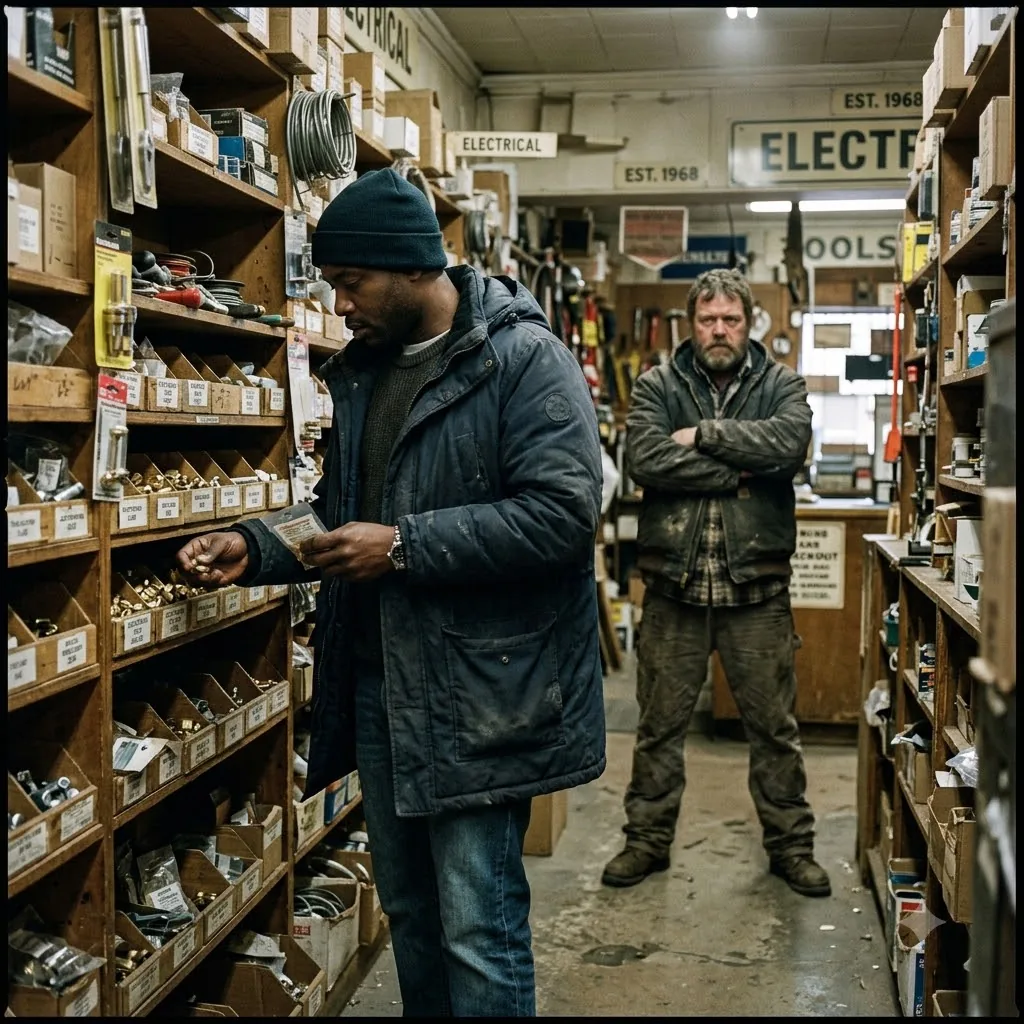
Marcus twisted his torso, a precise, calculated pivot that caused the clerk’s thick fingers to close on empty air. The sudden evasion threw the man-whose brass tag read *DALE* in stamped black lettering-momentarily off balance. Dale’s heavy work boots squeaked loudly against the scuffed linoleum as he caught himself, his ruddy face flushing a deep, dangerous crimson beneath the harsh fluorescent lights.
“Keep your hands off me,” Marcus said. His voice was low, devoid of the panic Dale clearly expected. He kept the four heavy two-hundred-amp fuses cradled securely in his left arm, making no sudden moves, keeping his right hand visible at his side.
“Oh, we got a tough guy,” Dale sneered. He did not step back. Instead, he occupied the center of the aisle with renewed aggression, his broad chest rising and falling, the heavy canvas of his apron shifting with each breath. “A tough guy who likes to stuff his expensive pockets with our inventory.”
“I am checking my notebook for panel specifications,” Marcus replied, keeping his tone measured and level. “I intend to pay for these four fuses, and I was going to ask if you had two more in the backroom. I need six in total.”
Dale let out a sharp, barking laugh that echoed off the high, corrugated steel ceiling. “Yeah, right. You’re outfitting a main panel. Nobody in this zip code uses two-hundred-amp commercial cartridges anymore. Not since the stamping plant shut down five years ago. Try another lie, slick.”
Without breaking eye contact, Dale turned his head just enough to bellow toward the front of the store. “Hey, Arnie! Hit the deadbolt! We got a booster in aisle four!”
The sound of a heavy metal latch sliding firmly into place reverberated through the quiet store. The click was definitive, a sharp mechanical punctuation that instantly shifted the atmosphere from hostile to actively dangerous. Marcus stood motionless, assessing the tactical disadvantage of the narrow space. The towering shelves of heavy chains to his right and discounted pressure washers to his left offered zero lateral movement. The locked door blocked the front exit.
“That is false imprisonment,” Marcus stated, maintaining a steady, unblinking gaze. “I strongly suggest you tell Arnie to unlock that door.”
“I strongly suggest you empty your damn pockets,” Dale countered, taking a heavy step closer. The pervasive scent of chemical fertilizer and stale sweat rolled off him, thick and suffocating. “You come in here, dressed like some Wall Street parasite, pacing my aisles, casing the expensive hardware. You think because this town is hurting, we’re just a bunch of rubes you can pick clean?”
Before Marcus could formulate a de-escalating response, the heavy squeak of rubber soles approached from behind him. He glanced over his shoulder. Two men had rounded the far endcap, effectively sealing off Marcus’s only avenue of retreat. Both wore heavily insulated canvas jackets stained with old motor oil and sawdust. One held a long, iron pipe wrench, tapping it rhythmically against his thigh. They moved with the synchronized, unspoken coordination of men who had spent years working side-by-side on dangerous factory floors.
“Problem, Dale?” the man with the wrench asked, his voice a low, gravelly drawl that carried easily over the persistent hum of the failing lights.
“Just waiting on our guest here to turn out his pockets, Roy,” Dale said, flashing a humorless, tight-lipped grin. “He says he’s outfitting a main panel. Says he needs the heavy commercial fuses.”
Roy stopped six feet behind Marcus, leaning his shoulder against a stack of fifty-pound concrete bags. “Is that so? Odd. Power company locked out the main grid substations last month. Nobody’s authorized to pull that kind of amperage in the valley unless they’re from the bank. And bank boys don’t do their own electrical work.”
The claustrophobia of the aisle magnified as the three men tightened the perimeter. The ambient hum of the fluorescent tubes felt deafening in the heavy silence that followed. Marcus calculated his options, his mind working with the same ruthless efficiency he applied to corporate acquisitions. A physical altercation would result in the police being called, which would delay his schedule, generate a chaotic public spectacle, and potentially jeopardize the delicate infrastructure repairs he needed to initiate by nightfall. This town was teetering on the edge of total bankruptcy; these men were acting out of desperate, misplaced protectionism. They were guarding the ruins of their livelihood.
“I assure you, I am not stealing,” Marcus said, carefully shifting the four heavy fuses entirely into the crook of his left arm so his right hand was completely free. “If you will permit me, I will reach into my inner pocket, retrieve my notebook, and show you the schematics I am working from. Then I will reach into my back pocket, retrieve my wallet, and pay for these items.”
“You aren’t reaching for a damn thing,” Dale snapped, the brass name tag on his chest catching the light as he shifted his weight. “I know a skell when I see one. You’re grabbing copper and high-end ceramics to fence them. Or worse, you’re one of those liquidation vultures here to strip the copper out of the old mill before the bank auctions it off. Either way, you’re a thief.”
The accusation hung heavy in the stale, dust-filled air. The men behind Marcus shuffled closer, the rhythmic tapping of the pipe wrench ceasing entirely as they prepared for a struggle. The tension in the aisle was pulled as tight as piano wire.
Marcus realized logic and words were failing to penetrate their defensive anger. He slowly lifted his right hand, keeping his palm open and visible, intending to slowly unbutton his coat to prove he had absolutely nothing concealed within the lining.
Dale’s eyes tracked the movement, instantly misinterpreting the slow, deliberate action near the lapel as a prelude to drawing a weapon. “I said no!”
Dale lunged again, this time with both hands, bypassing the fabric of the coat and violently seizing Marcus by the right wrist and collar. The sudden, immense kinetic force of the heavy-set clerk drove Marcus backward. His shoulder slammed hard into the metal pegboard, knocking a row of heavy brass padlocks off their hooks. They crashed to the linoleum with a deafening clatter, echoing through the empty store.
The sheer impact jarred Marcus’s coat wide open. The leather-bound notebook he had tucked loosely into the interior pocket slipped free, tumbling through the air. It landed splayed open on the dusty floor, coming to rest inches from Dale’s scuffed steel-toed boots.
Dale firmly pinned Marcus’s arm against the shelving, his breath hot and ragged against Marcus’s face, but his gaze instinctively dropped to the fallen notebook. The exposed page was covered in detailed blueprints of the town’s entire commercial grid, overlaid with thick red ink slashing through the old property lines. Bold, black letters printed at the top of the visible document read: *MUNICIPAL FORECLOSURE & LIQUIDATION ASSETS.*
Dale’s face contorted, the righteous anger of a protective clerk morphing instantly into a cold, venomous hatred. He looked up from the notebook, locking eyes with Marcus as he pressed his thick forearm even harder against Marcus’s collarbone, cutting off his air supply.
“I knew it,” Dale hissed, his grip on Marcus’s wrist tightening like an industrial vice. “You aren’t just a petty thief. You’re the corporate bastard the bank sent to tear the rest of our town apart.”