Story code: ST-001248
Part 4: The Rusted Skeleton
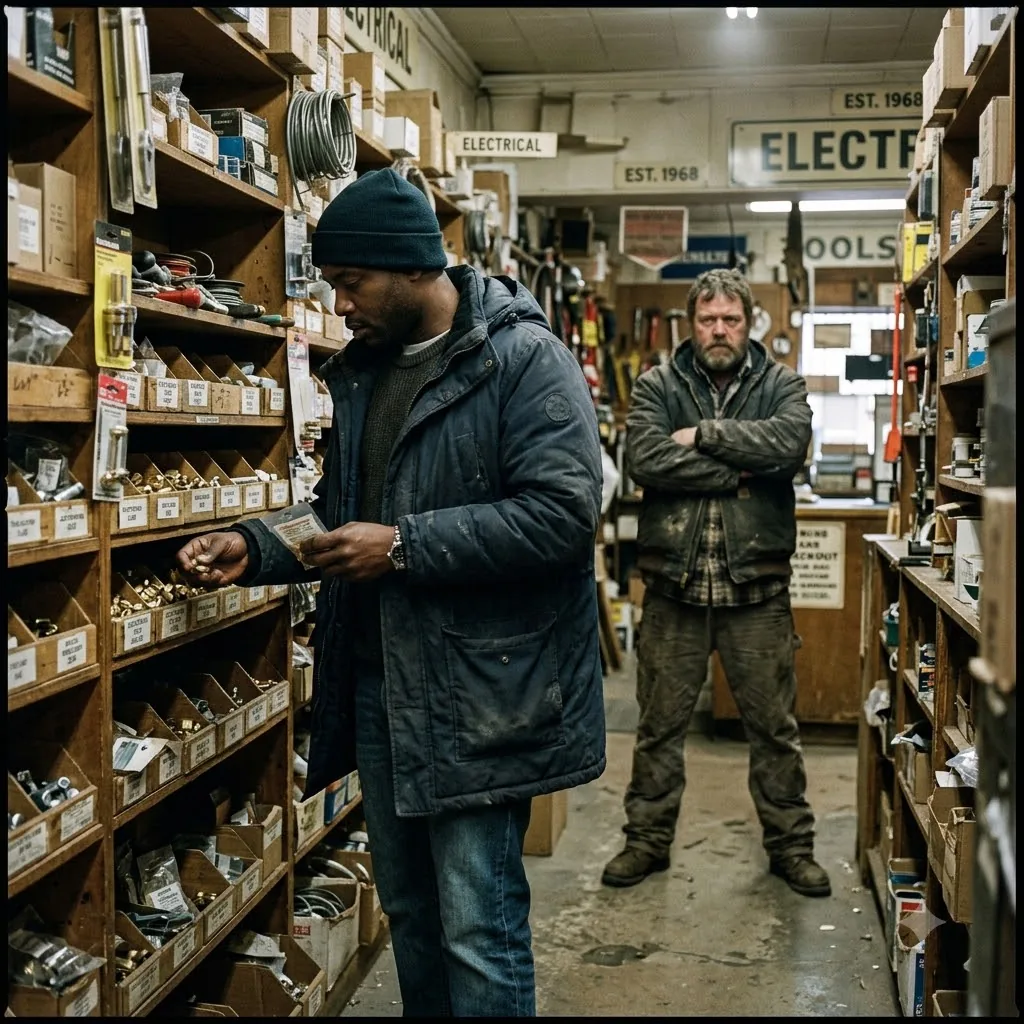
The silence at the checkout counter stretched into a suffocating vacuum, broken only by the persistent, failing hum of the overhead fluorescent tubes. Dale remained rooted to the scuffed linoleum, his thick shoulders slumped as he stared at the brushed-metal corporate card. The fight had drained entirely out of him, replaced by the hollow realization that the man he had tried to intimidate was the architect of his town’s final erasure.
Marcus did not break his calm exterior, but beneath the tailored charcoal wool of his coat, a cold bead of sweat tracked down his spine. He shifted his gaze from Dale to the man standing behind the register.
“Arnie, was it?” Marcus asked, his voice steady. “I still need two more of these cartridges to complete the array. I assume you have them in the backroom.”
Arnie swallowed hard, his Adam’s apple bobbing above the collar of his faded flannel. He looked at Dale for permission, but Dale was staring blankly at the scratches on the fiberglass countertop. Without a word, Arnie turned and shuffled through a swinging wooden door behind the register. He returned thirty seconds later with two dust-coated commercial fuses, setting them gently beside the other four.
Arnie typed the SKUs into the ancient point-of-sale system. The mechanical beeps of the register sounded obscenely loud in the quiet store.
“Four hundred and eighty dollars,” Arnie mumbled, refusing to meet Marcus’s eyes.
Marcus tapped the platinum SunForge card against the terminal. A small green light flashed, approving a transaction that cost more than this store likely made in a typical week. Marcus picked up the six heavy ceramic and metal fuses, stacking them carefully into his arms. He retrieved his card and slipped it back into his minimalist wallet.
“Unlock the deadbolt,” Marcus said.
Roy, still holding the pipe wrench loosely at his side, stepped backward to clear the path. He looked defeated, a man guarding a fortress that had already been conquered by paperwork months ago. Arnie reached under the counter and pressed a button. A loud electronic buzz signaled the release of the heavy locking mechanism on the front doors.
Marcus walked out, his polished leather oxfords leaving the stale air of fertilizer and sawdust behind.
The moment he pushed through the glass doors, the biting cold of the Pennsylvania afternoon hit him. The sky had bruised into a deep, purple-gray gradient, and freezing sleet was falling in sharp, diagonal sheets. The icy pellets pinged loudly against the metal roof of the hardware store and bounced off the cracked asphalt of the nearly empty parking lot.
Marcus walked to his rental SUV, a pristine, black luxury vehicle that sat in stark contrast to the rusted pickup trucks parked at the far end of the strip. He unlocked it with a click of his fob, pulled open the passenger door, and deposited the heavy fuses onto the passenger seat. He climbed into the driver’s side, shutting the heavy door to cut off the howling wind.
He started the engine and cranked the heat to maximum. The digital dashboard illuminated, casting a sterile blue glow over his face. Marcus gripped the leather-wrapped steering wheel, his knuckles turning white. The adrenaline was finally beginning to recede, leaving behind a deep, aching exhaustion and a throbbing pain in his collarbone where Dale’s forearm had crushed against him.
He turned on the windshield wipers. They scraped back and forth, clearing the rapidly accumulating sleet.
Through the clearing glass, Marcus looked out across the sloping valley. Just past the edge of the dilapidated commercial district sat the sprawling acreage of the old steel mill. Or, rather, what was left of it. Tuesday’s demolition crews had torn down the primary smelting warehouses and the massive corrugated shipping bays. All that remained against the winter sky was a rusted, skeletal framework of iron I-beams and a towering, defunct smokestack that SunForge was scheduled to implode on Monday morning.
In the corporate boardrooms back in California, the SunForge executives had called this project a “community revitalization initiative.” The slide decks featured bright, computer-generated renderings of gleaming solar arrays, green-collar job training centers, and a thriving local economy reborn from the ashes of fossil fuels. It had all seemed so clinical, so logically benevolent.
But sitting in the idling SUV, looking at the skeletal ruins of the mill, Marcus understood the profound disconnect between the boardroom and the ground. He could still feel the desperate, violent grip of Dale’s calloused hand. He could still see the horrified realization in the clerk’s eyes when he understood the “green-tech people” had arrived to bury the last remnants of their history.
The town did not want to be saved by SunForge. The men inside that hardware store-and the thousands of laid-off workers they represented-viewed the mill as their heritage, their identity, and their pride. Marcus hadn’t just bought their acreage; he had bought the headstone for their entire way of life.
The sleet continued to beat against the windshield, blurring the rusted bones of the mill into a jagged, imposing shadow. Marcus watched the ice accumulate on the glass, a heavy, sinking feeling settling into his chest. The resentment here wasn’t just a localized misunderstanding that could be solved with slick PR campaigns and catered town halls. It was toxic, deeply embedded into the very soil they were trying to build upon, and Marcus realized with cold certainty that no amount of clean energy would ever wash it away.