Story code: ST-000803
Part 3: The Ecosystem
The leather straps of the tote bag burned against David’s palms. He yanked hard, throwing his weight backward. The woman-Sterling-shrieked, a sharp, unpolished sound that shattered her corporate veneer. She stumbled, her designer heels skidding on the linoleum, but she didn’t let go. She clamped both arms around the bag, burying the heavy brass zipper against her camel-hair coat.
“Get your hands off me!” she screamed.
“David, stop!” Dr. Evans yelled.
A heavy hand clamped onto David’s shoulder. The older man who had been reading a magazine in the corner hooked an arm around David’s neck, pulling him backward. Dr. Evans grabbed David’s wrist, prying his fingers loose. The sudden release of tension sent David stumbling into a row of vinyl waiting-room chairs. They scraped loudly across the floor as he went down on one knee.
“Brenda, call the police!” Dr. Evans shouted, breathing heavily, his stethoscope swinging wildly around his neck.
“No,” David choked out. He held up both hands, his chest heaving. He stayed on the floor, staring at the scuffed toes of his work boots. “I’m done. I’m stopping.”
If the police came, he would go to jail. If he went to jail, Maya would be in the county system by midnight. He swallowed the bitter, metallic taste of adrenaline in his dry mouth. He slowly pushed himself up and backed away, pressing his spine against the cool drywall of the clinic.
Sterling was shaking. She brushed her coat down with frantic, trembling hands, checking the zipper of her bag to ensure the pristine white boxes of insulin were still safely entombed. She looked at David with absolute disgust, then took a long, unsteady breath. The mask slipped back into place. It was a terrifying transformation to watch. Within seconds, her posture straightened, her breathing slowed, and the polite, dead-eyed smile returned.
“It’s alright, Brenda,” Sterling said, smoothing her hair. “Don’t call the police. I don’t want to disrupt the clinic’s workflow any further. Unfortunately, patient volatility is just a reality of the healthcare ecosystem.”
She turned her back to David, dismissing him entirely, and stepped toward the reception counter. She reached for the glossy cardboard catering boxes she had brought in.
“As I was saying, Dr. Evans,” Sterling continued, her voice projecting brightly over the lingering tension in the room. She flipped open the lid of the first box. A cloud of steam rose, carrying the heavy, rich scent of seared filet mignon, roasted garlic, and truffle butter. “Novacor understands the transition to the new pricing tier might cause some friction at the ground level. But this adjustment is absolutely vital. It allows us to fund next-generation synthetic analogs. We aren’t just selling medication. We are providing a premium standard of life.”
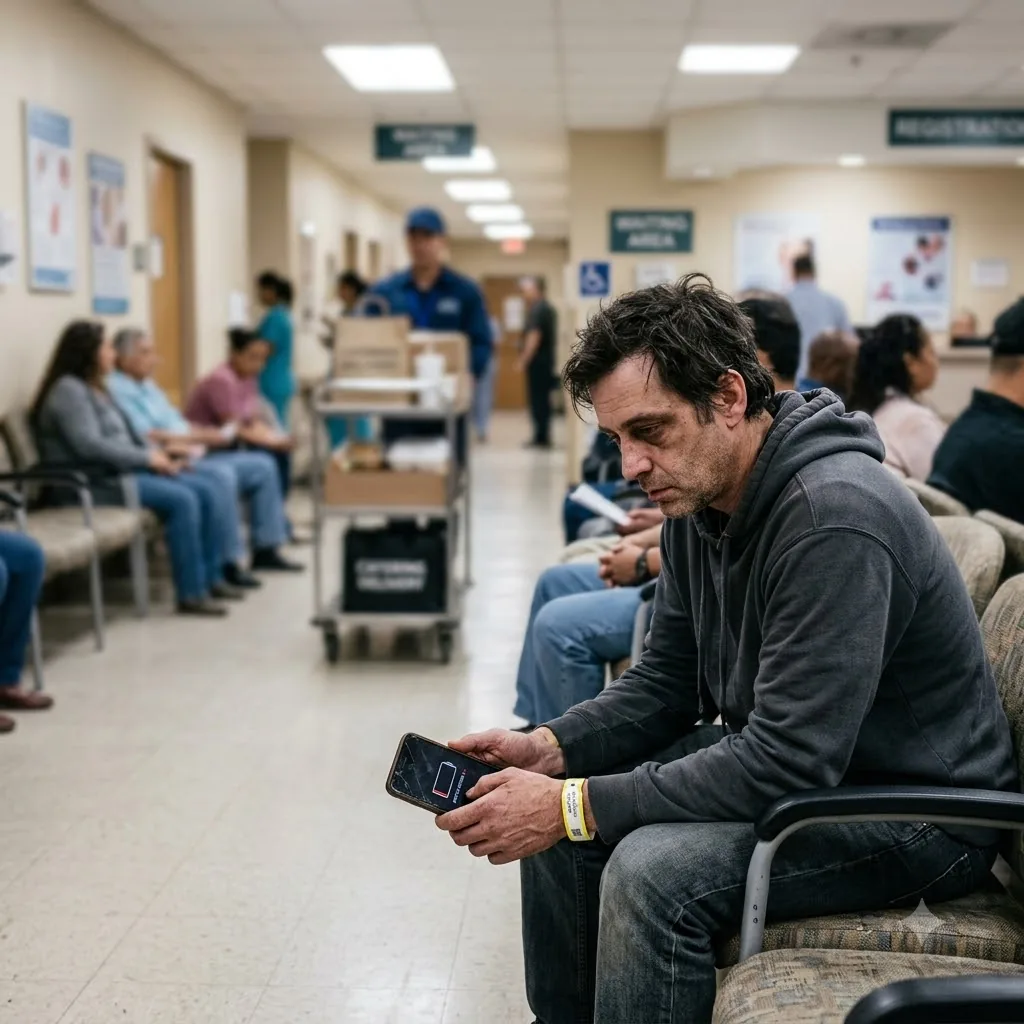
David stood paralyzed against the wall. *A premium standard of life.* He reached into his jacket pocket. His fingers brushed past his dead phone and found a folded piece of cheap printer paper. He had spent his last three dollars at the public library yesterday, printing fifty copies of his GoFundMe page to staple to telephone poles in the rain.
Right next to the paper was the empty vial of Novacor-R. He had brought it with him to show the doctor, a desperate visual aid to prove that the glass was completely, utterly dry.
“Our Q3 metrics show that clinics adopting the new framework see higher patient compliance,” Sterling lectured, gesturing to the open boxes of steak to invite the doctor and receptionist to eat. “When patients invest more in their care, they value the outcomes. It’s a win-win for the clinical ecosystem and the development pipeline.”
David unfolded the piece of paper. The creases were soft and worn from his sweaty hands. He gripped the empty glass vial in his left hand. He stepped away from the wall.
“David,” Dr. Evans warned, taking a half-step forward. “Don’t.”
David ignored him. He walked slowly toward the reception counter, his eyes fixed on Sterling’s back. He didn’t lunge. He didn’t yell. He looked down at the grainy, black-and-white photo of Maya he had printed on the flyer, and he began to read.
“‘My name is David Miller,'” his voice rang out, raw and echoing off the acoustic ceiling tiles. “‘My daughter, Maya, is seven years old. She loves dinosaurs and drawing. Two months ago, she was diagnosed with Type 1 Diabetes.'”
Sterling stiffened. She didn’t turn around. “Dr. Evans, I asked you to secure this waiting area.”
David took another step. “‘I work forty hours a week at a logistics warehouse, but my insurance will not cover her specific insulin tier. The out-of-pocket cost is now three hundred and forty dollars a vial.'”
“We are saving lives, Mr. Miller,” Sterling snapped, finally spinning around to face him. Her face was flushed, her corporate patience wearing thin. “Novacor pours billions into research to ensure your daughter has a future. You have no idea what it takes to bring these therapeutics to market!”
David stopped right next to the catering boxes. The smell of the hot steak made his empty stomach cramp violently. “‘We need three thousand dollars to survive the year,'” he read, his voice rising, cutting through her buzzwords. “‘If we do not hit this goal, we cannot buy her medicine. If we cannot buy her medicine, my daughter will go into diabetic ketoacidosis.'”
“Enough!” Sterling slammed her hand on the reception counter. “I am not listening to this! You are harassing a medical professional!”
David lowered the paper. He looked at Sterling, at the pristine camel coat, the gold jewelry, the heavy leather bag holding six months of Maya’s life just sitting in the dark. Then he looked down at the open catering box. Perfect medallions of seared steak rested on a bed of rosemary sprigs, glistening in the fluorescent light.
“‘If we do not hit this goal,'” David whispered, staring right into Sterling’s eyes. “‘My daughter will die.'”
He raised his left hand. The empty Novacor-R vial caught the overhead light, the gold foil of the double-helix logo flashing one last time.
He slammed the glass vial directly into the center of the catered lunch.
The impact sounded like a gunshot. The thick medical-grade glass shattered against the rigid cardboard bottom of the catering box. Shards of jagged glass exploded outward, sinking deep into the tender slices of filet mignon and tearing through the roasted garlic. Truffle butter splattered across the counter, dotting the sleeve of Sterling’s immaculate coat.
Sterling let out a sharp gasp, jumping backward. Dr. Evans froze. The receptionist covered her mouth.
The waiting room plunged into total silence, save for the faint, pathetic ticking of the wall clock.
David stood over the ruined feast. The steak was glittering with hundreds of razor-sharp fragments of glass, the expensive meal instantly rendered toxic, dangerous, and completely inedible. The gold-foil label of the vial sat on top of the ruined meat, torn exactly in half.
Sterling stared at the box. Her lips parted, but for the first time since she had walked through the clinic doors, no words came out. The corporate script was gone. She looked from the shattered glass to David’s hollow, unblinking eyes, trapped in the wreckage of the ecosystem she had just built.