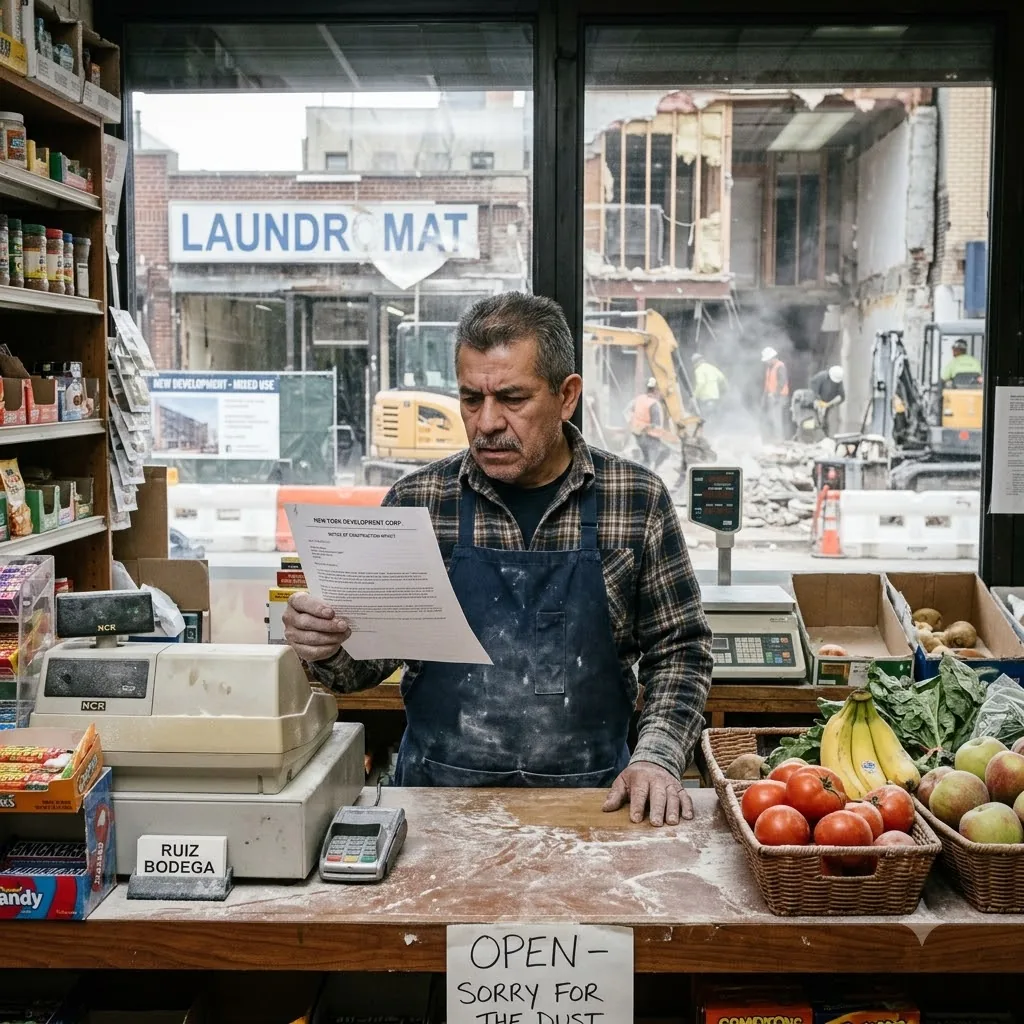
Story code: ST-000994
Part 2: The Devil’s Bargain
The furious speech died in Mateo’s throat, suffocated by the steady, rhythmic pulse of the blinking red light. The words he had rehearsed about the ruined inventory, the unbreathable air in his bodega, and the impossible rent hike evaporated into the chalky dust. He stared down at the young laborer’s ankles. The bulky black plastic bands weren’t just standard monitors; they were thick, heavy, and locked with industrial metal clasps.
Mateo’s eyes darted across the cavernous, gutted laundromat. He looked at the heavily built man struggling with the drywall, then at the men hauling stacks of steel framing studs. As they moved, panting and straining under the oppressive heat of the unventilated room, he saw the same unnatural bulges beneath their frayed jeans. Every single one of them was wired. Every single one of them bore the blinking red light of a captive.
The silence of the fifteen laboring men suddenly made horrifying sense.
“It’s a marvel of modern logistics, isn’t it?” a smooth, unbothered voice echoed across the plywood and concrete.
Mateo snapped his head up. The developer in the tailored charcoal suit stood only a few feet away, entirely at ease amidst the hazardous debris. He didn’t look caught or embarrassed. He looked proud. He tapped the manila folder against his palm, his flat, dead eyes locking onto Mateo.
“Who are you?” Mateo demanded, his voice sounding entirely too thin in the vast, quiet room. “What is this? You have them in chains.”
“I’m Marcus Thorne, and I prefer the term ‘state-partnered rehabilitation,'” the developer said, his thin smile never wavering. “These men made mistakes. Society put them in a box. My company provides them an opportunity to pay their debt through supervised, highly motivated labor. It’s perfectly legal, Mr. Ruiz. Well, the framework is.”
Mateo looked back at the young man kneeling on the floor. The kid’s hands were trembling so violently he could barely hold the screws he was trying to drill into the wood. He looked exhausted, starved, and terrified. This wasn’t a standard work-release program.
“They aren’t even allowed to speak,” Mateo said, taking a step toward Thorne. “You’re dusting out my store, destroying my family’s business, to build a sweatshop next door with slave labor.”
Thorne sighed, an exaggerated puff of air that rustled the lapels of his expensive suit. He opened the manila folder. “Let’s talk about your family’s business, Mateo. Thirty years your father swept those floors. A neighborhood institution. It would be a profound tragedy to see it turn into a trendy juice bar because of a simple rent recalculation.”
Mateo stiffened, his fists clenching at his sides. “A three hundred percent hike isn’t a recalculation. It’s an illegal eviction tactic.”
“It is a reality of the current market,” Thorne corrected smoothly. “However, I am a man who values stability. I have a problem, and you have a problem. My operation here requires… discretion. The men are on strict quotas. Noise complaints, surprise visits from city inspectors, or nosy neighbors with smartphones tend to disrupt their focus. It slows down development.”
Thorne pulled a crisp, heavy-stock document from the folder. It wasn’t the eviction notice. It was a commercial lease agreement.
“This is a ten-year lease for your bodega,” Thorne said, holding the document up so it caught the harsh glare of the temporary work lights. “The rent remains exactly what you pay now, locked in for the entire decade. I will personally send a specialized crew to your store at midnight tonight. They will clean every speck of dust, replace any ruined inventory, and install a commercial-grade vapor and sound barrier on the shared wall. You won’t hear a single drill, and you won’t see a single speck of drywall dust for the rest of construction.”
Mateo stared at the pristine white paper. A ten-year lease at the current rate. It was everything he had prayed for when he opened that terrifying letter this morning. It meant his father’s legacy was safe. It meant he wouldn’t have to lay off his aunt, wouldn’t have to pack up the life they had built into cardboard boxes and walk away in defeat.
“What’s the catch?” Mateo asked, his heart hammering against his ribs.
“The catch is that you go back to selling mangoes and Cafe Bustelo, and you never step foot on my job site again,” Thorne said, his voice dropping to a colder, harder register. “You don’t call the labor board. You don’t call the journalists. If you see a van pulling up at four in the morning to drop off my workers, you look the other way. You become a good, quiet neighbor.”
Before Mateo could answer, a sharp, electronic chirp sliced through the suffocating silence of the room.
Mateo flinched and spun toward the sound. On the unfinished mezzanine, the foreman in the white hard hat had tapped his tablet. Down on the floor, the young worker securing the floorboards suddenly gasped, his entire body going rigid. The red light on his ankle monitor had turned a blinding, solid yellow.
The young man collapsed onto his side, his hands clawing at the concrete as a violent tremor wracked his body. He wasn’t just being monitored. He was being shocked. The other workers didn’t stop to help him. They didn’t even look up. The frantic scraping of their trowels and the thud of their hammers only accelerated, driven by the immediate, visible threat of the foreman’s tablet.
Mateo took a horrified step toward the convulsing kid, but Thorne casually sidestepped, blocking his path.
“He missed his quota for the hour,” Thorne explained, his tone conversational, as if commenting on the weather. “Motivation is a crucial part of our rehabilitation metrics. As you can see, this is a delicate ecosystem, Mr. Ruiz. It doesn’t tolerate outside interference.”
The young worker on the floor gasped for air, dragging himself back up to his knees. His face was pale, slick with sweat and streaked with white dust, but he immediately reached for his drill, his hands shaking worse than before.
Bile rose in the back of Mateo’s throat. He looked at Thorne, at the dead, empty eyes of a man who could watch a human being tortured and complain about quotas.
Thorne extended the lease agreement, pressing it against Mateo’s chest until Mateo reflexively took it. Then, Thorne pulled a sleek silver pen from his breast pocket and held it out.
“You have a choice to make, Mateo,” Thorne said, checking a heavy gold watch on his wrist. “Sign that lease, keep your mouth shut, and your father’s store lives on. Or play the hero, walk out of here without signing, and my demo crew starts knocking out the structural supports next to your deli case at dawn. The resulting dust and structural instability will have the city red-tagging your building by noon. You’ll be locked out of your own store by Friday.”
Thorne smiled, the expression thin and devoid of any warmth. “I need the signed contract on my desk by eight o’clock tomorrow morning. Have a pleasant afternoon, neighbor.”