Story code: ST-000883
Part 2: The Fine Print
The heavy iron frying pan carved a desperate arc through the stifling air of the kitchen. Hector barely shifted his stance. His left hand shot up, his thick fingers snapping around Marisol’s wrist with the precise, bone-grinding force of an industrial vise. The iron pan stopped inches from his temple.
Simultaneously, the apartment door, which Hector had apparently failed to latch securely, hit the hallway drywall with a thunderous crack.
“Police! Hands where I can see them!”
Two patrol officers stepped into the narrow entryway. The taller one, a veteran with a graying mustache, rested his hand on his unholstered weapon. The younger officer unclipped his flashlight, the beam slicing through the dim apartment to illuminate the tableau: Hector gripping Marisol’s wrist, Leo standing protectively over the kitchen table, and the dark canvas duffel bag spread wide open.
The flashlight beam settled squarely on the thick stacks of banded hundred-dollar bills.
The room went completely still.
Hector released Marisol’s wrist, his movements slow and deliberate. He smoothed the front of his black shirt, adopting a posture of absolute calm. “Officers. We were just having a spirited family discussion.”
The older cop, reading Hector’s expensive clothes and the sheer volume of cash, stepped fully into the kitchen. “Step away from the table. All of you.” He looked at Marisol. “Ma’am, put the pan down.”
Marisol lowered the cast iron. Her wrist throbbed violently where Hector had grabbed her, but the physical pain was instantly eclipsed by the terrifying calculation forming in her mind.
“That’s a lot of paper for a kitchen table in this zip code,” the older officer said, his eyes locked on the open bag. “Looks like proceeds from illicit distribution. We’ll be seizing that pending a full asset forfeiture investigation.”
*The hospital.* The word echoed in Marisol’s head like a death knell. At 8:00 AM tomorrow, the billing department at St. Jude’s Medical Center required an $80,000 cashier’s check to initiate Julian’s targeted therapy. The insurance company’s appeals board had issued their final denial at 4:45 PM today via a sterile, automated email. They called the treatment “experimental.” They called Julian’s life “statistically unviable.”
If the police confiscated the cash under civil asset forfeiture laws, it would sit in a county evidence locker for a minimum of six months. Julian had less than three weeks.
The faceless corporate system had already condemned her husband to suffocate on his own fluids. Now, the state was about to seize his only lifeline.
“It’s not drug money,” Leo blurted out, stepping in front of the bag, shielding the cash with his own body. “It’s for my dad. He has cancer.”
The younger officer scoffed, pulling a set of heavy plastic zip-ties from his duty belt. “Sure, kid. And this gentleman in the silk shirt is from the Make-A-Wish foundation. We’re taking the bag to the precinct. You can explain the ‘charity’ to a judge.”
Hector sighed, reaching slowly into the interior pocket of his jacket. The older officer drew his weapon half an inch, but Hector only produced a folded sheaf of crisp, white paper.
“Actually, officer,” Hector said, his voice a smooth, resonant baritone that betrayed zero anxiety, “it is a strictly legal business transaction. A bonded loan and an advance on wages. I represent a local logistics and freight firm.”
Hector unfolded the document and laid it flat on the edge of the kitchen counter, sliding a silver pen next to it. He looked directly into Marisol’s eyes. The coldness in his stare was absolute. He wasn’t just offering her the money anymore; he was using the police to trap her.
“Mrs. Vargas was just about to co-sign the employment contract for her son,” Hector continued smoothly. “An apprenticeship program. The eighty thousand is a signing bonus and hardship loan, disbursed in cash at the family’s request due to their… urgent medical debts. Once she signs, the funds are legally documented corporate property allocated to her.”
The older officer leaned over the paper, squinting at the dense legal text. Marisol looked at it too. It was a masterpiece of corporate camouflage. It outlined an “independent contractor” agreement for Leo, citing “after-hours courier duties,” “liability waivers,” and “binding non-disclosure clauses.” It looked exactly like the endless, incomprehensible forms the hospital forced her to sign every time Julian was admitted to the ER. It was the language of indentured servitude, neatly typed and ready for a notary.
“Ma’am?” the older officer asked, his tone shifting slightly. The presence of a physical contract complicated things. Seizing documented corporate funds brought lawyers and internal affairs complaints. “Is he telling the truth? Is this man forcing you to sign this?”
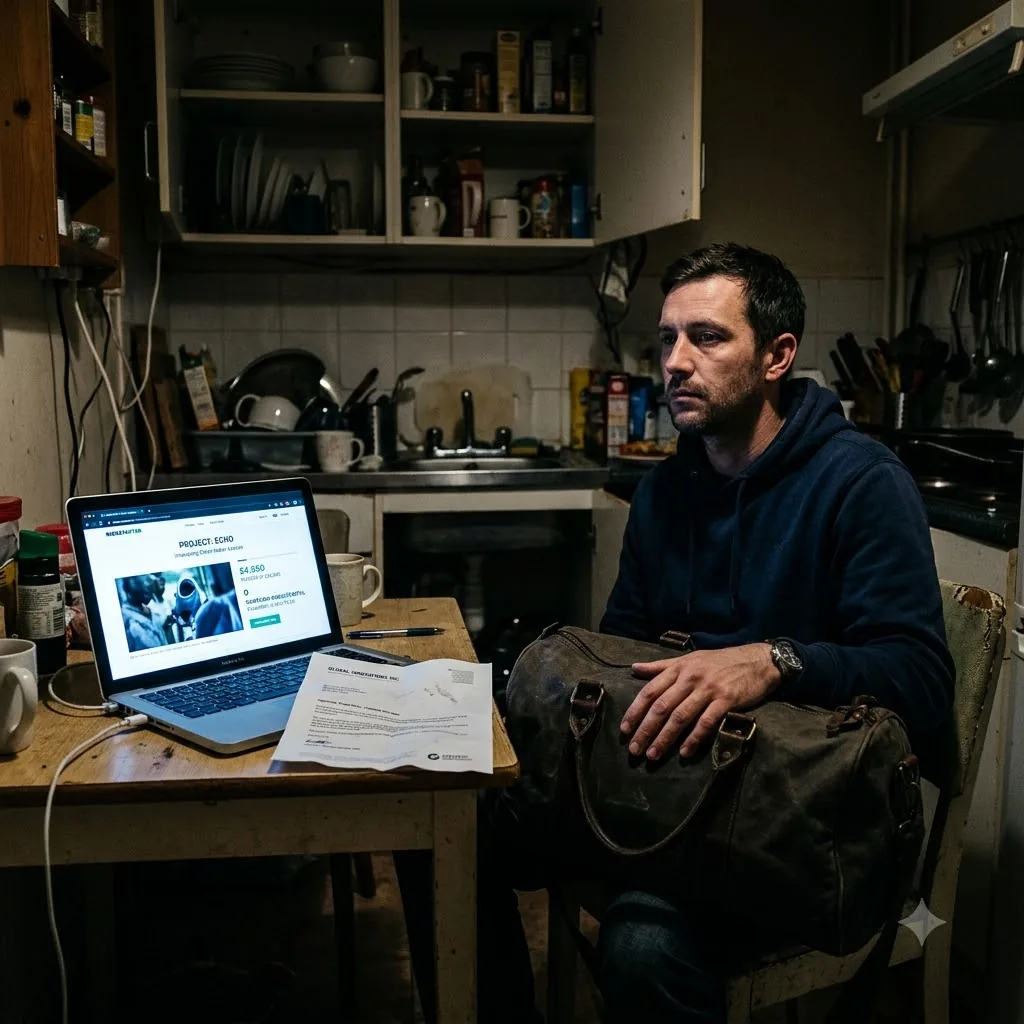
The officer’s hand hovered over his radio. He was offering her a way out from Hector. But taking the out meant the bag left with the police. The state would take the money. The hospital would withhold the medicine. The GoFundMe would remain at four hundred and thirty dollars, a digital monument to her failure.
Marisol looked at the duffel bag. She smelled the old paper and copper of the cash. She thought of Julian’s raspy, rattling breaths. She thought of the hospital administrator’s polite, apologetic smile as he explained that their hands were tied by the network’s unyielding policies.
She looked at Hector. He was offering a lifeline wrapped in barbed wire.
She looked at Leo. Her fourteen-year-old son was standing tall, his jaw set in rigid defiance, staring at the pen on the counter. He reached out to pick it up.
“No,” Marisol said, her voice cracking. She slapped Leo’s hand away.
“Ma’am, if you don’t sign that paper right now,” the older officer warned, misinterpreting her hesitation as a confession of guilt, “I am bagging that cash and calling narcotics.”
The pressure in the room was a physical weight, crushing the breath from her lungs. She was trapped between the sterile brutality of the medical system, the blunt force of the police, and the predatory patience of the streets. None of them saw Julian as a human being. He was just a liability, a suspect, or a piece of leverage.
Marisol picked up the silver pen. It felt heavier than the frying pan.
“It’s a loan,” Marisol lied to the police, her voice hollow and devoid of emotion. She pressed the pen to the signature line. “For my husband’s treatment.”
She signed her name, the cursive loops sealing her family’s fate.
The older officer frowned, clearly unsatisfied, but he tapped his partner’s arm. “Fine. It’s a civil matter now. But we’ll be running those serial numbers. If they pop on a federal registry, we’ll be back with a warrant.”
The officers backed out of the apartment, pulling the damaged door shut behind them. The latch clicked weakly into place. The silence in the kitchen roared back in, deafening and absolute.
Hector smiled. He picked up the contract, blowing gently on the wet ink before folding it back into his jacket pocket.
“A wise choice, Marisol,” Hector said quietly. “Julian gets his medicine.”
He turned to Leo, his smile fading into a grim, authoritative line. “Go put your shoes on, kid. You ride with me tonight. The logistics business doesn’t sleep.”
Marisol’s heart stopped. “Tonight? No. You said an apprenticeship. He’s a child. He has school tomorrow.”
Hector zipped the empty pockets of the duffel bag, leaving the main compartment of cash open on the table. He looked at Marisol with genuine, terrifying pity.
“You didn’t read the addendum on page three, Marisol,” Hector whispered, moving toward the door. “The advance is non-refundable. And the contract stipulates immediate deployment. If he isn’t in my car in five minutes, the contract is breached. And you know the penalty for breach of contract in our business.”