Story code: ST-000883
Part 4: The Ledger
The blue light of the monitor cast a sickly pallor over Arthur Vance’s face. Marisol leaned closer, her shadow falling over him. “Override it,” she demanded, her voice dropping to a harsh, ragged whisper. “If the machine made a mistake, you go in and you manually approve the claim. Right now.”
Vance shrank back, his shoulder blades pressing into the mesh of his chair. “I can’t. I swear to God, I don’t have the administrative privileges. Only a regional director can bypass a demographic auto-decline, and they don’t take calls from Level 1 adjusters!”
“Do it!” Marisol slammed her fist onto the cheap folding table, rattling the monitors.
Vance flinched violently, his eyes darting to her hands, terrified she was about to strike him. “Stay back!” he shouted. His hand darted under the edge of the desk, his fingers desperately jamming upward against a concealed plastic switch.
A deafening, high-pitched siren instantly erupted from a white plastic speaker mounted near the ceiling. The piercing wail vibrated through the floorboards, drowning out the sound of the crying baby in the back room.
“I triggered the panic button the second you pushed your way in!” Vance screamed over the mechanical shriek, scrambling out of his chair and retreating toward the hallway. “The security company already dispatched the police!”
Marisol froze. The flashing red *AUTO-DECLINE* box on the screen seemed to pulse in time with the alarm. If the police caught her here, she would be arrested for home invasion. She would be locked in a holding cell while Julian lay in the oncology ward and Leo rode shotgun with a cartel enforcer. She would lose the only leverage she had left.
She looked at the screen one last time, the cold reality settling into her bones. There was no secret switch. There was no reasoning with a faceless algorithm that had already written them off as acceptable losses.
Marisol turned and bolted. She sprinted out the front door, leaving the heavy bond paper of the denial letter on the keyboard. She threw herself into her idling car, slamming it into gear and tearing away from the curb just as a distant siren began to bleed into the morning air.
The drive back to her neighborhood was a blur of gray concrete and crushing defeat. She had nothing. The hospital had accepted the eighty thousand dollars at dawn, locking Julian into the first round of treatments. The money was spent. She could not get it back to refund Hector, and she could not prove to the insurance company that they were worthy of an exception. The system had perfectly engineered its own prophecy, forcing her to feed her son to the streets to survive the automated cruelty of corporate healthcare.
She parked outside her apartment building. The mid-morning sun offered no warmth, only a harsh, unforgiving glare on the cracked pavement.
Marisol climbed the stairs, her legs feeling like lead. She dreaded the silence of the apartment. She dreaded the empty room where her fourteen-year-old son should have been sleeping before school. She slipped her key into the lock, pushing the damaged door open.
She didn’t hear silence. She heard the crisp, rhythmic *snap* of heavy paper.
Marisol dropped her keys on the entryway table and walked slowly into the kitchen.
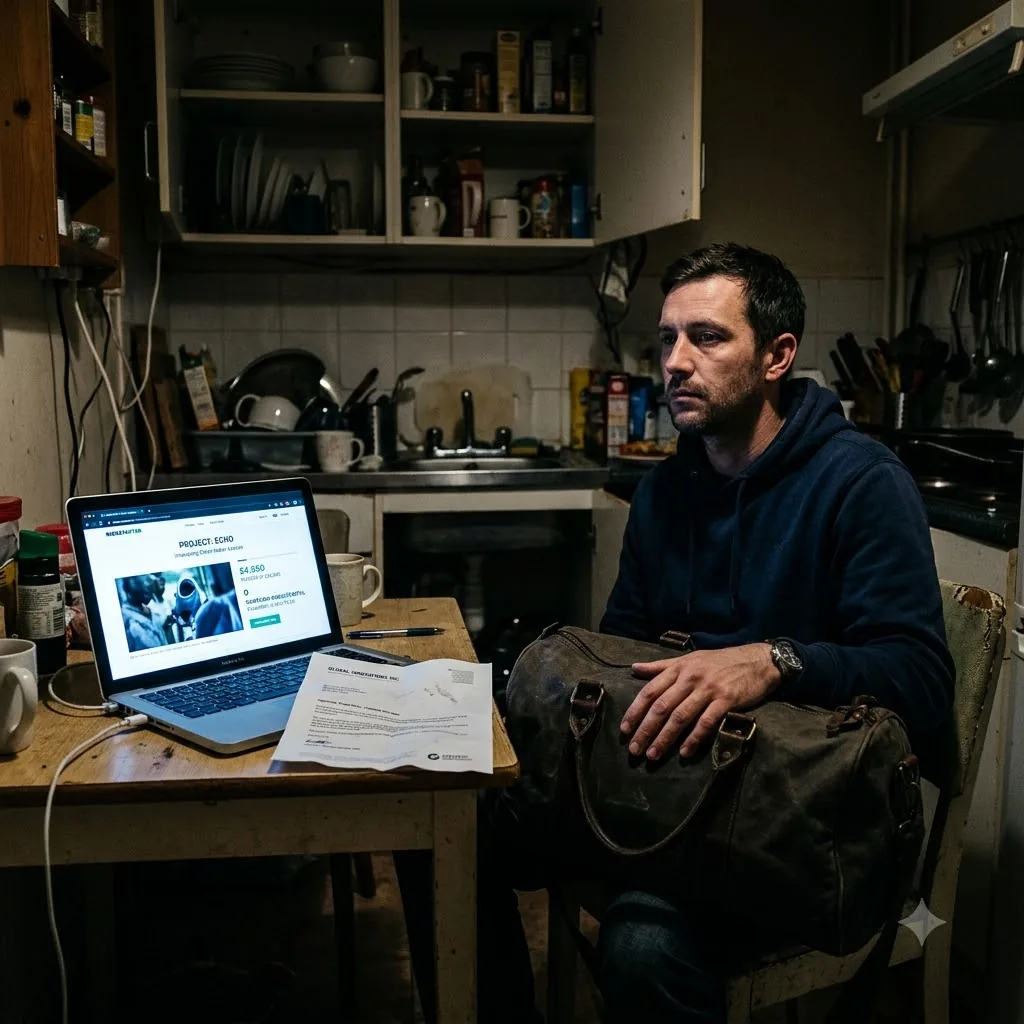
Leo was sitting at the table. He was wearing the same clothes he had left in last night, his jacket smelling strongly of stale cigarette smoke, engine exhaust, and cheap cologne. He was exhausted, dark circles bruised under his eyes, but his posture was rigid, wired with a dangerous, electric energy.
Spread across the cheap linoleum tabletop were hundreds of crumpled twenty and fifty-dollar bills.
He was sorting them. His hands moved with a jarring, mechanical efficiency, flattening the edges, separating the denominations, and snapping thick rubber bands around the finished stacks. A black burner phone and a small, leather-bound ledger sat near his elbow.
Marisol stopped in the archway. The breath left her lungs. It was the exact spot where Hector’s duffel bag had sat yesterday.
Leo looked up. The soft, uncertain boy who had shielded the money from the police was gone. His eyes were flat, guarded, carrying a heavy, ancient exhaustion that did not belong on a fourteen-year-old face. He looked down at the money in his hands, wetting his thumb to count out another twenty.
“Hector dropped me off an hour ago,” Leo said, his voice quiet but steady. “He said I did good. I didn’t flinch.”
Marisol stepped forward, her hand trembling as she reached out to touch his shoulder. “Leo…”
“He gave me a block,” Leo interrupted, not looking up from the cash. He snapped another rubber band into place. The sound was as definitive as a judge’s gavel. “I’m collecting from the bodegas on MLK Boulevard. It’s a lot of math, but Hector says I’m smart. He says I can work off the eighty grand in three years if I don’t mess up the count.”
Marisol stared at the neatly organized stacks of illicit cash. She had fought the hospital, the insurance company, and the police to save her family, only to realize she had been fighting a war that was lost the moment they were assigned a zip code.
Leo stacked the banded money neatly into a dark canvas backpack at his feet. “Julian’s going to get his medicine, Ma,” he said, finally looking her directly in the eyes, his expression utterly hollowed out. “I’m taking care of it now. Just like Dad used to.”
Marisol sank into the chair opposite him, listening to the relentless, unending snap of the bills, knowing with absolute certainty that her husband’s life had been bought with her son’s soul.