Story code: ST-000698
Part 2: The Seventy-Fourth Floor
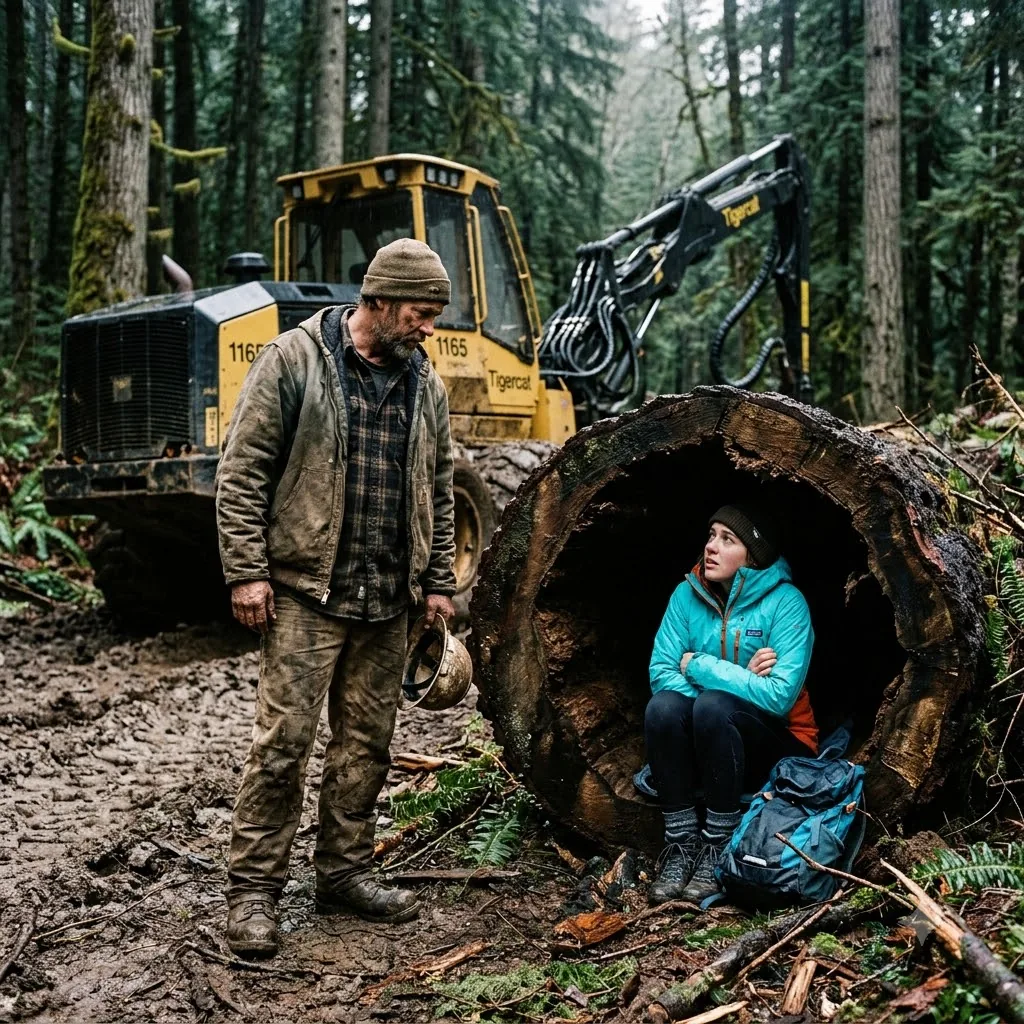
Arthur let the wrench drop. It hit the saturated earth with a dull, heavy thud, sinking halfway into the muck. The girl flinched, her eyes darting to the tool and back to his face, but Arthur’s focus had completely detached from the ruined million-dollar machinery behind him. His mind was rapidly re-indexing the situation, parsing her sentence structure, the vocabulary, and the distinct lack of context she possessed while using it.
“ESG compliance mandates,” Arthur repeated, his voice devoid of the gruff, lumberjack drawl he usually affected for the regional supervisors. His tone was suddenly flat, clipped, and calibrated to the acoustics of a boardroom rather than a forest clearing. “That metric hasn’t been public-facing since the Q3 restructuring. The activist manifestos use ‘ecological impact parameters.’ Only the acquisitions department uses ‘compliance mandates’ when they want to force a lease buyout.”
The girl blinked, the self-righteous certainty faltering for a fraction of a second. She pressed harder against the cedar bark, her premium boots sliding slightly in the slime. “I don’t-I don’t know what you’re talking about. We know about your yield targets. We know your company is destroying this sector.”
“Who gave you the coordinates to Section Four?” Arthur asked, stepping over a decaying fern. He wasn’t yelling. He was auditing her.
“We have sources,” she shot back, gripping the strap of her messenger bag. “People who actually care about the old growth. Whistleblowers who see past your corporate greed.”
Arthur mentally overlaid her script with the holding company’s organizational chart. He had spent six years on the seventy-fourth floor as a risk assessment actuary before the market crash and his own spectacular scapegoating had exiled him to the mud and the chainsaws. He knew how these people operated. They didn’t leak to activists out of morality; they leaked to weaponize them.
“A whistleblower,” Arthur said, calculating the timeline. “Let me guess. An anonymous secure message board. They gave you the exact telemetry of my harvester, the gate codes for the logging road, and told you that disabling this specific unit would disrupt the parent company’s quarterly reporting.”
She swallowed hard. The cold air plumed around her face as her breathing hitched. She didn’t confirm it, but the defensive tightening of her shoulders was all the affirmative data Arthur needed.
He looked back toward the invisible outline of the harvester through the dense trees. The math of his ruin shifted from a tragic accident of activism to a precision corporate assassination. The parent company wanted this specific tract of timber back before his contract vested next month. If he defaulted, they reclaimed the land, the timber, and his equipment under the punitive clauses. They didn’t just want him bankrupt; they needed a documented, third-party force majeure to trigger the repossession without paying him a severance buyout.
“They didn’t give you that phrasing to make you sound smart,” Arthur said, turning his gaze back to her. The temperature in the forest seemed to drop another ten degrees. “They gave it to you so when you got caught, and you repeated it to the local deputies, it would go on the public police report. It creates a paper trail proving a targeted ESG-related disruption. That allows the holding company to claim an insurance write-off while simultaneously voiding my independent contractor status.”
“You’re lying,” she snapped, though her voice wavered. “You’re just trying to scare me so I won’t report you for assaulting me.”
“I dropped the wrench, kid,” Arthur said tiredly, wiping his muddy hands on his jacket. “And I’m not going to touch you. Because you aren’t a saboteur. You’re a free, disposable liquidation tool.”
Before she could formulate a retort, a sharp, electronic chirp echoed from Arthur’s chest pocket.
He froze. It was the emergency satellite pager, issued by the parent company for critical safety incidents. It only triggered when the central dispatcher initiated an override. Arthur unzipped his pocket with numb, muddy fingers and pulled the heavy yellow device into the gray light.
The LCD screen glowed with a harsh green backlight. It wasn’t a safety check. It was an automated system alert, pushed directly from the holding company’s legal department.
*NOTICE OF CONTRACTUAL BREACH. TELEMATICS INDICATE CATASTROPHIC HYDRAULIC PRESSURE LOSS. RECOVERY TEAM DISPATCHED TO SECURE CORPORATE ASSETS. ETA 40 MINUTES. DO NOT LEAVE THE SITE.*
Arthur stared at the pixelated letters. The telematics unit on the harvester ran on a twenty-four-hour delay to save bandwidth in the remote mountains. The only way the parent company knew about the pressure loss right now was if they were monitoring the live diagnostic feed-a feed that was only activated when someone manually opened a monitoring ticket from the seventy-fourth floor. They had been watching the pressure gauges drop in real time. They had been waiting for her to do it.
He looked up at the girl. She was shivering now, the damp cold finally penetrating her expensive shell jacket, eyeing him like a trapped animal.
“Forty minutes,” Arthur muttered, the corporate calculus accelerating into a blind sprint. A recovery team wasn’t a couple of mechanics in a pickup truck. It was a private security detail sent to lock down the machinery and physically remove the defaulting contractor from the premises. If they found the girl here, they would hand her over to the county sheriff, completing the perfect paper trail for his bankruptcy.
He had forty minutes to evade a corporate extraction team and figure out how to leverage a naive, hostile activist who still thought he was the enemy.
“Get up,” Arthur said, his voice dropping into a harsh, commanding register that left no room for debate.
She pressed tighter against the tree. “No. I’m not going anywhere with you.”
“The people who gave you your target are coming up that mountain road right now,” Arthur said, stepping toward her and pulling a heavy nylon zip-tie from his tool belt. “And if they find you here, I lose my livelihood, and you go to federal prison for industrial sabotage. So you’re going to walk, or I’m going to carry you.”