Story code: ST-000698
Part 3: The Derivative Market
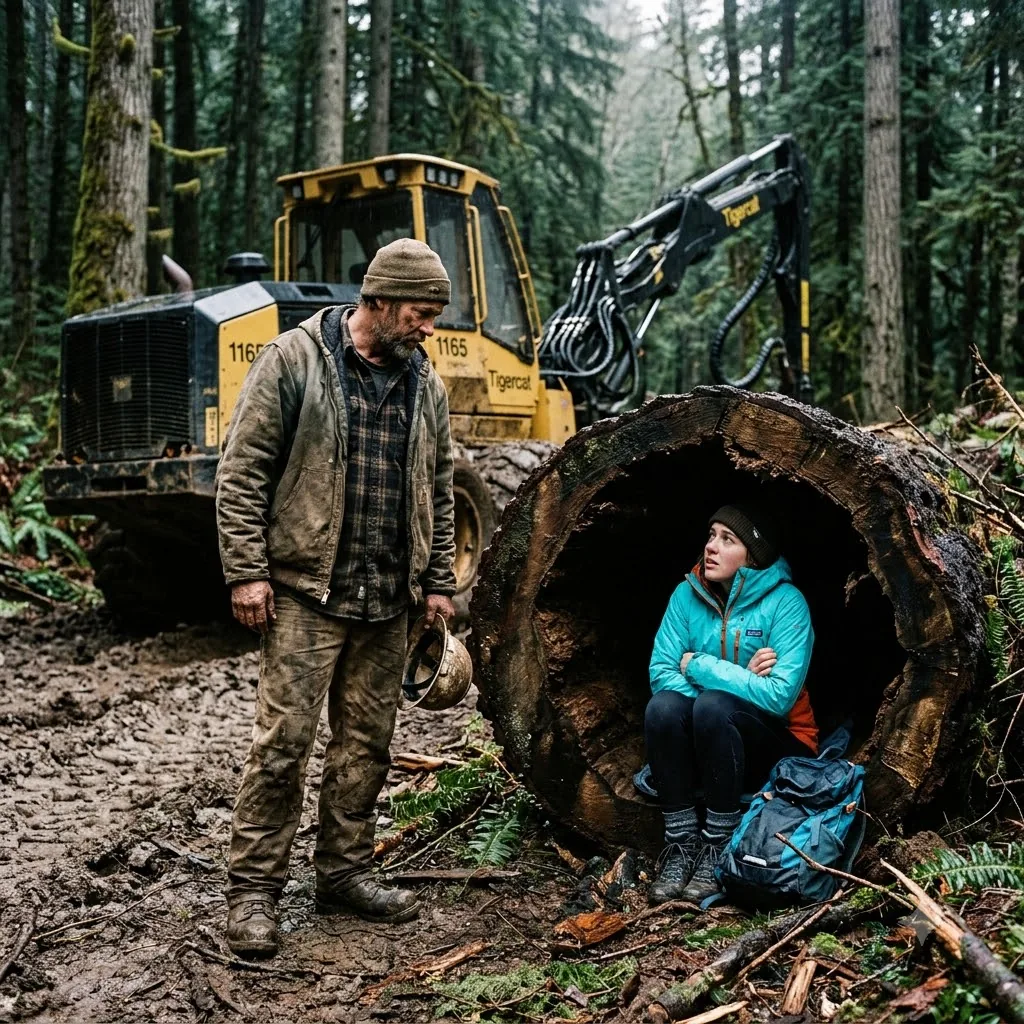
She stared at the thick nylon zip-tie in his muddy glove, then up at the cold, dead certainty in his eyes. The defiance drained from her posture, replaced by a raw, shivering survival instinct. She didn’t offer her wrists, but she turned and began to march up the steep incline of the ravine, pushing through the dripping salal bushes.
Arthur followed close behind, his long strides easily matching her frantic scrambling. The freezing rain began to fall again, slicking the limestone outcrops and turning the soil into a treacherous slurry.
For ten minutes, the only sounds were their ragged breathing and the snap of dead branches. But as the adrenaline of the initial confrontation faded, her ideological armor began to reassemble itself.
“You can’t hide this,” she panted over her shoulder, grabbing a mossy branch to pull herself up a slick embankment. “My affinity group has the telemetry. We logged the pressure drop on a decentralized server. You can’t just sweep a three-day operational delay under the rug. That’s a minimum thirty-thousand-dollar hit to your quarterly projections. We broke your margins.”
Arthur didn’t miss a beat. The heavy, exhausted lumberjack routine he had worn for the past three years evaporated, replaced by the razor-sharp cadence of a boardroom executioner.
“You didn’t break a margin, you triggered a Class-4 Catastrophe Clause,” Arthur said, his voice slicing through the cold air with clinical precision. “You’re operating on obsolete, public-facing ESG data. You assumed stopping the harvester halts the revenue stream. It doesn’t. It diverts it into the derivative market.”
She slipped, her premium boot sliding off a root. She caught herself, throwing a confused, angry glare back at him. “What are you talking about? You’re a logger.”
“The holding company carries a comprehensive downtime insurance policy on all Tier 1 heavy machinery,” Arthur continued, ignoring her interruption. “It’s a hedge against eco-terrorism and natural disasters. But the payout isn’t pegged to the base value of the timber. It’s pegged to the speculative futures market. By physically destroying the hydraulic manifold with a documented foreign substance, you didn’t just delay the harvest. You activated the force majeure rider.”
“I stopped you from cutting!” she yelled, halting on a flat ridge to catch her breath and glaring at him.
“You made it more profitable to leave the trees standing for exactly one fiscal quarter,” Arthur corrected, stepping up onto the ridge beside her. He didn’t look tired anymore. He looked like he was dissecting a spreadsheet. “The insurance payout for a third-party sabotage event yields one hundred and forty percent of the projected lumber value. The parent company gets paid more for a broken machine than a working one. And because my independent contract stipulates I must maintain operational capacity, my default allows them to seize this land lease and sell it to a mega-conglomerate that uses autonomous drones. They’ll clear-cut the entire valley floor in three days, and your little stunt just provided the capital to fund it.”
The blood drained from her wind-chapped face. Her mouth opened, but no words came out. The absolute certainty of his financial arithmetic hit her harder than any physical threat.
“No,” she finally stammered, shaking her head. “No, you’re lying. The whistleblower on the forum-they walked us through the exact impact. They said this would cripple the regional division.”
“There is no whistleblower,” Arthur said, his voice devoid of pity. “There is an automated routing script. It scrubs social media for idealistic college students with high disposable income, tracks their purchasing habits for expensive outdoor gear, and feeds them encrypted target coordinates disguised as leaked intel.”
She backed away from him, her eyes wide, staring at the muddy, hulking man in the flannel shirt as if he were a ghost. “How could you possibly know that?”
Arthur turned his head, looking down through a break in the treeline. Below them, barely visible through the mist, a convoy of three black SUVs was already snaking its way up the muddy switchbacks of the logging road. The extraction team.
“Because I wrote the algorithm,” Arthur said softly.
She froze.
“Five years ago, I was the senior risk actuary for the holding company,” Arthur said, his eyes tracking the headlights. “Projected Yield Hostile Acquisition Model. PYHAM. I designed the predictive AI to identify over-leveraged independent contractors, calculate their exact moment of maximum financial vulnerability, and deploy anonymous third-party disruptors to trigger the breach-of-contract clauses.”
He turned his gaze back to her. The absolute horror dawning in her eyes mirrored the exact sinking terror he had felt three years ago.
“I built the machine that prints their money out of other people’s bankruptcies,” Arthur said, the bitterness finally bleeding through his clinical tone. “And I designed it so efficiently that it eventually audited the payroll, determined my salary was a redundant expenditure, and fired me using my own parameters. It exiled me out here. And today, it used you to finish the job.”
She stared at him, the rain plastering her hair to her face, her hands trembling by her sides. The self-righteous activist who had marched into the woods to save the world was gone, entirely hollowed out by the crushing realization that she had just been a line of code in the very machine she thought she was fighting. She had absolutely nothing left to say.