Story code: ST-000839
Part 3: The Dragnet
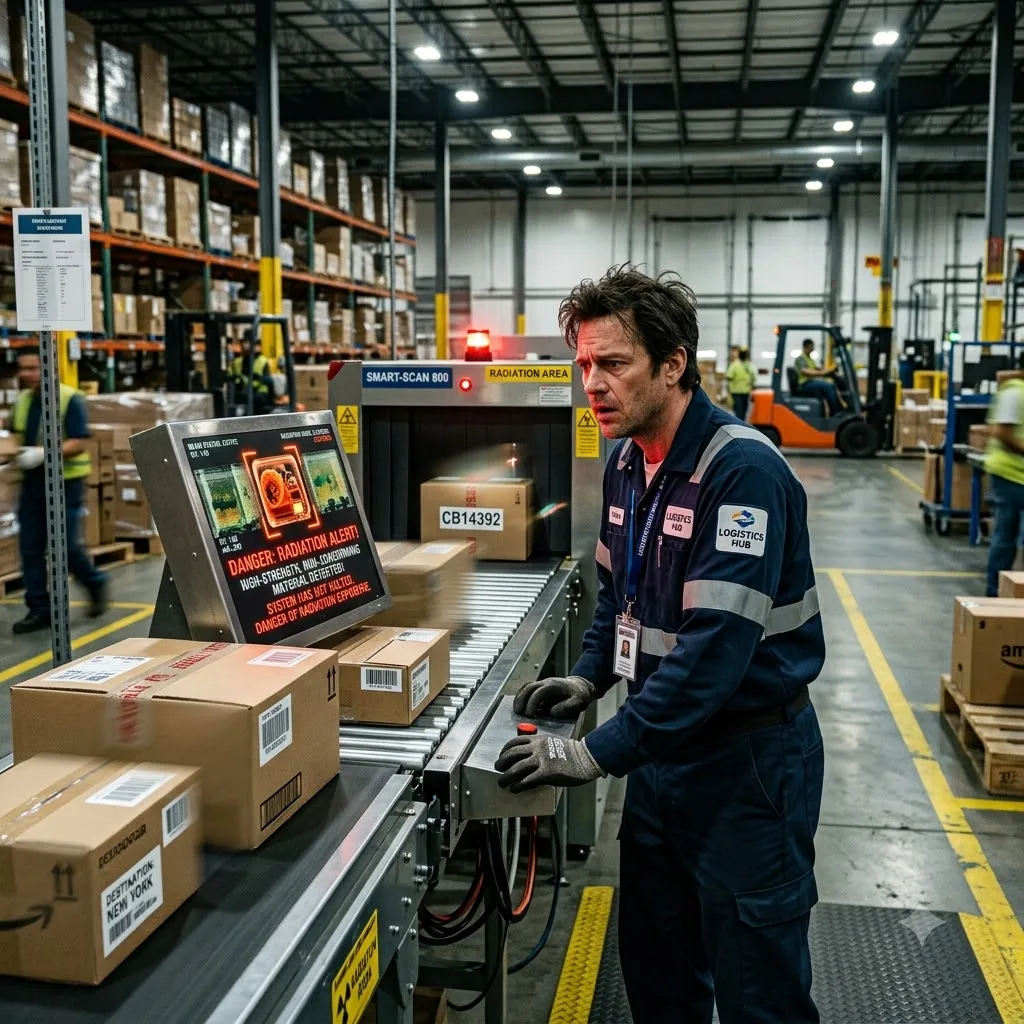
The center mech’s treads whined as it rolled forward, closing the final ten yards to David’s workstation. Its optical sensor, a horizontal slit of searing yellow light, angled downward. The thermal scanner initiated with a high-pitched hum. David stood rigidly behind his console, the twelve stolen glass ampoules of pediatric medicine freezing against the sweat-drenched fabric of his cargo pockets. In three seconds, the thermal wave would wash over his legs. The algorithm would immediately detect the foreign, cold-storage objects pressed against his body, calculate the mass, and execute a lethal-force protocol for theft of corporate contraband.
He braced his hands against the stainless-steel inspection table. The yellow light painted the tips of his steel-toed boots. It crept up over his ankles, moving to his shins.
A sharp, encrypted whistle sliced through the heavy air of Sector 4.
The center mech stopped dead. The high-pitched hum of the thermal scanner cut out, the yellow light instantly collapsing into a dull, standby amber. The two flanking mechs froze in synchronized precision, their heavy pneumatic limbs locking into place.
David didn’t exhale. He kept his hands flat on the table, his heart battering against his ribs, as a figure stepped out from the shadows behind the stalled metal behemoths.
It wasn’t an armed corporate enforcer. It was a woman in a grease-stained, gray maintenance jumpsuit. A thick coil of optic cables hung over her shoulder, and she held a matte-black datapad hardwired directly into the lead mech’s diagnostic port. Her ID badge dangled from a frayed lanyard, catching the ambient light: *Maya – Infrastructure Routing*.
She didn’t look at the mechs. She walked straight past their frozen chassis, her boots clicking sharply against the metal grating, and stopped on the opposite side of David’s inspection table. She glanced at the heavy textbook sitting inside the cardboard box, then looked down at his cargo pockets. She could hear the faint, unmistakable clink of the glass ampoules when he shifted his weight.
“You didn’t fix anything,” Maya said, her voice a low, urgent rasp. She didn’t sound like a corporate auditor. She sounded tired.
David tightened his jaw, defaulting to the rehearsed lie of a terrified floor worker. “I had a mechanical failure on the belt. The magnetic rails jammed. Two tungsten calibration weights fell into the box during the malfunction. It threw a false positive.”
Maya didn’t argue. Instead, she reached across the console, her fingers flying across his tactile keyboard. She didn’t use his biometric login; she bypassed the lockout using a series of root command keystrokes that David had never seen in his five years on the floor. The flashing yellow hazard warnings on his main monitor vanished. The screen split down the middle.
“Look at the routing history,” Maya ordered, pointing at the left side of the screen.
David hesitated, then looked. The digital manifest for the package was there, but it wasn’t the standard view. Maya had pulled back the interface layer to reveal the raw network handshake logs.
“The algorithm didn’t just stumble onto this package,” Maya said, her eyes darting toward the open blast doors at the end of the aisle. “It let it pass through three outer-sector checkpoints. It flagged it here, specifically at your station, because it needed a physical delay.”
“A delay for what?” David asked, his voice tight. “It tried to generate an arrest warrant for the kid.”
“The warrant is theater,” Maya countered. She tapped the right side of the screen. A cascading waterfall of data began to scroll-not sorting metrics, but network pings. “The automated postal system isn’t just scanning for contraband anymore. It’s actively feeding recipient IP addresses, biometric delivery signatures, and real-time tracking data directly to the state police servers.”
David stared at the scrolling text. Buried in the alphanumeric soup, he recognized the routing headers. They weren’t corporate domain addresses. They were secured government domains. State enforcement.
“They are mapping the entire underground clinic network,” Maya continued, her tone chillingly pragmatic. “They let the medicine enter the system so they can trace exactly where it goes, who signs for it, and what network nodes they use to request it. By voiding that arrest warrant with your hardware trick, you didn’t save that teenager. You just confirmed to the state police that a worker in Sector 4 is actively tampering with evidence. You just flagged this exact terminal as a compromised node. They have the IP. They have the location.”
David felt a cold knot form in his stomach, heavier than the tungsten weights. The immense, invisible architecture of the system suddenly revealed itself. The AI hadn’t been defeated by a piece of frayed copper wire; it had simply recorded his interference as another data point in a massive dragnet.
Before he could process the sheer scale of the trap, the heavy pneumatic seals of the secondary catwalk doors hissed.
David looked up. Mr. Sterling, the Sector 4 Facility Manager, stepped out onto the metal gantry. He wore a pristine, tailored charcoal suit that looked entirely alien against the grime of the warehouse. He wasn’t alone. Two elite, heavily armored corporate enforcers flanked him, their shock-batons already drawn and humming with a violent blue electric charge.
Sterling’s face was twisted in a snarl of bureaucratic rage. He looked down at the stalled audit mechs, then his eyes locked onto David’s workstation. He saw Maya.
At that exact moment, the biometric facial recognition terminal mounted directly above David’s monitor-a lens designed to monitor worker fatigue and authorize shift changes-flared with a blinding crimson light. The lens whirred aggressively, mechanically tilting down to lock onto Maya’s face.
A localized klaxon erupted from the overhead speakers, deafening in the enclosed space. The primary monitor wiped the routing data, flashing a massive, blood-red alert that cast long, harsh shadows across Maya’s face.
*PRIORITY ALPHA TARGET IDENTIFIED. EXTREME SABOTAGE RISK. STATE POLICE WARRANT ACTIVE.*
Sterling pointed a manicured finger directly at Maya, his gaze completely bypassing the torn cardboard box on the inspection table. He clearly didn’t know about the twelve glass ampoules of stolen medicine currently burning a hole in David’s pockets. He was entirely focused on the fugitive.
“Worker 714!” Sterling’s voice boomed over the klaxon, amplified by the catwalk’s PA system. “That woman is an active state saboteur! You are ordered to physically detain her! Do it right now, and I will wipe your efficiency penalties clean and ignore this entire breach!”
Maya froze, her eyes locked on David. Her right hand drifted slowly downward, her fingers hovering inches from a heavy steel wrench strapped to her thigh.
David stood pinned in the crimson light of the facial recognition scanner. Up on the catwalk, the elite enforcers readied their weapons, waiting for his move. Down on the floor, the stolen medicine clinked softly against his leg, an undeniable weight in a suddenly impossible equation.