Story code: ST-001295
Part 2: The Negative Space
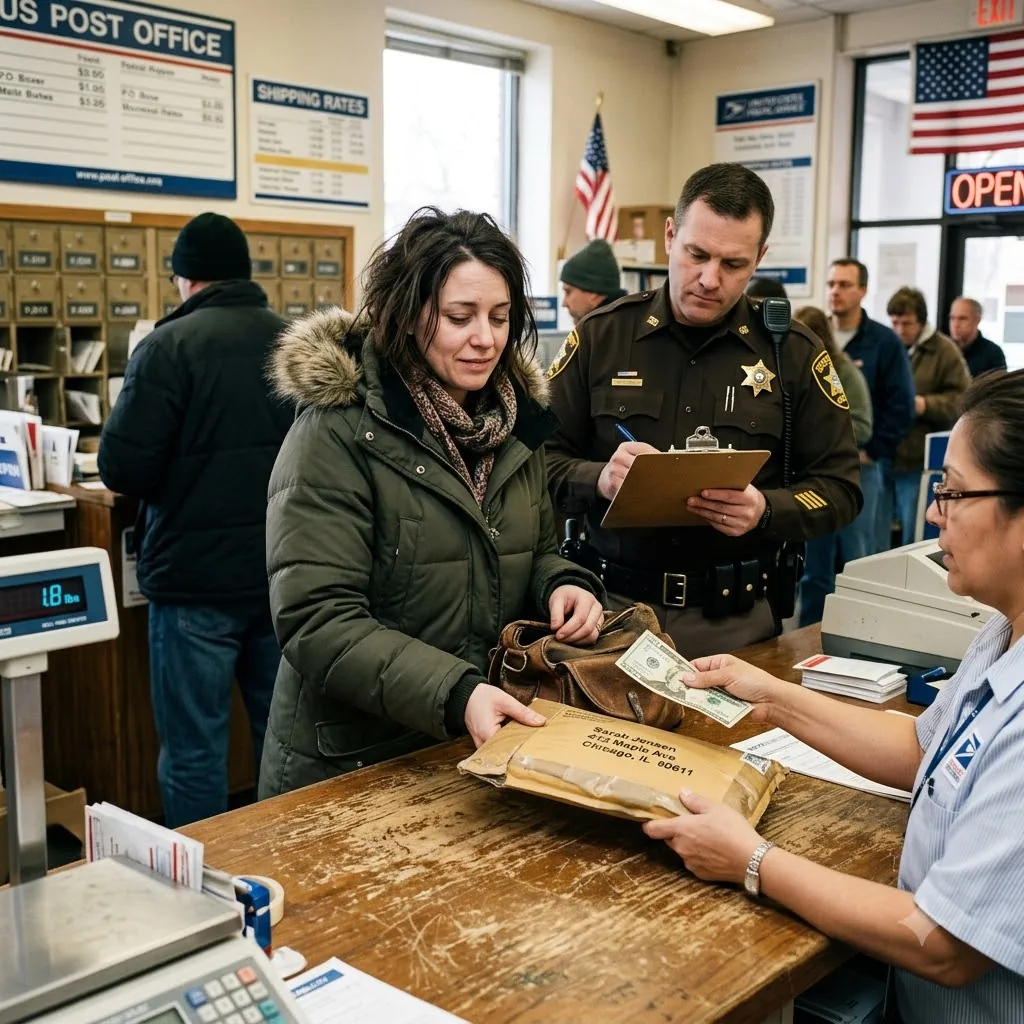
Sarah stared at the thick, calloused edge of Miller’s thumb, less than an inch from the black ink. She forced the muscles in her neck to remain entirely slack, maintaining her rigid physical discipline. If she snatched the bag away, the sudden movement would trigger every cop instinct pounded into him over his twenty-year career. She had to de-escalate without retreating.
“Area code, Jim?” Sarah asked, her voice carrying the perfect pitch of mild, professional exasperation. She offered a dry, dismissive chuckle. “Since when does the post office sort logistical routes by telephone numbers?”
Miller blinked, pulling his hand back a fraction of an inch to look at the envelope again, thrown off balance by her correction. “You know what I mean, Doc. The zip prefix. 902-whatever. DA Marcus has a real stick up his ass about that whole sector.”
Sarah did not reach for the bag. She left it exposed, resting against her hip like it held nothing more interesting than a packed lunch. “It’s bloodwork,” she lied smoothly, keeping her eyes locked on Doris behind the glass. “Going to the specialized immunology lab in Hawthorne. Zip code 90250. It’s standard protocol for the new tick-borne panel.”
Miller frowned, his eyes dropping back to the padded manila envelopes sticking out of the canvas material. “Looks awfully heavy for a few blood vials.”
“Cooling packs,” Sarah replied without missing a beat, shifting her weight as if annoyed by the interrogation. “And the accompanying patient files. Which, as I’m sure you remember from the last town hall meeting, are strictly protected under federal HIPAA laws. Unless Marcus’s new algorithm somehow overrides federal privacy mandates now?”
The mention of federal law did exactly what Sarah needed it to do. Local deputies despised federal oversight, and Miller was no exception to the rule. His posture stiffened slightly, a flash of defensive irritation crossing his face as he took a half-step back from her personal space.
Sarah turned her attention back to the plexiglass partition. Doris was still frozen, her hand suspended over the damp sponge, her eyes darting nervously between the deputy’s tactical vest and the canvas tote bag.
“Doris, the sponge is drying out,” Sarah said, keeping her tone gentle but applying a subtle, insistent pressure.
Doris flinched. She looked at the remaining three envelopes in the bag, then at the federal outgoing bin behind her, where the first three packages were currently resting safely out of local jurisdiction. Doris swallowed hard, shaking her head by the barest millimeter. She wasn’t going to touch the rest of them. The risk had just become entirely too real.
Sarah read the absolute terror in the postal worker’s magnified eyes and made a rapid, split-second calculation. She couldn’t force Doris’s hand, not with Miller standing two feet away watching the exchange. She had to cut her losses and secure the three packages already swallowed by the system.
“Actually, Doris, let’s stop there,” Sarah said, smoothly pulling the flap of the canvas tote bag over the remaining three envelopes to conceal them. “I just remembered I need to add a secondary authorization form to the rest of these. Just ring me up for the three you’ve already stamped.”
Doris let out a shaky breath that fogged the bottom edge of the plexiglass partition. She rapidly began typing the transaction into her ancient, click-heavy register, desperately avoiding Miller’s gaze.
“That’ll be twelve dollars and forty cents,” Doris whispered, her voice trembling.
Sarah pointed to the four twenty-dollar bills still sitting on the gouged laminate counter. “Keep the change. Put the remainder toward the clinic’s PO Box renewal.”
Before Doris could reach out to take the cash, the heavy black radio on Miller’s shoulder hissed with a burst of sharp, deafening static.
“Dispatch to Unit Four,” the radio squawked.
Miller keyed the mic on his collar, leaning his head sideways. “Unit Four. Go ahead, Brenda.”
“Jim, I need your twenty. DA’s office just escalated a priority ping on that tracking software you’re running. They’re asking for immediate visual confirmation on a flagged vehicle.”
“I’m at the Oakhaven post office,” Miller said, his eyes still lazily tracking Sarah as she slung the tote bag securely over her shoulder, preparing to walk out. “What vehicle?”
“Vintage blue Chevy pickup,” Dispatch replied, the audio perfectly clear in the quiet room. “License plate starting with Delta-Niner. Marcus’s system just flagged it bypassing the Route 9 license plate readers via the dirt access roads. They think the driver is currently attempting to blind-drop contraband bound for the 902 sector.”
The fluorescent lights overhead seemed to hum louder in the sudden, suffocating silence. Sarah’s grip on the canvas strap tightened until her knuckles ached. They hadn’t needed her smartphone at all. The algorithm had simply mapped the missing data-calculating the absence of a digital footprint where a heavy vehicle was physically moving. The system had figured out her exact route by noting which highway cameras she *didn’t* pass, analyzing the negative space of her analog camouflage. Her evasion tactic had become the very anomaly they were tracking.
Miller’s expression transformed instantly. The bored, complaining deputy vanished, replaced entirely by a rigid, hyper-alert law enforcement officer. He looked directly at Sarah, his hand dropping casually but deliberately toward his heavy leather utility belt. He knew exactly what she drove. Everyone in town knew the blue Chevy.
“Brenda,” Miller said slowly into his radio, not breaking his intense eye contact with Sarah. “I have visual on the owner of that vehicle right now. What’s the directive?”
“Hold her there, Unit Four,” Dispatch said, the voice echoing against the linoleum floors. “Marcus just dispatched a data-extraction team to her clinic. They have a warrant for her medical logs, but they need her keys to bypass the reinforced steel doors. Do not let her leave your sight.”
Sarah felt the blood drain entirely from her face. Her heavy keyring dug into her thigh through her pocket. Her clinic was rigged to violently incinerate the master ledgers if the reinforced doors were breached improperly. If she wasn’t there, the clinic would burn, destroying irreplaceable medicine and data. But if she handed over her keys, the analog network she had spent three years building would be completely, surgically dismantled by Marcus’s team.
She took a slow, deliberate step backward toward the exit, calculating the distance to the jingling brass bell above the door.
Miller stepped sideways, physically blocking the narrow aisle between the counter and the exit. The friendly familiarity was completely gone from his eyes, replaced by cold, professional suspicion as he stared dead at the canvas tote bag still hanging from her shoulder.
“Put the bag on the floor, Doc,” Miller commanded, snapping open the leather retention strap over his holster. “And step away from the counter.”