Story code: ST-001263
Part 4: The Asset Freeze
Julian did not have his ring light. He did not have his curated script. He stepped backward, his pristine work boots squeaking against the damp concrete.
Frank did not yell. That was the worst part. The older machinist just looked at the towering projection on the brick wall, then down at the spilled coffee soaking into his boots, and finally at the man who had promised to pay his daughter’s tuition.
“Frank,” Julian started, his voice thin, the rugged baritone entirely absent. “You have to understand the market forces-”
Tom cut him off. The freight driver stepped forward, his broad shoulders squared, stopping so close that his chest practically brushed the front of Julian’s flawless flannel shirt. “Get out.”
Julian looked around the circle of faces. The hardware store owner. The corrugated box supplier. The forklift mechanics. None of them moved to let him pass. They did not raise their hands, but they did not offer a path, either. They just stared, their collective silence heavier than the freezing rain pounding on the aluminum roof.
Julian swallowed hard. He adjusted his collar, a nervous tic breaking his composure. He slipped past Tom, keeping his back to the wall, sidestepping the folding chairs. He did not look back at the AV cart. He did not ask for his silver MacBook. He just walked quickly toward the glass-walled office, grabbed his keys from the desk, and pushed out the side exit into the storm.
A moment later, the roar of a high-end European engine cut through the rain, fading down the access road toward the interstate.
He was gone.
Maeve stood by the AV cart, her hand still resting on the cold metal rim. The projector fan whirred into the silence. The giant blue text of *Project Phoenix* continued to loom over the empty stage, outlining the precise dollar amount their town was being sold for.
“Well,” Tom said, his voice rough. He kicked a folded chair, not hard, just enough to make it scrape against the floor. “That is that, then.”
The crowd of vendors began to drift apart. There was no shouting, no dramatic rallying cry. Just the slow, crushing realization of ruin. The illusion of the artisanal revival had kept the town moving for eighteen months, running on fumes and IOUs. Now the tank was empty.
Frank walked slowly to the stage. He bent down with a groan and picked up his dented thermos.
Maeve stepped away from the cart. Her wet clothes clung to her, the chill finally sinking deep into her bones. She walked over to Frank, navigating the puddle of spilled coffee.
“I am sorry,” Maeve said. Her voice cracked, betraying her exhaustion. “I only found it twenty minutes ago. He offered me ten thousand dollars to help him load the last crates tonight.”
Frank looked at her. His eyes were red-rimmed, heavy with the weight of maxed-out credit lines and a mortgage in arrears. He did not look angry, just incredibly old. “Ten grand. That would have been nice, Maeve.”
“I could not take it. Not if it meant letting him use you to finish the grift.”
Frank sighed, wiping a calloused hand across his jaw. “The bank locks the gates tomorrow at six, he said?”
Maeve nodded. “Asset freeze.”
Tom walked up beside them, pulling a pack of chewing gum from his jacket pocket. He offered a piece to Frank, who shook his head, then looked at Maeve. She declined as well.
“Those six steel crates sitting by the loading dock,” Tom said, unwrapping a piece of mint gum. “The ones you just broke your back moving inside. The ones Frank here spent August machining.”
“Pre-sold to a boutique distributor in Los Angeles,” Maeve said. “Julian needed them out tonight before the bank seized everything.”
Tom chewed slowly, looking toward the dark loading bay. “My rig is still out there. I am empty. And I do not think the bank has any moral claim to inventory that never legally existed under an insolvent LLC.”
Frank turned to look at the trucker, a flicker of life returning to his eyes. “What are you saying, Tom?”
“I am saying,” Tom replied, “that scrap steel is pulling a decent price down in the city. And finished artisanal machine parts might pull even more if we find the right buyer who does not ask questions. It will not cover everything he owes us. But it is better than letting the bank take it to pay off his corporate data center buddies.”
Maeve looked at the six massive wooden crates resting in the shadows at the far end of the floor. Her muscles ached just looking at the splintered wood.
“We have until six in the morning,” Maeve said.
Frank managed a small, bitter smile. “I brought coffee.”
The other vendors did not leave. The hardware store owner walked over to the breaker box and killed the power to the projector. The sterile corporate pitch deck vanished from the brick wall, plunging the warehouse back into its natural, cavernous gloom. Across the floor, a mechanic backed a forklift out of the charging bay, the backup beeper echoing sharply through the steel rafters.
Maeve walked back toward the loading dock. She pulled her wet canvas gloves from her pockets and slipped them on. The fabric was freezing, stiff against her raw knuckles.
They were jobless. The town was still going to hurt. Tomorrow, the bank would chain the doors, and the developers would eventually come to gut the mill for server racks and cooling pipes. Julian would likely fail upward in California, pitching a new aesthetic to a new board of investors.
But tonight, the warehouse did not belong to a media company. It did not belong to a data center.
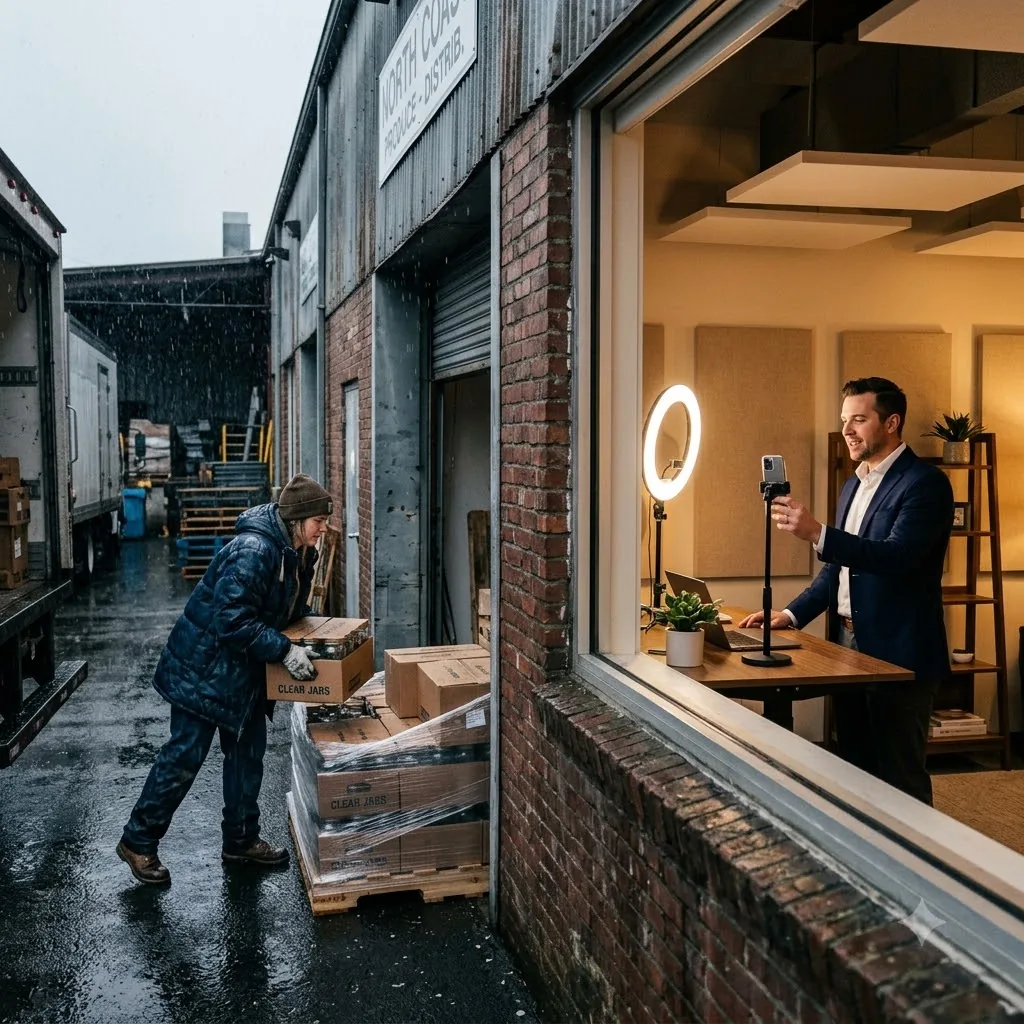
Maeve unlatched the heavy rolling door. The freezing rain blew into the bay, smelling of river mud and diesel. She grabbed the handle of the hand truck, leaned her weight back, and got to work.