Story code: ST-001834
Part 3: The Progressive Persona
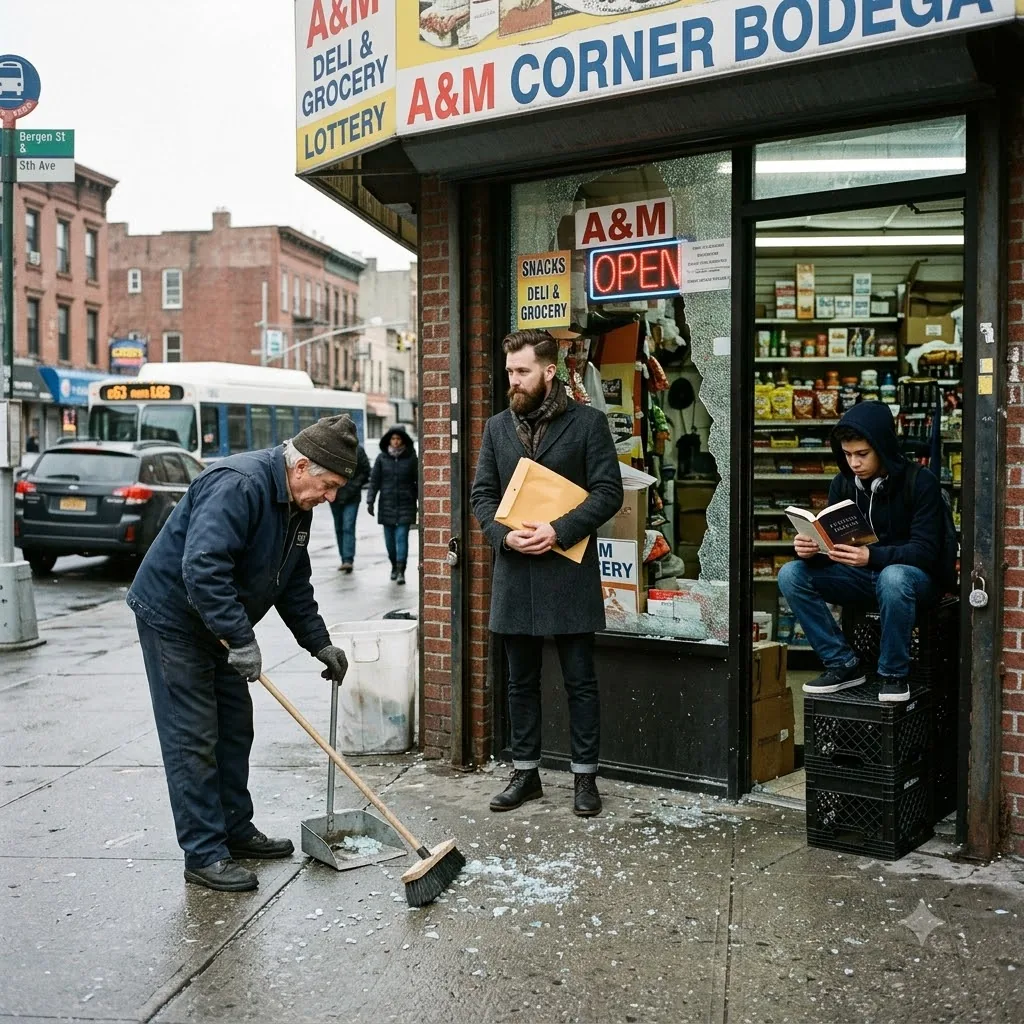
Hector remained completely still as the engine of Silas’s town car faded down the avenue. The cold breeze blowing through the shattered storefront bit through his thin cotton work shirt, but he barely felt it. He looked down at the thick manila envelope in his hand, then back to the pale, dust-covered cinderblock resting on his scuffed linoleum.
He walked back behind the counter, his boots crunching on stray fragments of safety glass. He knelt beside the cinderblock. The pale dust from the shattered window coated its top, but as Hector reached out and wiped the powder away, he noticed a patch of smooth, fresh color on the rough concrete.
Someone had used a stencil. Sprayed across the side of the block in jagged, aggressive lettering were the words: *CLASS WAR NOW*.
It was a perfect piece of culture war theater, designed to look like the work of radical neighborhood activists protesting the new management. But Hector’s calloused thumb rubbed against the paint. It wasn’t cheap hardware-store enamel. It was a thick, chalky, matte sage green.
Hector stared at the pigment flaking onto his skin. He knew that exact color. It was the custom Pantone shade Apex Horizon had used just last week to paint the exterior trim of *The Commons*, their newly opened artisanal coffee shop three blocks down the avenue.
Hector pulled the glossy introductory pamphlet from his back pocket-the one Silas had shoved under his gate weeks ago. He flipped to the third page. His eyes locked onto a paragraph highlighted in a neat, corporate sidebar: *Apex Horizon is committed to securing our neighborhoods against the recent nationwide surge in ideological vandalism and extremist property damage. Safety is our ultimate priority.*
It clicked, cold and sharp in his chest.
There were no neighborhood radicals throwing bricks. There was no culture war spilling onto his sidewalk. It was a business model. A manufactured, heavily weaponized crisis. Silas’s crew was staging fake extremist attacks to artificially trigger the “safety and structural modernization” clauses in the legacy leases. It was a perfectly legal way to force old tenants into unpayable levies, accelerating evictions while playing the victim of a divided political climate.
Hector stood up. He looked over the counter at Diego. The teenager was still sitting on his milk crate, clutching his worn paperback, watching Hector with guarded, quiet eyes.
“What is that you’re reading, Diego?” Hector asked, his voice low and tight.
Diego looked down at the cover. “Mr. Harrison gave it to me before they fired him. It’s a people’s history of the city labor movements. Principal suspended me for bringing it to homeroom. Said the school board banned it last week. Said it violates the new community decency mandate.”
Hector walked around the counter. He reached out his hand. “Give it to me.”
Diego hesitated, then placed the battered paperback into Hector’s palm.
“Stay here,” Hector said.
He walked out of the bodega, leaving the broom leaning against the counter. He marched down the avenue, his heavy boots pounding a steady, relentless rhythm against the concrete. The neighborhood shifted physically as he walked south. The cracked pavement and fading brick facades gave way to power-washed sidewalks, Edison bulb string lights, and expensive, minimalist signage.
He reached *The Commons*. It was the crown jewel of Silas’s redevelopment portfolio. A sleek sandwich board on the sidewalk declared in chalk: *Hate Has No Home Here. Ethical Sourcing. Inclusive Community.*
Hector pushed through the heavy glass doors. The interior was a cavern of reclaimed wood, hanging ferns, and polished brass. The air smelled intensely of roasted cardamom, oat milk, and expensive cologne. The cafe was packed. Affluent newcomers hunched over silver laptops, sipping seven-dollar lattes beneath a large neon sign that read: *Build Bridges, Not Walls.*
Silas was standing near the pour-over station. He had removed his charcoal suit jacket, revealing a crisp white shirt with rolled-up sleeves that made him look approachable, energetic, and progressive. He was talking animatedly to a woman wearing a press badge on a lanyard, gesturing warmly toward a wall mural dedicated to local history.
Hector stepped directly into the center of the room. He didn’t shout. He didn’t break anything. He simply opened Diego’s worn paperback to a dog-eared page, took a deep breath of the cardamom-scented air, and began to read.
“‘Whenever the property class requires new capital, they do not ask for permission,'” Hector read. His booming, gravelly baritone had spent thirty years cutting through the noise of delivery trucks and street traffic. It instantly filled the cavernous cafe, bouncing off the exposed brick walls. Heads snapped up from screens. The gentle hiss of the espresso machine seemed to abruptly stop.
Silas froze. His television-host smile faltered for a fraction of a second before snapping back into a mask of polite concern. He murmured something to the reporter and walked briskly toward the center of the room.
“‘They manufacture a crisis of morality,'” Hector continued, projecting his voice over the smooth jazz playing on the hidden speakers. “‘They disguise their greed behind the language of public safety, using the fear of unrest to justify the violent removal of the poor.'”
“Hector,” Silas said, stopping two feet away. His voice was a tight, controlled whisper meant only for Hector’s ears. “This is highly inappropriate. We are doing a profile on community integration.”
Hector didn’t look at him. He turned the page, holding the book high. “‘The law becomes a weapon wielded by the landlords, who fake their own victimhood to steal the land.'”
“I am telling you to leave,” Silas hissed, the warmth entirely vanishing from his eyes. His jaw muscles feathered. “Put the book down and get out before I call the police.”
“You like this book, Silas?” Hector asked, finally lowering the paperback and looking directly at the landlord. He didn’t whisper. He spoke to the entire room. “It’s the one your management group and the school board just got a kid suspended for reading. You ban the history to look tough on the culture war.”
Hector reached into his pocket and pulled out his thumb, holding it up. The chalky sage-green paint was clearly visible on his skin.
“And then you use your own custom exterior paint on the cinderblocks you throw through immigrant windows in the middle of the night,” Hector said, his voice echoing in the dead silence of the cafe. “You fake the vandalism. You trigger the eviction clause. And you steal the block. All while standing in here playing the progressive savior.”
The cafe was completely motionless. The reporter slowly raised her smartphone, the camera lens pointing directly at Silas.
Silas looked at the staring crowd. He looked at the glowing red recording light on the reporter’s phone. The perfectly curated progressive persona, the corporate camouflage, the safe-space aesthetics-they all evaporated in a single, agonizing second.
Silas didn’t call for security. He didn’t use his smooth, soothing voice. His face flushed a violent, mottled red.
He lunged.
Silas’s hands closed like a vice around Hector’s throat and the collar of his work shirt. With a guttural snarl of pure rage, Silas drove Hector backward with brutal, shocking force, sending them both crashing into a high display shelf of artisanal clay mugs, shattering them against the floor in a deafening, devastating echo of Hector’s own broken window.