Story code: ST-001834
Part 4: The Empty Avenue
The impact knocked the breath from Hector’s lungs. He hit the polished hardwood floor hard, a cascade of heavy, artisanal clay mugs raining down around him, shattering into hundreds of jagged ceramic fragments. The booming crash echoed off the exposed brick walls, followed by a profound, suffocating silence.
Silas’s hands were still locked in a white-knuckle grip around Hector’s collar. The landlord was breathing heavily, his face suspended inches from Hector’s. But the raw, unfiltered violence that had just surged through Silas vanished as quickly as it had erupted, replaced instantly by the icy, paralyzing realization of what he had just done.
Hector coughed, tasting airborne ceramic dust that smelled sharply of cardamom. He didn’t fight back. He didn’t need to. He simply looked past Silas’s shoulder.
The reporter was still standing there, her smartphone locked on Silas’s face. But she wasn’t alone. A group of teenagers-local high school kids who usually loitered outside the transit station-had rushed toward the commotion from the front of the cafe. Half a dozen cell phones were raised high, forming a rigid semicircle of unblinking camera lenses. Red recording icons glowed brightly in the dim, atmospheric lighting of the coffee shop. They had captured the entire sequence: the progressive, community-focused developer violently choking an aging, immigrant bodega owner over a banned history book.
Silas let go as if Hector’s shirt had caught fire. He stumbled backward, his polished leather shoes crunching over the broken clay. He raised his hands, his television-host smile twitching violently as he tried to resurrect the mask.
“Turn those off,” Silas commanded, his voice trembling, stripped of its smooth corporate warmth. “This is a private establishment. I am asking you to stop recording.”
None of the teenagers lowered their phones. One of them, a girl in a worn denim jacket, tapped her screen. The video was already uploading.
Ten days later, the heavy brown cardboard boxes were taped shut.
The internet had done its work with ruthless efficiency. The teenagers’ footage had spread across the city before Hector even made it back to his own broken storefront. The backlash was absolute and merciless. *The Commons* was entirely empty now. The baristas had walked out in a coordinated strike the very next morning, refusing to serve coffee for a man who staged hate crimes to evict the working class. The sleek sandwich board on the sidewalk had been kicked into the gutter, the ‘Inclusive Community’ chalk washed away by the rain. Silas’s carefully curated brand was reduced to ashes, his management group besieged by digital outrage and canceled contracts.
But digital justice did not rewrite commercial real estate law.
Hector sat on his stool behind the counter, looking at the legal notice taped to his register. The Legal Aid attorney had been sympathetic but clear. The assault was a criminal matter-a misdemeanor battery charge that Silas’s expensive legal team would delay and plea down to a fine. The lease, however, was a binding contract. The redevelopment clause was airtight. Hector could not pay the 210 percent rent increase, nor the mandatory escrow levies. He had missed the forty-eight-hour deadline to replace the window. Apex Horizon held the paper, and the paper said Hector was out.
He had refused the fifteen-thousand-dollar buyout. He wouldn’t take a dime of Silas’s money. Instead, he was leaving on his own terms.
Diego walked out from the back room, carrying the last crate of canned black beans. He set it down by the front door. The teenager wasn’t wearing his hood today. He looked around the stripped shelves, the empty wire racks that used to hold potato chips, the dark, silent refrigeration units.
“That’s the last of the dry goods, Hector,” Diego said quietly.
“Thank you, Diego,” Hector replied. He reached into his jacket pocket and pulled out the worn paperback history book. Its spine was bent from the fall in the cafe, but the pages were intact. He handed it to the boy. “Keep reading it. Don’t let them tell you what you can’t know.”
Diego took the book, holding it firmly. “Where are you going to go?”
“My brother’s place in Queens,” Hector said, standing up and grabbing his coat. “He needs a manager for his hardware store. It’s time for a change of scenery anyway.”
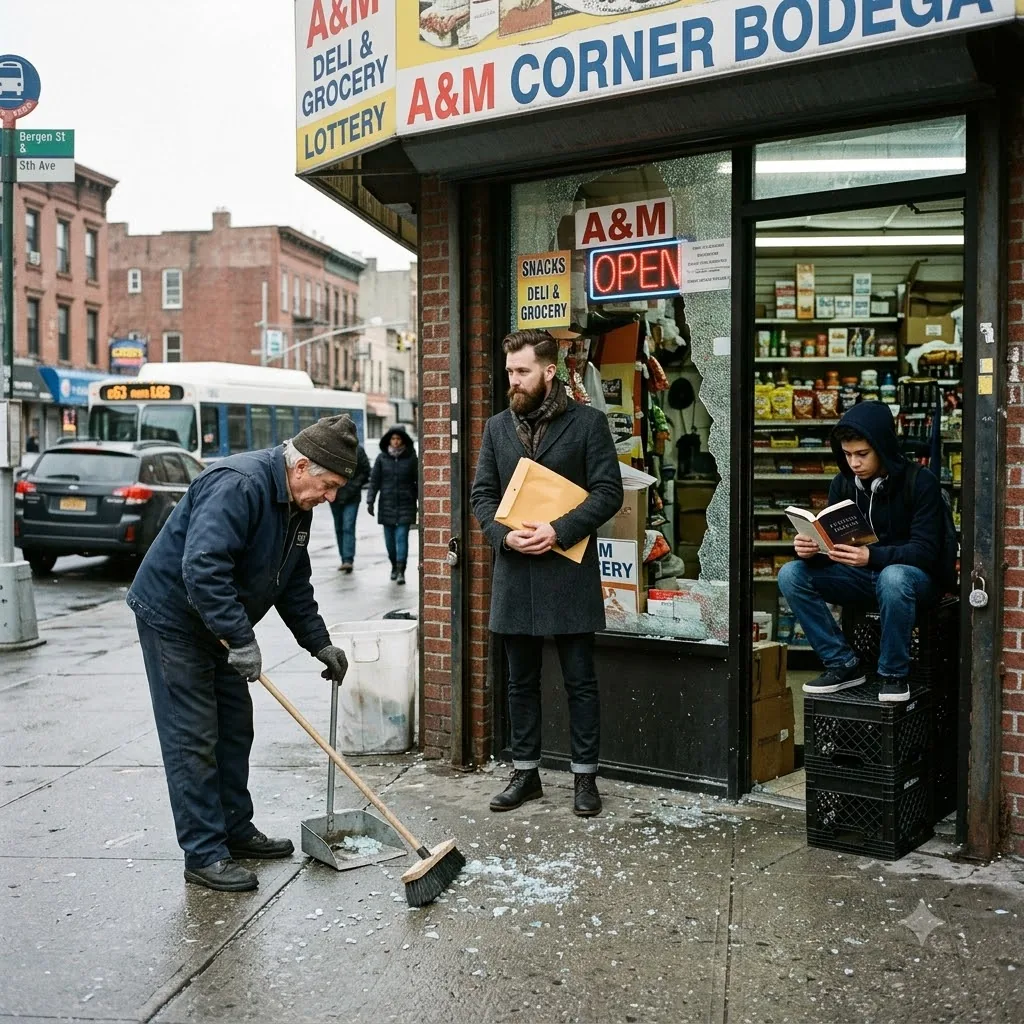
Hector picked up his broom. He swept the floor one last time, gathering the final traces of dust and dried leaves from the scuffed linoleum. He walked outside into the biting morning air and pulled the heavy steel security gate down over the storefront. The metal screamed on its tracks before locking into the concrete with a heavy, final thud.
Hector turned around. Standing across the avenue, perfectly framed between a closed laundromat and the boarded-up windows of *The Commons*, was Silas.
The landlord was no longer wearing a tailored charcoal suit. He wore a heavy overcoat, his shoulders slumped, dark circles carved deep beneath his eyes. He stood entirely alone. No press, no town car, no corporate lackeys. He was staring at the neighborhood he now fully owned.
He had the real estate. He had the bodega. He had the avenue. But the avenue was dead. The community had formed a rigid, hostile wall against him. No local business would sign a lease in his buildings. The victory was completely hollow, a kingdom of empty brick and shattered glass.
Hector looked at the broken man across the street. He didn’t feel anger anymore. He felt a profound, settling peace. Hector adjusted the collar of his jacket, turned his back on the empty storefront, and walked away down the avenue, leaving Silas standing alone in the cold.