Story code: ST-000660
Part 2: Level 5 Access
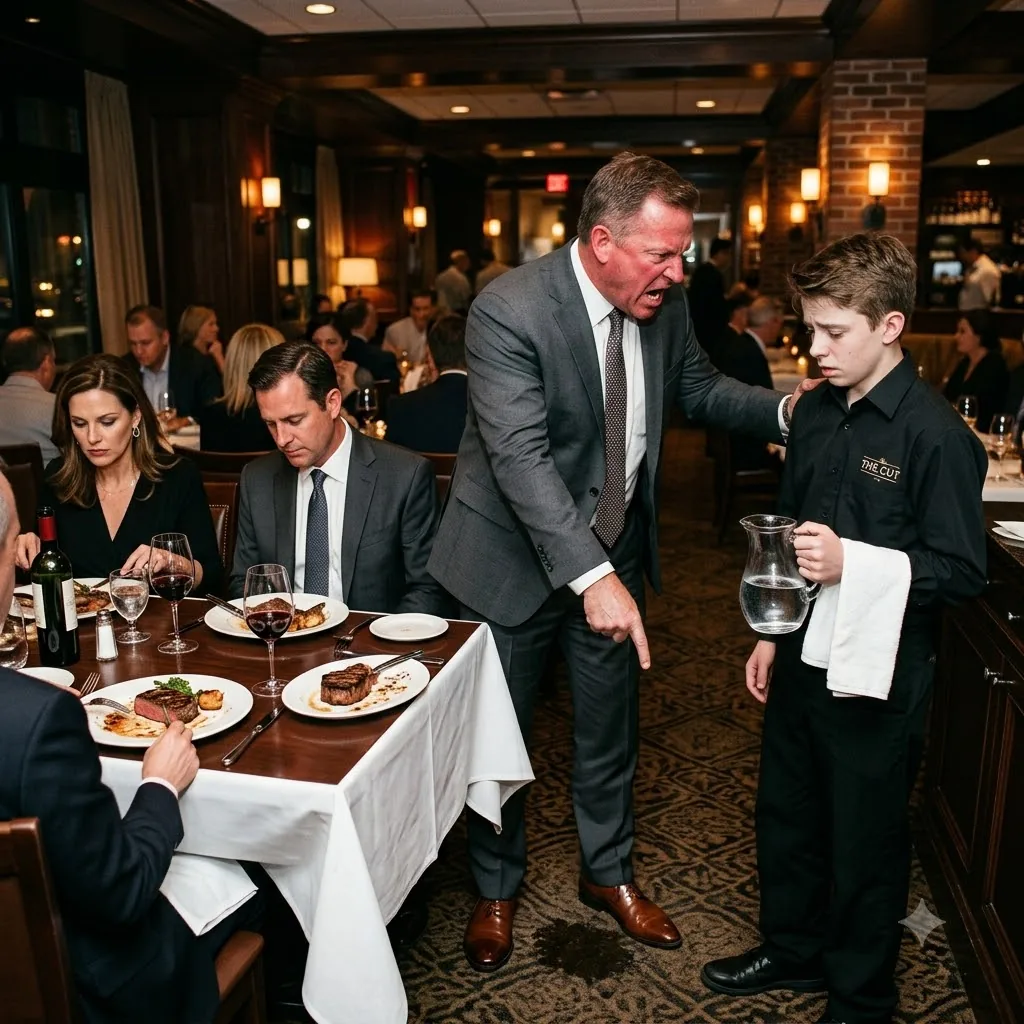
The Director stared at the metal card resting on the polished mahogany. His brain took a full three seconds to process that the interruption had come from his own table, from the subordinate who had spoken exactly zero words during the preceding forty-five minutes of appetizers.
“Put that away,” he said. The baritone was no longer calibrated for a public audience. It was tight, pitched for immediate insubordination.
I kept my hand resting near the card. “You stated a clear policy. Consequences for incompetence. I am simply agreeing that we should apply it immediately. To the actual liability in this room.”
The marketing director’s breath hitched. The lead designer pushed his chair back a fraction of an inch, physically distancing himself from the blast radius.
“Are you drunk?” the Director asked, letting out a short, breathy laugh that held absolutely no humor. “Or did you just forget who signs your performance reviews? Pick up the card. We are having a business dinner.”
I did not move. I looked at the floor manager, who was still standing in the awkward no-man’s land between the table and the kitchen doors, shielding the terrified busboy.
“You don’t need to fire the kid,” I told the manager, keeping my voice at the same flat, uninflected baseline. “My director is currently experiencing a high-stress emotional event because he is trying to project authority to compensate for a systemic failure. The water is an excuse. You can return to your duties.”
The Director’s face flushed a deep, mottled red, the color crawling rapidly up his neck from his starched collar. The vein in his temple, usually invisible beneath his expensive, styled haircut, began to throb against his skin.
“Get out,” the Director snapped at the manager, his voice cracking like a whip.
The manager did not hesitate. He bowed his head quickly and retreated, pulling the teenager through the swinging doors and out of sight.
“And you.” The Director turned his entire body toward me, abandoning his previous target entirely. The crosshairs had shifted. “You are done. I don’t know what kind of stunt you think you are pulling, but you are suspended pending termination. Leave the restaurant.”
“Please,” the marketing director whispered, looking at me with wide, panicked eyes. “Just apologize. Let’s not do this here.”
“She isn’t apologizing,” the Director said, his index finger jabbing the empty air between us. “She’s leaving. And I am making a phone call to HR the second she walks out that door. A backend engineer does not speak to me like that. Not in the office, and certainly not when I am paying for the meal.”
I looked at the marketing director. Her fear was highly rational. The Director had fired three people in the last quarter alone for minor pushback during sprint planning. He ruled the division through an architecture of intimidation, relying heavily on the fact that those who built the actual infrastructure were generally too introverted or too afraid to challenge his aggressive narratives.
“He isn’t paying for the meal,” I said to the marketing director. “The corporate card is currently locked.”
The Director stopped. His finger lowered slowly. His eyes narrowed into tight slits. “What did you say?”
“The corporate expense account is locked,” I repeated. I tapped my index finger against the heavy metal keycard on the table. “This is a Level 5 physical access token. It is issued exclusively to lead system architects. It grants read-write access to the core financial ledgers and root control over the security subroutines. I spent the last three hours of my afternoon running a standard delta-check on the Q3 deployment you authorized.”
The designer looked back and forth between us, entirely lost. The marketing director had stopped breathing entirely, her hands gripping the edge of the table so hard her knuckles were white.
The Director leaned forward, closing the physical distance, lowering his voice to a dangerous, serrated whisper. “You are violating protocol. You do not run audits without my explicit sign-off.”
“I run audits when the automated guardrails trigger,” I said. “And the guardrails triggered because someone pushed an unverified patch to the payment gateway yesterday at 2:00 AM, explicitly overriding the safeguard protocols. A patch that conveniently masked a seven-figure data discrepancy in your flagship project.”
He didn’t flinch, but his left pupil dilated by a millimeter. A microscopic biological tell. He knew exactly what I was talking about.
“You are making baseless accusations in a public space,” he said. His voice was colder now, the loud bluster replaced by something lethal and calculated. “You are a mid-level code monkey who fundamentally does not understand the business logic of a phased deployment. If you think you found a bug, you file a Jira ticket. You don’t throw a temper tantrum at a Michelin-star restaurant.”
“A phased deployment does not manually delete transaction logs,” I said. “And it does not route phantom vendor payments to an offshore holding account.”
The silence at the table shifted. It was no longer born of social discomfort. It was the suffocating silence of a hostage situation.
The Director smiled, a thin, bloodless stretching of his lips. He recognized the threat, but he also recognized my immediate tactical disadvantage.
“You have no proof of anything,” he said smoothly. “You have a deranged theory. And you have just committed gross insubordination, slander, and a breach of NDA in front of two senior witnesses.” He looked at the marketing director. “Did she not?”
The marketing director looked down at her lap. She swallowed hard, then nodded weakly.
He looked at the lead designer. “Did she not?”
“She did,” the designer mumbled, refusing to look in my direction.
“There.” The Director leaned back in his leather chair, steepling his fingers. He had re-established his perimeter. He had successfully isolated me from the group. “You are completely alone. You have no authority here. Pick up your stupid little keycard, get up, and walk out. If you leave right now, quietly, I might let you keep your severance package.”
It was an excellent counter-move. He knew I didn’t have my company laptop with me. He knew this restaurant was notoriously a dead zone with no public Wi-Fi. He knew I was physically separated from the terminal where the audit logs lived, and he knew he had the entire weekend to wipe the servers clean before HR opened on Monday morning.
He picked up his water glass, the ice clinking softly against the crystal, and took a slow, deliberate sip. He was waiting for me to break. He was waiting for the realization of my isolation to crush me, forcing me to retreat.
Instead, I slid the metal keycard across the mahogany table until it bumped gently against the base of his water glass.
“I am not isolated,” I said. “Read the serial number on the back of the card.”