Story code: ST-001707
Part 3: Sensory Immersion
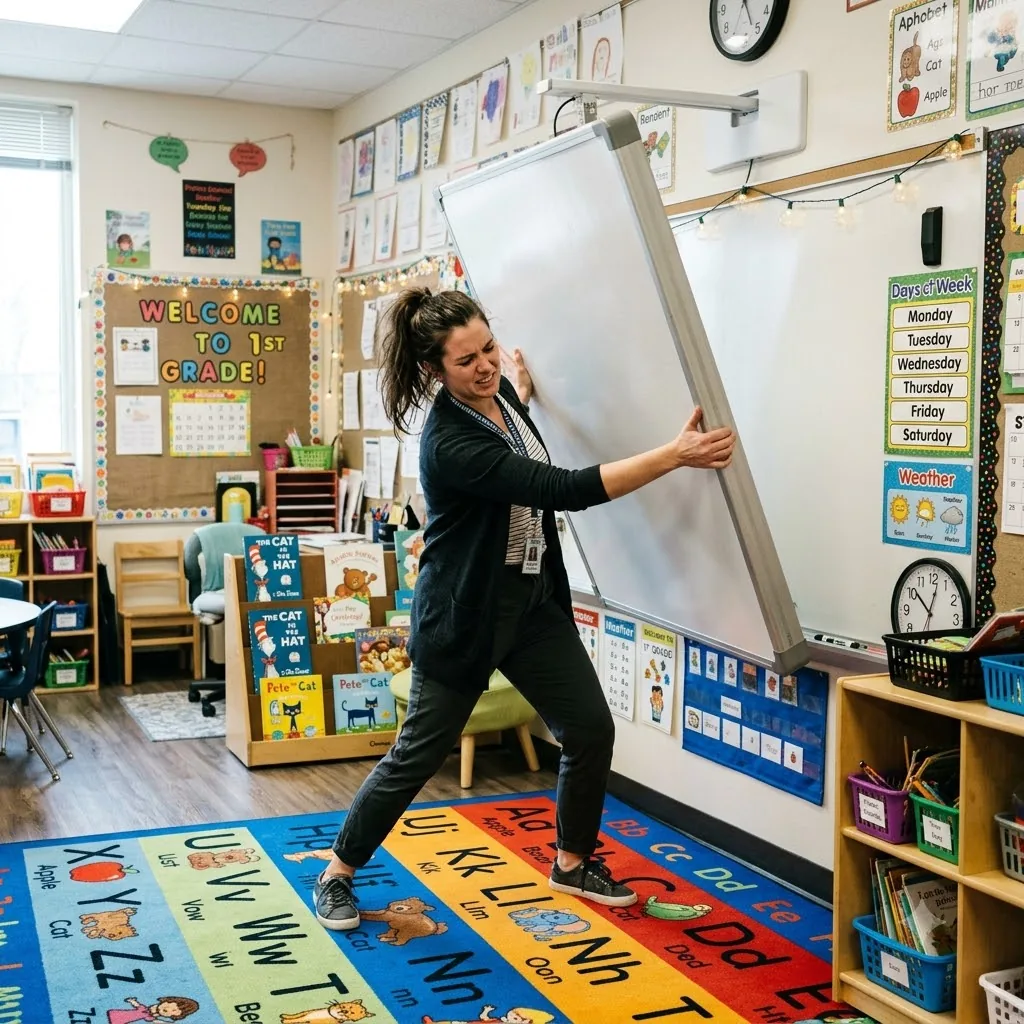
By 7:15 AM on Monday, Sarah’s hands were stained with blue marker ink and covered in tiny, stinging burns from a hot glue gun. Over the past twelve hours, she had transformed the imposing four-hundred-pound ballistic slab into a chaotic, brightly colored collage of first-grade curriculum. She had meticulously hot-glued three overlapping layers of ruffled, yellow corrugated border around the thick steel frame, desperate to mask its heavy, armored depth. The glossy white expanse was now completely obscured by a barrage of educational camouflage: an oversized paper thermometer, a bulky felt weather calendar, and twenty-two construction-paper hand-turkeys the kids had made on Friday. It no longer looked like a tactical barricade. It looked like the disorganized bulletin board of a wildly over-enthusiastic primary teacher.
Sarah stood by her desk, drinking lukewarm coffee from a thermos, her eyes scanning the reading rug. The camouflage held. The board jutted out from the wall slightly more than standard furniture, but beneath the assault of autumn leaves and laminated phonics charts, the raw metal was invisible.
The heavy click of the hallway door handle made her jump.
Principal Davis entered first, clutching his metal clipboard, looking paler and more exhausted than he had yesterday. Behind him stepped Superintendent Hayes, a woman who rarely descended from the central office, wearing a sharp navy suit and an expression of detached calculation. And then came the consultant.
Vance was a man who dressed as if he were expecting to repel from a Blackhawk helicopter rather than audit a brightly lit primary school. He wore fitted olive-drab tactical pants, a black moisture-wicking polo stretched tight across his chest, and a heavy lanyard thick with ID badges. He didn’t glance at the cheerful morning message written on the smartboard. Instead, his eyes darted to the corners of the ceiling, the window latches, and the door frame hinges.
“Room 14,” Vance said, his voice a practiced, gravelly baritone that seemed entirely too loud for the space. He carried no clipboard, just a ruggedized black tablet in a thick rubber case.
“First grade,” Davis provided weakly, rubbing the back of his neck. “Sarah’s class.”
Vance paced the perimeter, his heavy boots squeaking aggressively against the freshly buffed linoleum. “Too much clutter. In a kinetic event, you want sterile sightlines. All these hanging mobiles?” He pointed his tablet at the painted styrofoam solar system models dangling from the acoustic ceiling tiles. “Visual interference for responding officers.”
Sarah gripped the edge of her desk, her knuckles turning white. “They’re six years old. They’re learning about the planets.”
Vance ignored her, continuing his march toward the reading rug. He stopped exactly three feet from the heavily disguised ballistic board. Sarah stopped breathing. Her fingernails dug into her palms. If he touched it-if he tapped the metal underneath the yellow ruffled paper with his heavy tactical ring-it would ring like a bank vault.
“This,” Vance said, gesturing broadly at the calendar and the hand-turkeys. “This is a fatal funnel obstruction. From the doorway, an active shooter can’t see what’s behind this angle. But neither can law enforcement. It completely breaks the standardized visibility protocol.”
“It’s a reading nook,” Sarah said. She stepped out from behind her desk, deliberately placing her body between Vance and the board. “The children sit here on the rug. The board gives them a focal point for morning meetings.”
“It’s a blind spot,” Vance corrected, tapping his tablet with a thick stylus. “Tear it down by tomorrow. I want this wall completely flat. Wednesday’s drill requires total environmental control. When my team initiates the active threat simulation with the blanks, I need to see exactly how these kids react in the open hallway and classroom spaces. If they bunker down behind a bulletin board, we can’t accurately assess their freeze-flight response times.”
Sarah felt a cold, sharp clarity replace her mounting panic. She looked at Superintendent Hayes, who was watching the exchange with her arms crossed and an unreadable expression, then back at Vance.
“You want to remove a physical barrier so you can have a better view of first-graders being terrorized?” Sarah asked, her voice dropping its polite, accommodating teacher cadence.
Davis cleared his throat loudly. “Sarah, please. Mr. Vance is implementing the mandatory sensory immersion protocol-”
“Sensory immersion,” Sarah interrupted, taking a step closer to Vance. “You mean the AR-15 blank drill. You are planning to fire blanks at one hundred and fifty decibels in a hallway lined with acoustic tile specifically designed to echo. Do you have any idea what that decibel level does to a developing nervous system?”
Vance offered a patronizing, tight-lipped smile. “Ma’am, with all due respect to your teaching degree, I am a certified tactical consultant. The district paid fifty thousand dollars for my firm to bring real-world readiness to this campus. The bad guys don’t care about developing nervous systems.”
“No, they don’t,” Sarah said, her voice shaking with a sudden, furious power. “But you are supposed to. You’re not preparing them. You’re traumatizing them. When Maya hears that first shot in the hall, her brain isn’t going to process a ‘drill.’ Her cortisol levels are going to spike, her amygdala will hijack her prefrontal cortex, and she will believe, with one hundred percent certainty, that she is about to die.”
“It builds resilience,” Vance said, shifting his weight, clearly annoyed by the resistance. “Muscle memory. Repetition saves lives.”
“It builds PTSD,” Sarah fired back. She reached into her canvas tote bag resting on her chair, her fingers instantly finding the crumpled paper she had hidden yesterday. She pulled it out and slapped it onto the surface of her desk with a sharp smack. “Fifty thousand dollars. That’s what the district paid you to march down these halls and simulate a massacre.”
She snatched the paper back up and shoved it directly toward Vance’s chest. He instinctively recoiled, his tactical training apparently failing to anticipate a first-grade teacher brandishing a store receipt.
“Look at it,” Sarah demanded. “Look at the total. Three thousand, two hundred dollars. That is my rent money. That is my grocery budget for the next three months. I spent my own money to install actual, physical, ballistic protection in this classroom.”
She pointed over her shoulder at the yellow-rimmed board. “While you charge the district fifty grand to play dress-up and shoot blanks at babies, I bought a Level IIIA armor shield. So that if someone actually comes through that door, my kids have a real chance to survive without being used as props in your action movie.”
Vance stared at the thermal receipt, then looked past her at the massive, bulky board wrapped in corrugated paper. He blinked, his brain struggling to reconcile the messy kindergarten aesthetic with the words ballistic armor.
Superintendent Hayes took a sudden half-step forward, dropping her arms. “Wait. You installed ballistic armor in a classroom?”
Vance’s face flushed a deep, mottled red. The cool, gravelly consultant persona evaporated in an instant. His jaw clenched, and the thick veins in his neck bulged visibly against the collar of his tight black polo. He had been directly challenged, his expensive and brutal methodology dismantled by a woman in a cardigan holding a piece of thermal paper.
“You arrogant, insubordinate bitch!” Vance screamed, his voice cracking with a sudden, unhinged fury.
He lunged forward, closing the distance between them in a violent step, pointing a trembling, thick finger an inch from Sarah’s nose. “You think you know tactics? You think you know security? I am the expert here! You do not question my drills, you do not question my fee, and you do not ever talk to me like one of your little brats!”
His spit hit Sarah’s cheek. The deafening echo of his scream bounced off the cinderblock walls, ringing loudly in the sudden, absolute silence of the room.