Story code: ST-001194
Part 2: Salting the Earth
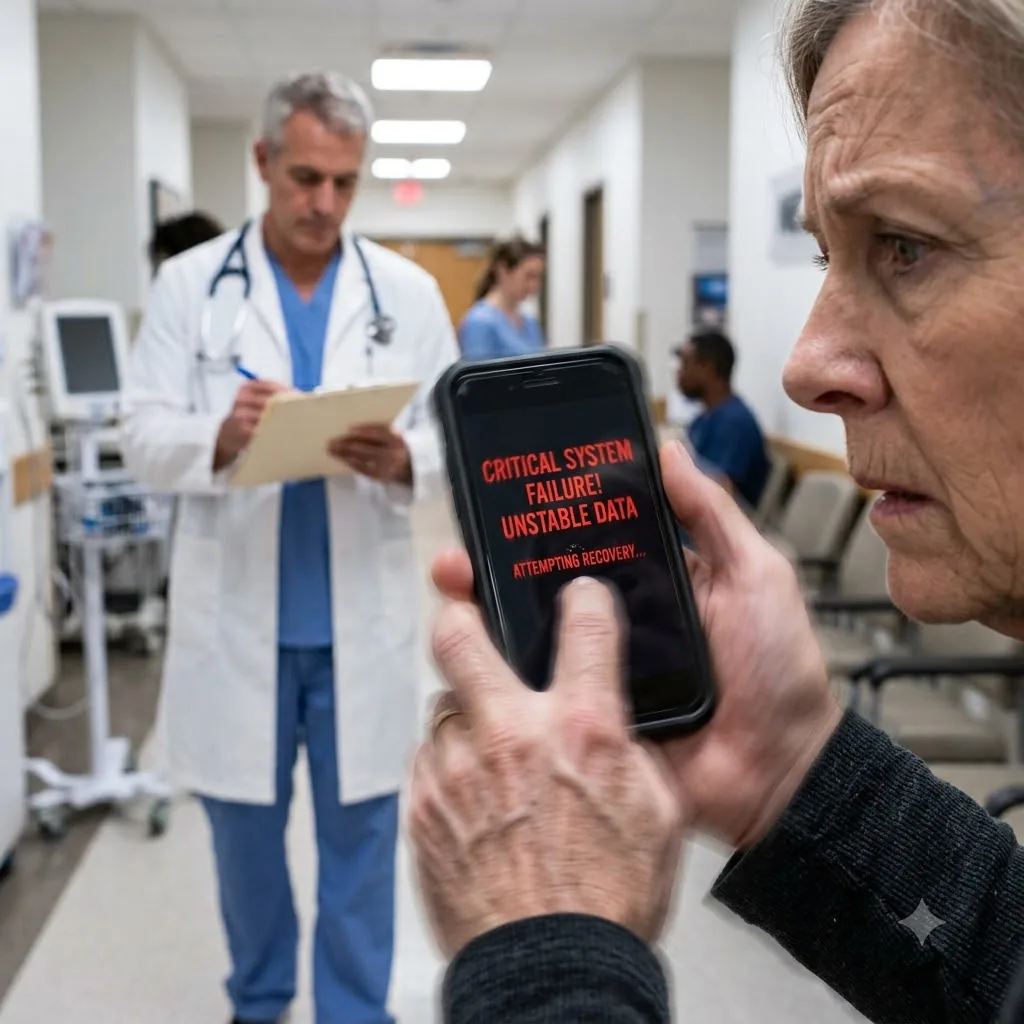
“Medical Proxy Invoked.” Silas stared at the bright red text, the glow reflecting in his widening eyes. The phrase made absolutely no sense in the context of a cyberattack. Ransomware syndicates didn’t query HR databases for executive medical leave statutes. That specific error message meant the system had recognized his root credentials, verified his identity, and then intentionally locked him out based on the board of directors’ recent ruling.
The board had weaponized his diagnosis against him faster than he could have ever anticipated.
“Silas, you are hyperventilating,” Dr. Aris said, stepping closer, his rubber-soled shoes squeaking against the sterile laminate. “Your heart rate is visibly elevated. I need you to close the computer immediately.”
“Who did you tell?” Silas demanded, his voice cracking. He didn’t look up from the screen. His right arm was tucked so tightly into his side that his ribs ached, his muscles cramping from the violent, unyielding tremors.
“Excuse me?”
“The scan results!” Silas barked, finally looking at the neurologist. “Did you upload them to the company’s insurance portal? Did your automated system flag my disability status to the board?”
Dr. Aris looked thoroughly bewildered. “Medical records are entirely confidential. No one has seen these scans but you and me. Now, please, put the device away before you induce a full-body seizure.”
Silas looked back at the dashboard. The deletion counter was a blur of spinning digits. Two hundred and twelve thousand volumes. Two hundred and thirty thousand. The algorithm was becoming brutally efficient, grouping files by metadata tags and wiping entire historical eras simultaneously. The 19th-century patent schematics were evaporating. The digitized transcripts of the Salem witch trials were gone. It was a digital Library of Alexandria burning in real-time, and Silas was locked out of the firehouse.
He awkwardly pinned the laptop against his left thigh, using his one functioning hand to swipe his phone screen. He dialed Elena, his Chief Operating Officer. She was the only other person who held the master cryptographic keys, and more importantly, she was the legally designated medical proxy for the company’s executive continuity plan. If the system was citing a medical proxy, her credentials were the ones overriding his.
The call went straight to voicemail.
“Answer the damn phone, Elena,” he muttered, hanging up and dialing the main server floor operations desk. It rang endlessly. No one was picking up. Either the building had been evacuated, or they were completely locked out of the communications grid.
The physical toll of the stress was skyrocketing. A sharp spasm rocked Silas’s core, causing his right leg to kick out involuntarily. The sudden movement knocked his laptop off his thigh. He lunged for it with his left hand, missing by an inch. The heavy machine slammed onto the hard clinic floor.
“That is enough!” Dr. Aris shouted. The doctor stepped forward, reaching down to grab the laptop by its aluminum chassis. “You are having a severe neurological episode. I am stepping in as your physician.”
“Don’t touch that!” Silas roared. He threw himself off the examination table, landing hard on his knees. The impact sent a shockwave of pain up his spine, but he ignored it. He snatched the laptop out of the doctor’s grip with his left hand, dragging it across the floor and sheltering it against his chest like a wounded child. He scooted backward, pressing his spine against the cold steel of the medical supply cabinets, putting maximum distance between himself and the neurologist.
“Silas, you are acting completely irrationally. I am going to call security if you don’t calm down,” Dr. Aris warned, though he took a cautious step back, his hands raised in surrender.
Silas tuned him out, resting the laptop on his crossed legs. The screen was cracked in the top right corner, but the terminal was still running. Three hundred and eighty thousand texts destroyed.
If his root access was blocked by the executive proxy, he couldn’t stop the purge from the top down. He needed to go underneath it. He closed his eyes for a fraction of a second, fighting the dizziness, and visualized the server architecture he had built from scratch six years ago. There was a ghost account-a low-level, unlogged diagnostic service port he used during the initial cloud migration. He had never formally documented it because it deliberately bypassed their own security audits.
He brought his left hand to the keyboard. Typing one-handed while his entire right side convulsed was like trying to thread a needle on a turbulent flight. He missed keys, backspaced, and typed again. `ssh -p 4421 diag_svc@core.alexandria.archive`.
He hit enter. The system prompted for a password. He typed the archaic thirty-character string he hadn’t used in half a decade.
Access Granted.
He was in. The ghost account didn’t have the privileges to kill active executive scripts-he still couldn’t stop the deletion-but it did have deep-level monitoring access. He could see exactly what the proxy script was doing.
Silas typed a rapid command to trace the active deletion protocol, watching the system map the destructive data flow. The results populated on his screen in raw, scrolling text.
His breath hitched. The script wasn’t just executing standard deletion commands. It was running a Department of Defense-standard multi-pass wipe. It was overwriting the digital books with zeroes, then ones, then random alphanumeric garbage, ensuring that absolutely no data recovery firm on earth could ever reconstruct the files. This wasn’t a glitch, and it wasn’t a ransom tactic. You don’t wipe data beyond recovery if you want to sell it back. This was calculated, malicious sabotage designed to salt the earth.
Worse, the script’s origin IP wasn’t external. It wasn’t masked through a labyrinth of overseas proxy servers. The trace resolved to a local, internal network address.
192.168.1.4.
Silas stared at the IP address, a cold dread washing over him, completely overriding the physical pain of his tremors. He knew that IP address by heart. It belonged to the physical administration terminal locked inside the glass-walled server room at Alexandria Archive headquarters. Someone was standing inside his building, on the secure floor, executing the destruction locally.
He desperately queried the network map to check the status of their off-site cold storage-the magnetic tape backups housed in a secure vault fifty miles away. If the primary servers fell, the tapes were the ultimate failsafe.
The terminal output flashed across his cracked screen.
`Connection to Cold_Storage_1: OFFLINE.`
`Connection to Cold_Storage_2: OFFLINE.`
`Network link severed at origin.`
The attacker hadn’t just wiped the live servers. They had physically severed the connection to the backup vaults before triggering the purge. The 650,000 books that were already gone were dead forever. And in exactly fourteen minutes, the rest of the archive would join them. The only way to stop the purge now was to physically rip the power cords out of the server racks, but Silas was ten miles away, trapped on the floor of a medical clinic, in a body that was rapidly refusing to obey his commands.