Story code: ST-000928
Part 4: The Empty House
The echo of the ugly word froze the air on the street. Alma kept her phone perfectly still, the camera lens capturing the exact moment the polished, cosmopolitan facade of Lumière entirely collapsed. Bryce stared at her phone, his chest heaving, the shattered crystal of his wine glass glittering around his Italian leather shoes.
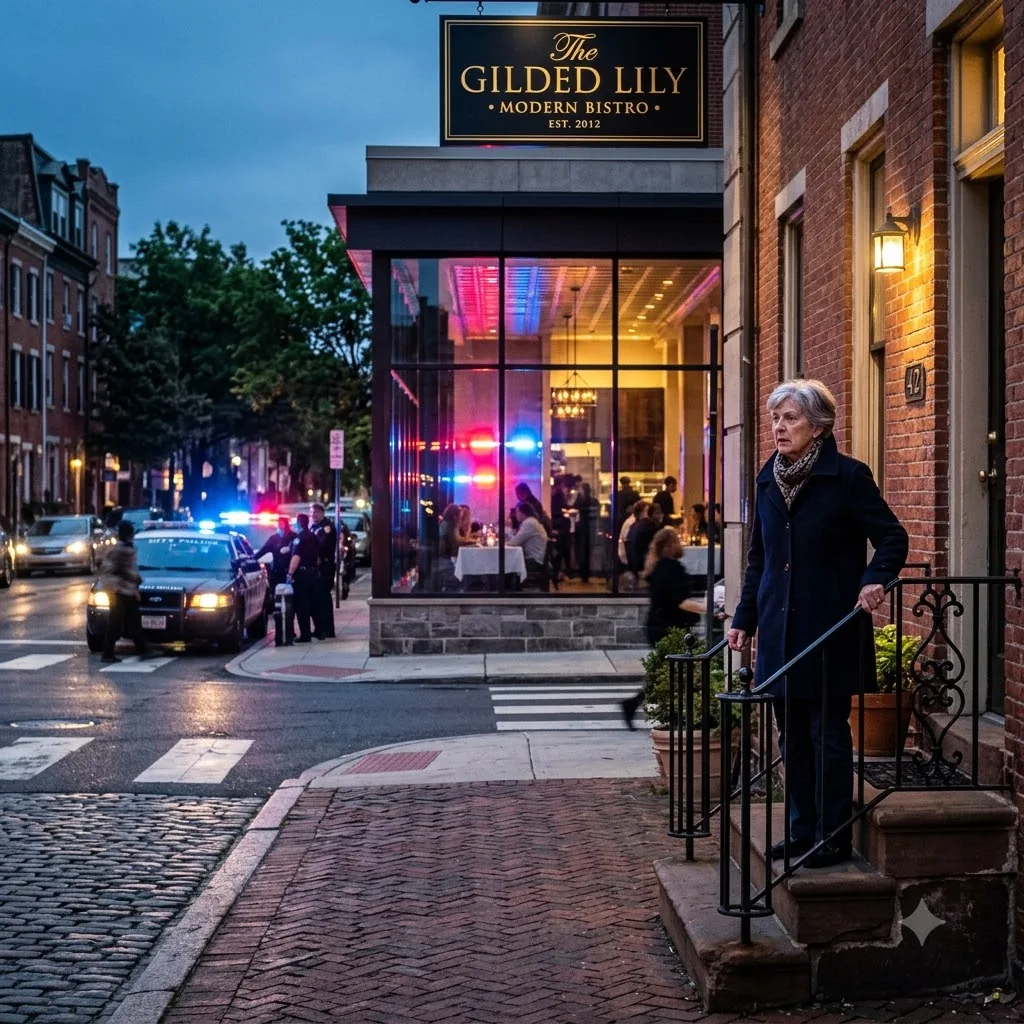
Behind Alma, the heavy, ratcheting sound of the metal handcuffs did not click. The original officer slowly stepped back, his hands raised in a universal gesture of complete disengagement. He looked at Bryce as if the restaurant owner had suddenly caught fire. Marcus slumped forward against the hood of the police cruiser, taking deep, ragged breaths, rubbing his free wrists. The backup officers didn’t even unclip their radios. They simply exchanged a single, grim look and took a collective step backward into the shadows. They were not going to be the armed enforcers for a man who had just screamed a racial slur on camera in front of thirty silent witnesses.
Inside the bistro, behind the expensive plate glass, the wealthy patrons had stopped eating. The soundproofing couldn’t keep out the sheer volume of Bryce’s outburst, or the undeniable context of the flashing police lights and the angry crowd. Alma watched through the glass as a woman in a silk blouse stood up, dropping her linen napkin onto a half-eaten, ninety-dollar steak. The man across from her stood too. Then another table. The patio diners, who had been sitting in stunned silence under the amber heat lamps, began to push back their chairs.
Bryce saw them moving. His eyes darted from Alma’s phone to the patio. The panic hit him violently.
“No, wait, please!” Bryce shouted, his voice cracking, raising a trembling hand toward his fleeing customers. “That came out wrong! I was provoked! You all saw it, she was inciting a mob!”
The patio patrons didn’t look at him. They didn’t wait for their checks. They simply walked out, pushing past the velvet ropes, wrapping their coats tight, and averting their eyes. They wanted absolutely nothing to do with the viral disaster unfolding on the sidewalk.
“Stop!” Bryce pleaded, stepping toward them, his tailored suit suddenly looking disheveled and absurd. “You can’t just leave! We have a civilized establishment here!”
Alma pressed the red button on her screen, saving the video. She slid the phone back into her heavy cardigan pocket. She had what the neighborhood needed. The rest was just noise.
She turned her back on Bryce and walked straight toward the police cruiser. She wrapped her arm around Marcus’s trembling shoulders. The teenager buried his face in her knit sweater, sobbing quietly. The officer who had pinned him down wouldn’t meet Alma’s eyes. He muttered something defensive into his radio, shook his head, and quickly got into the driver’s seat. The cruiser’s emergency lights snapped off, plunging the street back into its normal, dim lighting. The backup unit was already pulling away, eager to vanish before anyone asked for badge numbers.
Bryce was hyperventilating now, standing completely alone in the center of his deserted patio. The profound humiliation warped instantly into blind, destructive rage. If he couldn’t control the neighborhood, he would break whatever piece of it he could reach.
He stormed past the mahogany host stand, marching directly to the edge of the property line where Alma’s small, wooden community pantry stood atop a short concrete wall.
“This is your fault!” Bryce screamed at Alma’s back. He grabbed the wooden frame of the pantry with both hands and shoved it violently.
The wooden box tipped and crashed onto the sidewalk. A glass jar of peanut butter shattered. Cans of soup, bags of rice, and a dozen foil-wrapped loaves of bread spilled across the cold concrete, rolling into the dirty gutter.
Alma didn’t flinch at the crash. She just patted Marcus’s back until the boy’s breathing finally steadied. Only then did she turn around.
Bryce stood over the ruined pantry, his fists clenched, waiting for a fight. He wanted her to scream back. He desperately needed her to become the chaotic aggressor he had described to the police dispatch so he could justify his collapse.
Alma gave him nothing. She didn’t say a single word. She didn’t even look at his face.
She walked slowly to the spilled pantry, her thin house slippers crunching over the broken glass. She knelt down on the cold pavement. She picked up a dented can of tomato soup, wiped the dirt from the label, and placed it carefully back into the upright wooden crate.
Bryce stared at her, utterly defeated by the silence. The silence was heavier than the police sirens. The silence meant he no longer mattered.
“I’m calling the city tomorrow,” Bryce muttered weakly, a pathetic, trembling threat that held absolutely no weight. When Alma didn’t acknowledge him, he finally turned and retreated into Lumière, pulling the heavy oak door shut behind him. He was locked inside an empty, silent restaurant that the neighborhood would never allow to survive.
Alma reached for a crushed box of granola bars. A pair of worn sneakers stepped into her line of sight. Marcus knelt beside her. He picked up a loaf of bread and set it gently in the crate. Then, Mr. Henderson was there, his old knees popping as he bent down to retrieve a bag of rice.
One by one, the neighbors who had stood on their porches came forward. They didn’t speak. They didn’t need to. They simply gathered around Alma in the quiet dark, picking up the scattered pieces, rebuilding the pantry together on the very street they refused to give up.