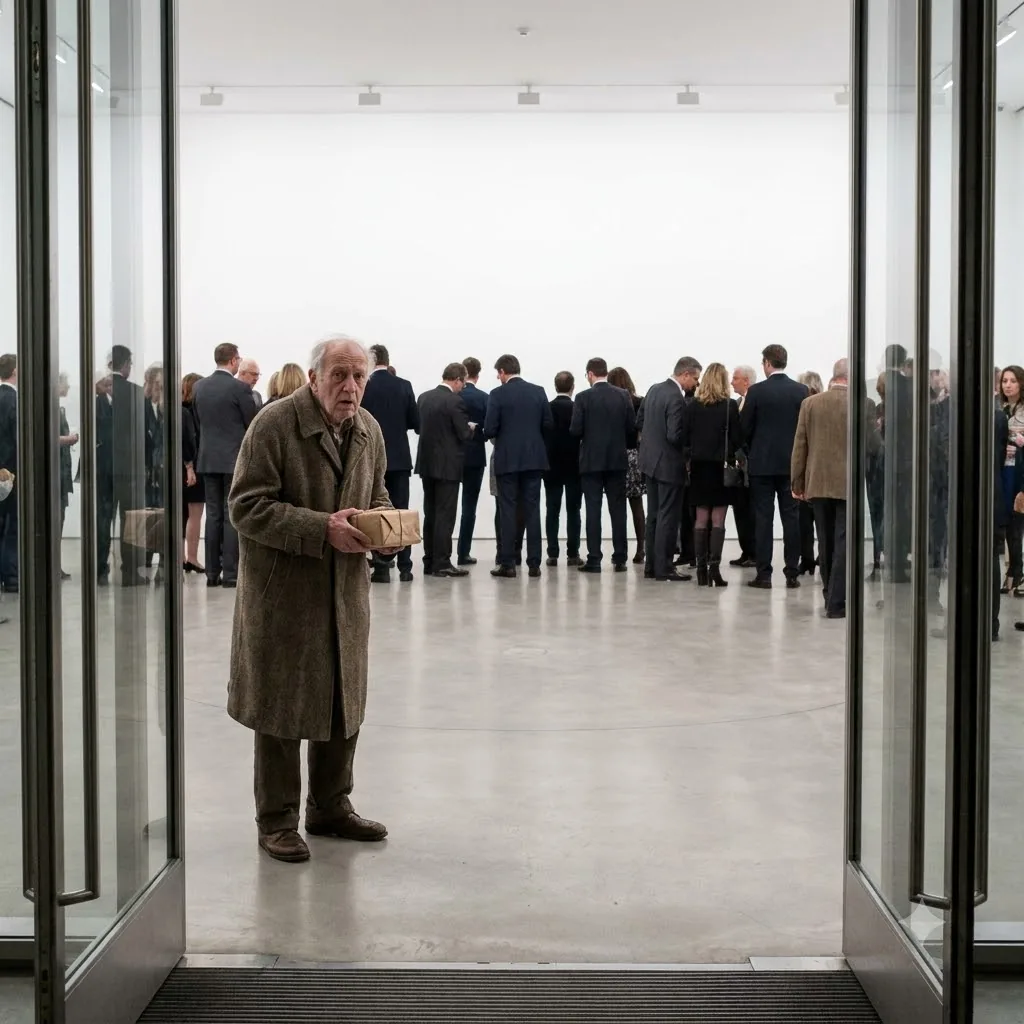
Story code: ST-000089
Part 2: The Hidden Canvas
The amber glow of the streetlamp illuminated the stiff, jagged edges of the paper. Elias smoothed it out against the cold brick facade of the gallery’s exterior wall. The freezing autumn wind caught the torn corners, forcing him to pin the sheet flat with his bare palms. The paper was a low-quality photocopy, the black toner uneven and heavily smudged across the rough grain.
At the top left corner, stamped in thick black ink, was the official seal of the Federal Bureau of Investigation’s Art Crime Team. Next to the seal, bold, capitalized letters spelled out a single heading: SEARCH AND SEIZURE WARRANT.
The target property listed on the second line was Elias’s own residential studio address. The document authorized the immediate confiscation of all “textured oil works, specifically those mounted on custom-braced wooden frames attributed to Elias Thorne.”
Taking up the bottom half of the page was a high-contrast radiographic scan. Elias instantly recognized the sweeping, topographic lines of his own palette knife technique on the X-ray. It was the scan of his breakthrough landscape piece from 2008. But beneath the heavy layers of his signature cadmium red and titanium white oils, the X-ray exposed a second, distinct layer of pigment. The scan showed the precise structural outline of a seventeenth-century Dutch portrait. The underlying face featured a distinct lace collar and a sharp, angled jawline, unmistakable to anyone with a passing knowledge of European art history. It was a priceless historical piece famously stolen from an Amsterdam vault fifteen years prior.
The heavy impasto technique Elias utilized-layering thick, unthinned oil paint with a steel trowel-had created an impenetrable casing that defeated standard visual gallery inspections. His art had served as a flawless Trojan horse.
Written diagonally across the bottom margin of the photocopy were thick, hurried strokes of black permanent marker. Julian’s handwriting bled completely through the thin paper: *The Feds raided the back office vault at five o’clock. They X-rayed the inventory. Your framing supplier took a plea deal and named you as the primary fence. I plastered the east wall to stop them from scanning the new collection. DO NOT GO HOME.*
Elias stared at the black marker ink. The framing supplier. The man inside the gallery who had physically stepped away from Elias, the man who had stared intensely at his own shoes while clutching a plastic wine cup. For twenty years, that specific supplier had been delivering pre-stretched, heavily gessoed “reclaimed” canvases to Elias’s studio at a severe discount. The supplier had provided the physical foundation for every landscape Elias had ever painted and sold. Elias had unwittingly spent his entire career burying stolen international masterworks beneath his thick, heavy landscapes, perfectly insulating a global smuggling ring.
Elias lowered the crumpled paper. He looked back through the heavy glass door of the gallery.
The dark silhouette was still standing in the window. Suddenly, the interior track lighting of the Lumina Gallery clicked off, plunging the entire showroom into pitch blackness. Only the ambient glow of the streetlamp illuminated the figure standing just inches behind the glass. It was not Julian.
The figure was a woman wearing a heavy tactical jacket. She did not look at the blank east wall, and she did not look at the remaining patrons huddled in the dark. She stared directly through the glass at Elias. Slowly, she lifted a handheld radio to her mouth, her eyes never leaving his face.
The screech of tires echoed from the adjacent intersection. Two unmarked black SUVs turned aggressively onto the narrow street, their headlights cutting through the descending autumn fog. They accelerated rapidly toward the front entrance of the gallery, their heavy engines revving loudly in the quiet neighborhood.
Elias folded the photocopy and shoved it deep into his coat pocket. He backed away from the streetlamp, retreating instantly into the deep shadow of the narrow brick alleyway that ran parallel to the gallery building. The damp air in the alley smelled of rotting cardboard and wet exhaust. The brick walls towered three stories high on either side, offering no fire escapes or low windows.
His breathing accelerated, the exhalations forming thick white clouds in the freezing air. His leather boots slipped slightly against the damp, moss-covered cobblestones as he turned and broke into a sprint.
He navigated the dark alley by running his hand along the freezing brickwork of the gallery’s exterior. He reached the rear loading zone and ducked behind a rusted steel dumpster to break his line of sight from the street. He needed his truck. It was parked two blocks east, in the municipal lot.
Elias shoved his hands into the pockets of his heavy wool coat to retrieve his keys. His fingers found the familiar brass ring, but the physical weight of the metal was entirely wrong. He pulled the keychain out and held it up into the faint moonlight filtering down between the buildings.
The brass ring held only his electronic truck fob. The heavy metal keys to his apartment, the brass padlock key for his studio, and the magnetic security fob for the gallery’s rear entrance were gone. The thick metal ring itself had been forcibly bent outward, the keys sheared off and removed while the coat had been hanging unguarded in Julian’s back office earlier that morning.
A vehicle turned into the far end of the alley, blocking his only path to the municipal lot. It was a marked police cruiser, its overhead lightbar completely dark. The cruiser crawled forward, the tires crunching slowly and methodically over the broken glass and loose gravel.
Elias stood completely still in the freezing shadows, pinned between the solid brick wall and the rusted dumpster. He gripped a sabotaged keychain that could no longer open his own front door, isolated from the community that had already convicted him, as the cruiser’s spotlight snapped on and swept a blinding white beam directly toward his hiding place.